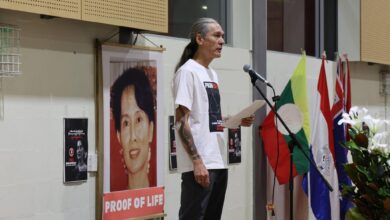
This month marks the 10th anniversary of Myanmar Now, which began its journey in August 2015.
Throughout Myanmar’s history, milestone years like 1962 (the military coup by General Ne Win), 1988 (the nationwide uprising against military rule), and 2021 (the most recent coup) have all coincided with crackdowns on the press and the imprisonment of journalists. In Myanmar, journalism has often been one of the first targets in times of political repression.
Yet, during brief periods of stability, independent media outlets have emerged, and new generations of journalists have taken root. It was during one such period in 2015 that we founded Myanmar Now—starting with just a small team of reporters in a modest office on Seikkantha Street in downtown Yangon.
In those early days, we were supported financially by the Thomson Reuters Foundation in London. Reuters also sent its Bangkok-based Myanmar correspondent, Thin Lei Win, to co-found Myanmar Now with Swe Win. Other founding members include Zarny Win, a longtime editor at The Irrawaddy, and reporters Phyo Thiha Cho, Htet Kaung Linn, Ei Cherry Aung, and Kyaw Linn Htoon.
At that time, our newsroom had a monthly operating budget of just 10 million kyat—much of it spent on taxi fares for reporters chasing stories around the city.
Still, we were driven not by resources, but by purpose. We felt an urgency to report on the injustices that had been silenced for decades—to bring light to a system still corrupted, a society still struggling under the legacy of dictatorship.
In many modern countries, justice can be sought through courts and police. But in Myanmar, these very institutions have historically been instruments of oppression. Decades of military rule and a crony-driven economy have cemented social inequality on a scale that places Myanmar among the world’s poorest and most oppressed nations.
While forced labour and other exploitative practices have declined globally, they remain entrenched in Myanmar. So does a prison system that can ruin a young life over a minor infraction. These were—and still are—the stories Myanmar Now set out to cover, with resolve and responsibility.
We committed to reporting without discrimination—regardless of ethnicity, religion, or citizenship. We believed our work should be accurate, deeply sourced, and strong enough to serve as a historical record.
We also believed journalism should be a force for positive change, and that our primary readers should be the people of Myanmar.
That belief came at a cost. Members of our team and others associated with Myanmar Now have endured long legal battles, physical assaults, arrests, and torture.
In 2021, reporter Kay Zon Nway was arrested in Yangon while covering anti-coup protests. In 2022, Mandalay-based lawyer Ywet Nu Aung—who had previously represented Swe Win—was sentenced to 15 years in prison by a military-controlled court. And in 2023, our photojournalist Sai Zaw Thaike was handed a 20-year sentence for working with an “illegal” media outlet.
Despite these hardships, Myanmar Now continues to report the news—thanks to the resilience of our team, the courage of our sources, and the trust of our readers.
We also owe our continued existence to the generous support of our funders over the past decade. Without their belief in our mission, and their commitment to press freedom and independent journalism in Myanmar, none of this work would have been possible. We extend our heartfelt gratitude to every organisation and individual who has supported us, especially during the most difficult times.
We remain committed to honest, independent journalism—for as long as we are able.
If you would like to support Myanmar Now, you can subscribe or donate.