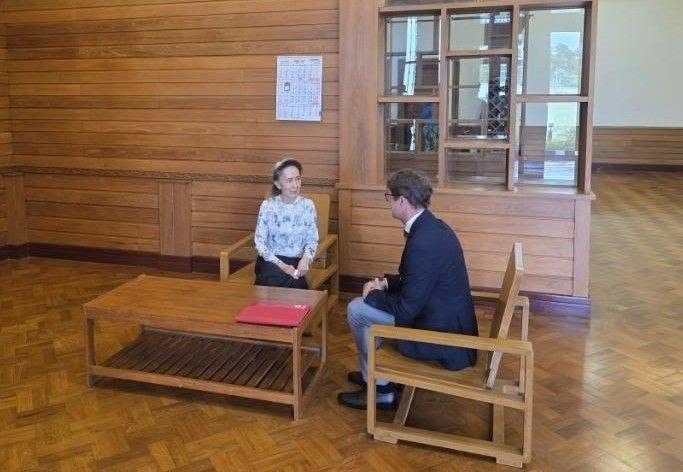
When news broke on Monday morning that Myanmar’s military junta had permitted a senior representative of the International Committee of the Red Cross (ICRC) to meet Aung San Suu Kyi, the imprisoned leader of the country’s ousted, democratically elected government, it inevitably raised the question: Is the regime finally beginning to soften its approach towards opponents of its rule after more than five years of brutal repression?
The answer, of course, is that nothing has changed. Just last Friday, junta chief Min Aung Hlaing dismissed the idea that the Five-Point Consensus formulated by the Association of Southeast Asian Nations (ASEAN) in the months after he seized power was in any way binding. One of the pillars of that agreement—which was reached with Min Aung Hlaing present—was that there should be political dialogue among all stakeholders. But it is clear that Myanmar’s newly self-appointed president continues to see Suu Kyi more as a pawn than as a potential dialogue partner.
The fact that this is the first time he has allowed a representative of an independent international organisation to meet Suu Kyi since she was first detained in February 2021 speaks volumes to his attitude towards her—and towards those who still see her as a key figure in Myanmar politics. Like previous dictators, he believes that treating the 81-year-old democracy icon with a measure of “leniency” should be enough to placate at least some of his critics abroad.
Having declared himself president following military-organised elections widely condemned as neither free nor fair, Min Aung Hlaing is now on a mission to win international acceptance for his regime. China and India have both welcomed him with open arms, and now ASEAN is showing signs of a thaw in its chilled relations with its most recalcitrant member. Allowing one carefully managed humanitarian visit is a small, low-risk concession that could strengthen the regime diplomatically at little or no cost.
Thailand, citing concerns over border security, refugees, and stalled trade, has become ASEAN’s most vocal proponent for normalising relations with the junta. Min Aung Hlaing is expected to visit the country this week, so a minor gesture like the ICRC meeting could help his allies in Bangkok make the case that Myanmar is moving in the right direction, even if it still has a long way to go to achieve any real resolution of its political crisis.
Such cost-free concessions to international public opinion have worked wonders in the past. They serve chiefly to support arguments in favour of engagement with the regime, despite the fact that terror is still its primary tool of governance.
Across the country, the military continues to carry out indiscriminate airstrikes against civilian targets on a daily basis, for no other purpose than to weaken support for the resistance. And in the cities, ordinary citizens are still handed lengthy prison sentences for holding brief and peaceful protests.
Against this backdrop, it is meaningless to treat a fleeting glimpse of Suu Kyi as evidence that this regime is ready to end its reign of terror. The real test of its intentions is whether it releases political prisoners, ends attacks on civilians, relaxes its repression of the public, and engages in genuine political dialogue.
Until those changes occur, the ICRC meeting should be viewed for what it is: a strategic move by the junta that does nothing to alter its disastrous policies, which have driven Myanmar’s crisis for the past five years. ASEAN in particular must resist any temptation to be persuaded by this cynical ploy and continue to stand by its Five-Point Consensus. Anything less would be a capitulation to a regime that values nothing but its own survival.