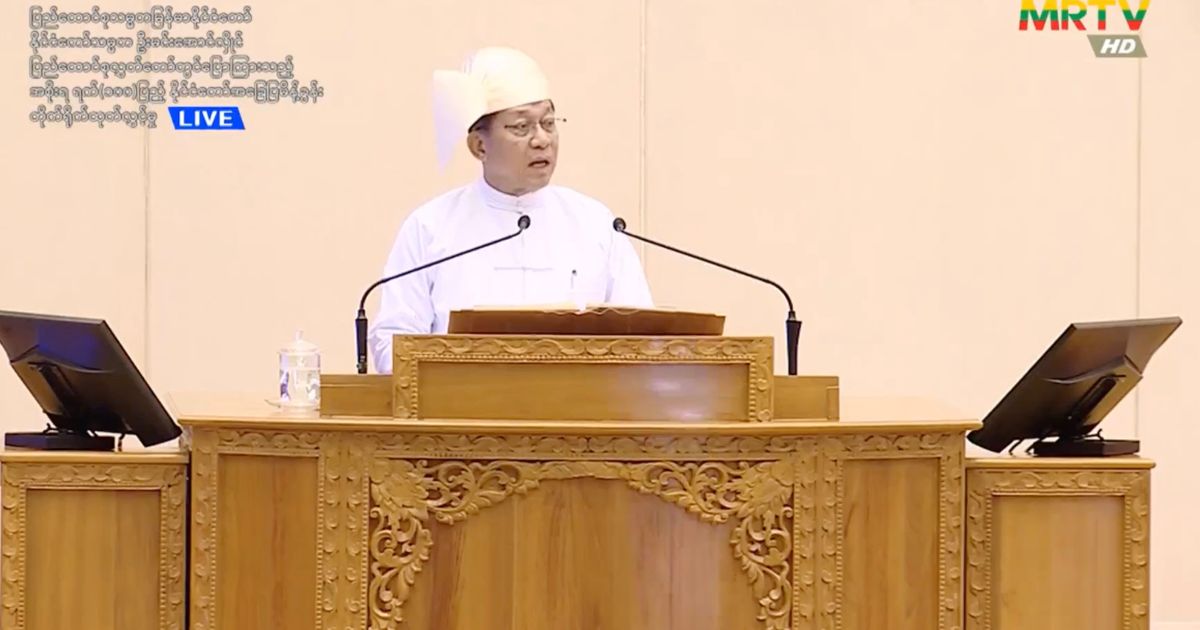
Junta leader Min Aung Hlaing claimed on Friday that the Five-Point Consensus formulated by the Association of Southeast Asian Nations (ASEAN) in 2021 was not the regional bloc’s collective position on Myanmar’s post-coup situation, but merely a statement issued at the time by its then chair, Brunei.
The remarks came during a speech to parliament marking the first 100 days since the former commander-in-chief of Myanmar’s armed forces assumed his current role as president of a military-backed “civilian” administration.
“The Five-Point Consensus is not the consensus of all ASEAN member states. It was only the statement of the then ASEAN chair, Brunei,” Min Aung Hlaing said.
He also accused some ASEAN member states of discriminating against his administration.
“We have exercised tolerance towards the discriminatory attitude of some ASEAN member states,” he said, without identifying the countries.
The Five-Point Consensus was agreed at a special ASEAN leaders’ summit in Jakarta on April 24, 2021, less than three months after the military seized power in a coup. Min Aung Hlaing attended the meeting, where ASEAN leaders agreed on a peace plan calling for an immediate end to violence, dialogue among all parties, humanitarian assistance, the appointment of a special envoy, and meetings in Myanmar between the envoy and all parties involved.
Friday’s remarks were not the first time Min Aung Hlaing has sought to downplay the agreement. Shortly after returning from the Jakarta summit in April 2021, junta-controlled state media asserted that it had been announced without his consent and was merely a statement by the ASEAN chair, rather than a consensus reached by all member states.
The junta subsequently said it would consider implementing the proposals only after first ensuring stability and when they aligned with the country’s domestic priorities.
Myanmar’s military authorities have since been widely criticised for failing to implement the peace plan. ASEAN has continued to exclude the junta’s political representatives from its leaders’ summits and foreign ministers’ meetings, allowing only non-political representatives to participate.
Although Thailand has recently advocated for the current military-backed administration in Myanmar to be accepted as a normal participant in ASEAN, the bloc maintained its policy at its most recent ASEAN Foreign Ministers’ Meeting by continuing to bar the regime’s political appointees from attending.
The Five-Point Consensus remains the bloc’s primary framework for addressing Myanmar’s political crisis.
Ben Lee, executive director of the Special Advisory Council for Myanmar (SAC-M), said Min Aung Hlaing’s latest remarks amounted to a rejection of ASEAN’s efforts to resolve the crisis.
“Accused war criminal Min Aung Hlaing is now deploying his proxy ‘parliament’ to heap further humiliation onto ASEAN,” Lee told Myanmar Now.
He said ASEAN had “failed to extract a single meaningful concession from the junta,” adding that the bloc should set “clear benchmarks and a hard deadline enforced by escalating consequences for non-compliance” while preparing a new framework beyond the Five-Point Consensus if the regime continued to reject it.
Lilianne Fan of the Malaysian Advisory Group on Myanmar said Min Aung Hlaing was attempting to rewrite the history of the agreement.
“The Five-Point Consensus was never Brunei’s policy alone. It was a collective ASEAN decision, unanimously endorsed by all ASEAN heads of government in April 2021, including Min Aung Hlaing himself,” she said.
Fan said the junta leader’s attempt to repudiate the agreement would only reinforce doubts among Myanmar’s resistance groups about the regime’s willingness to honour future commitments.
“If Min Aung Hlaing is unwilling to uphold even commitments made to ASEAN heads of government, it is difficult to see why Myanmar’s resistance would have confidence that commitments made to them would be honoured,” she said.
Despite the military’s transition to a nominally civilian government, there has been little evidence of meaningful change. In recent reporting on the new administration’s first 100 days, Myanmar Now found that various forms of political repression, including media crackdowns, surveillance, overnight household inspections, forced military recruitment, and restrictions on movement, all remain the norm.
More than five years after ousting Myanmar’s democratically elected government, the regime also continues to detain thousands of political prisoners and target civilians in conflicts raging across much of the country.
The change in government structure has also done little to alleviate the hardships that the majority of the population faces due to the economic impact of the coup.