In-Depth 
Deutsche Bank’s Halliburton financing linked to Myanmar military ‘should have been rejected’: leaked documents
Records reveal the bank’s own sanctions advisors warned against the deal, which links the US-based oilfield services company to a junta-run conglomerate

Leaked documents reveal that Deutsche Bank provided financing related to an offshore gas project linked to the Myanmar military, despite its own sanctions team claiming that it shouldn’t have approved the transaction.
In January 2022, almost a year after the military coup that deposed the democratically elected government of Myanmar, Deutsche Bank received a request from its client, oilfield services company Halliburton, to increase its bond guarantee for operations at the Zawtika gas field offshore Myanmar.
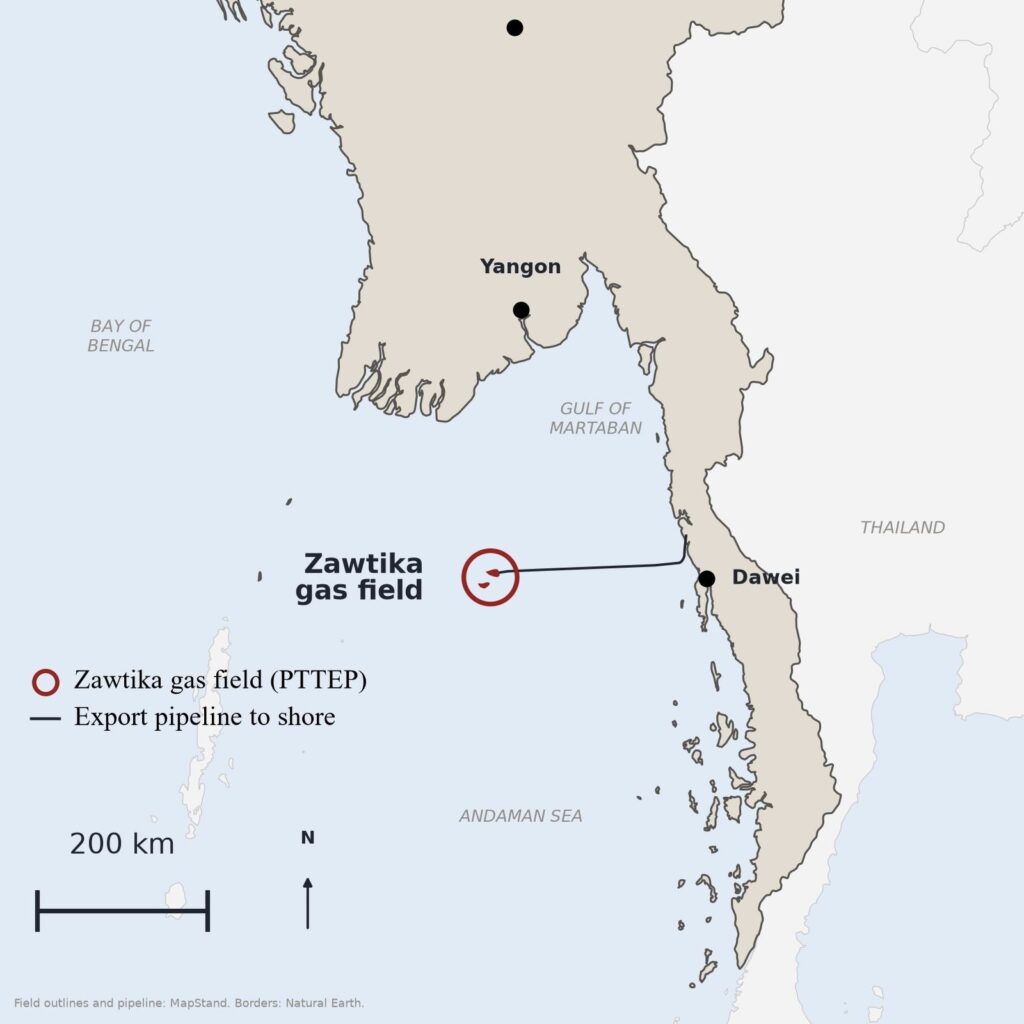
The original bond guarantee of approximately US$700,000 had been issued in September 2018 for the benefit of Halliburton’s client PTTEP International Limited, the Thai state-owned oil company and majority owner of the Zawtika field.
The remaining 20% stake belongs to the state-owned Myanmar Oil & Gas Enterprise (MOGE), entitling it to a portion of revenues from the project. The subject of the finance was tubing and pumping services for the gas field’s operations.
In response to the 2022 request to increase the bond to over a million dollars, a sanctions officer at the bank internally raised concerns that “research shows that the Zawtika Gas Field is owned by the Myanmar Oil & Gas Enterprise (MOGE), and a UN investigation indicated that MOGE is now controlled by Myanmar’s Military Junta.”
Saw San Aye, secretary of the Ministry of Electricity and Energy in the exiled National Unity Government, formerly worked for MOGE and confirms that “the Zawtika project revenue directly benefits the military council through MOGE.”
A Publish What You Pay report from June 2021 found that revenues from MOGE are the military’s single largest source of foreign exchange.
However, Deutsche Bank ultimately approved the transaction, claiming that its financing was not flowing directly to MOGE and did not involve any sanctioned entity. The bank relied on “client confirmation [of] no military involvement,” suggesting that due diligence was not pursued beyond taking Halliburton’s word.
The leaked documents reveal that within days of the deal being approved, a senior member of the sanctions advisory team raised concerns that “the further increase of the value of the BG [Bank Guarantee] could be seen as facilitating the provision of benefit indirectly to MOGE/Myanmar junta government.”
The staff member’s conclusion was that increasing the bond was not in line with the bank’s objective to reduce or cease exposure to the Myanmar military, and “should hence have been rejected,” asking if “there is any opportunity to roll back on the amendment request.”
The transaction could not be reversed, however, and no incident report was filed.
Nway Oo Li Li, spokesperson for the Blood Money Campaign, a group established after the military coup with the aim of disrupting foreign currency flows to the junta, rejects the claim that oil and gas service providers have reduced complicity.
“Money received from the energy sector entity MOGE flows through official international bank channels. These revenues allow them to purchase weapons, aviation fuel, military aircraft, and other military hardware via international and intermediary banks as well as money transfer networks,” says Nway Oo Li Li.
“The question these companies need to answer is to what extent their services are enabling the energy sector—controlled by the junta that is committing war crimes, severe human rights violations, and mass atrocities—to remain operational under MOGE.”
The bank’s approval for the transaction came at a moment of heightened scrutiny over links between Myanmar’s gas sector and the military junta. Just days before the transaction was approved, oil and gas majors TotalEnergies and Chevron announced plans to leave Myanmar, citing an intention to “limit the financial flows received by the national oil company MOGE.”
A Justice for Myanmar report from February 2021, just a month after the military coup, explicitly linked revenues from the Zawtika gas project to the military via MOGE.
The leaked documents also contain a copy of a letter sent to the bank from the United Nations Special Rapporteur on the situation of human rights in Myanmar in August 2021. The letter questioned how the bank was handling transactions “with a US or UK nexus that involve Myanmar state-owned enterprises.”
While the bank’s response is not known, in discussing how to reply to this letter, senior members of the bank expressed their “fear” that “we may not know notwithstanding our checks” if the bank has exposure to “relationships with the Military.”
Within weeks of the approval of the Halliburton guarantee, on February 21, 2022, the EU officially adopted its fourth round of sanctions relating to Myanmar, which included sanctions against MOGE.
Oil and gas companies fail to leave Myanmar post-coup
The Halliburton transaction was not the only deal with a US oilfield services company being contemplated by the bank in January 2022. When considering a request from Baker Hughes, a Texas-based energy technology company, for a Standby Letter of Credit (SBLC) for provision of goods—also for PTTEP at the Zawtika gas field—the bank’s Global Head of Sanctions expressed concern about the project’s links to the regime that had seized power the previous year:
“[G]iven that MOGE is likely controlled by the Myanmese [sic] military and given that the [transaction] below is to the benefit of Pttep which ultimately will transfer the benefits resulting from the guarantee indirectly onwards to MOGE […], this is just that kind of transaction which I would want to be rejected under our policy,” the bank’s head sanctions officer stated.
It is unclear whether this specific transaction was rejected in light of this intervention, or why this standard was not also applied to the Halliburton transaction.
In response to a 2023 NGO report detailing the extent of oil and gas companies’ involvement in Myanmar, Baker Hughes claimed that since the coup it had “not signed new contracts” and had only “a very limited number of personnel in the country to support critical Safety and Operations needs.”
But an internal spreadsheet circulated within the bank shows new letters of credit being provided to an entity named Baker Hughes International Holdings LLC (Yangon Branch) in July and August 2021.
That same spreadsheet shows that even after the coup, the bank continued issuing letters of credit to PTTEP International Limited’s Yangon branch, which was involved in multiple joint ventures with MOGE at the time.
A 2023 report found that both Baker Hughes and Halliburton reported profits in Myanmar for the period after the military coup.
According to publicly available evidence accessed by the Blood Money Campaign and Justice for Myanmar, both companies are indicated as still operating in Myanmar. In July 2026, Burma Campaign UK added both Halliburton and Baker Hughes to its “Dirty List” of companies linked to the Myanmar military junta. In April 2026, Halliburton advertised for a position related to oil and gas services based in Yangon.
There is no suggestion that sanction breaches occurred.
Baker Hughes and Halliburton did not respond to questions. In response to this investigation, Deutsche Bank said that the bank stands by its 2023 statement in response to a public letter from No Business with Genocide wherein the bank stated that “[b]esides taking steps to ensure compliance with the sanctions imposed by the UN, EU, and US, Deutsche Bank continues to have an internal policy in place aimed at restricting business with Myanmar.”

The Inside Deutsche Bank leak was obtained by Indian author and journalist, Josy Joseph, and South African investigative journalist, Khadija Sharife.
The Inside Deutsche Bank investigation was coordinated by Barracuda Media NPC in South Africa with technical support from the Data and Research Center (DARC) in Germany. Over 50 media outlets globally, covering upwards of 50 countries were involved in the investigation including Malaysiakini, Tempo, Kyodo News, Africa Uncensored, Le Monde, The New York Times, and Der Spiegel. For a full list of outlets participating in the investigation, go to the project website at: inside-db.com.