In-Depth
Myanmar’s military is regaining ground, costing the resistance key connections
As junta troops retake key highways, resistance forces face longer journeys, disrupted weapons supplies, and a growing risk of arrest
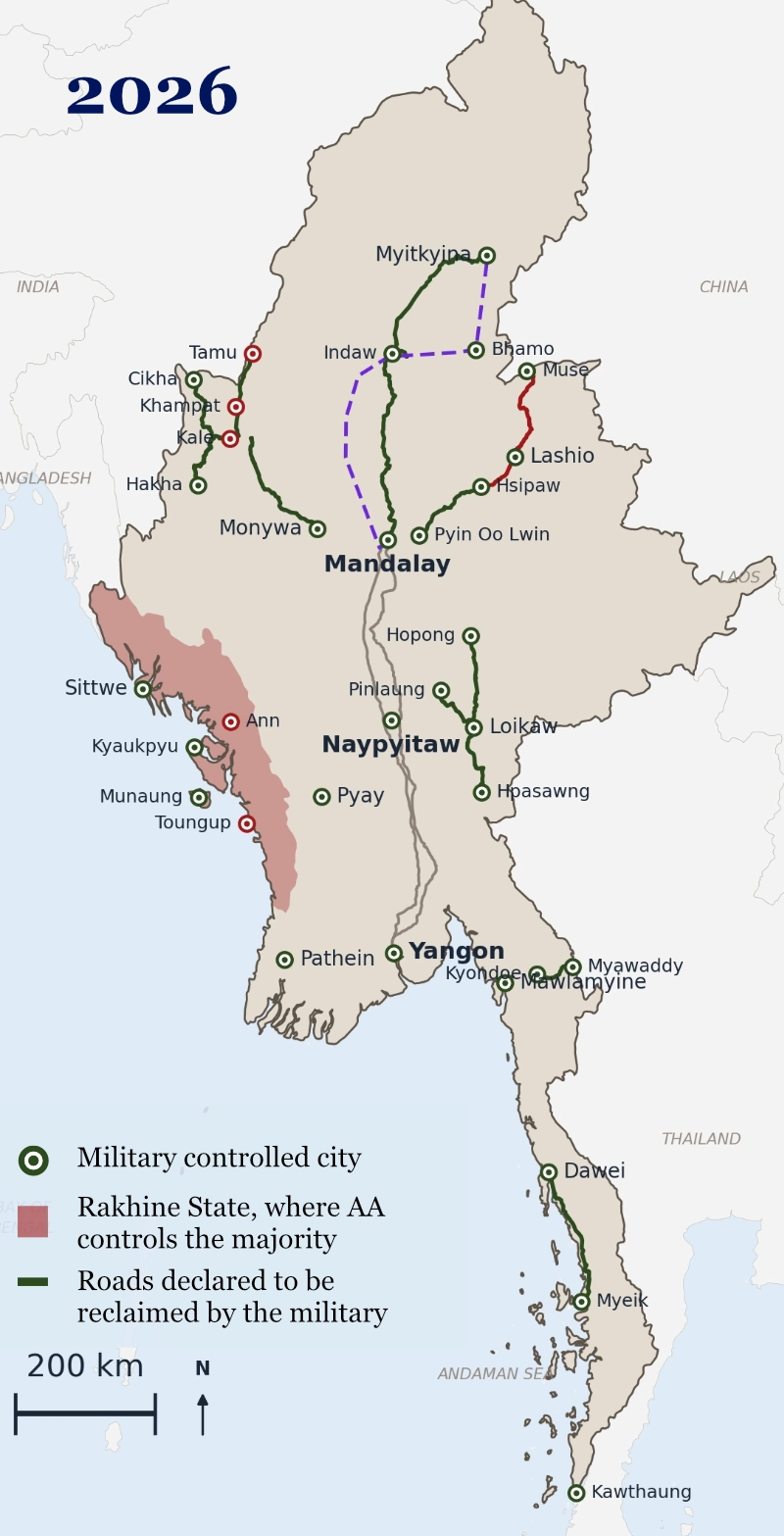
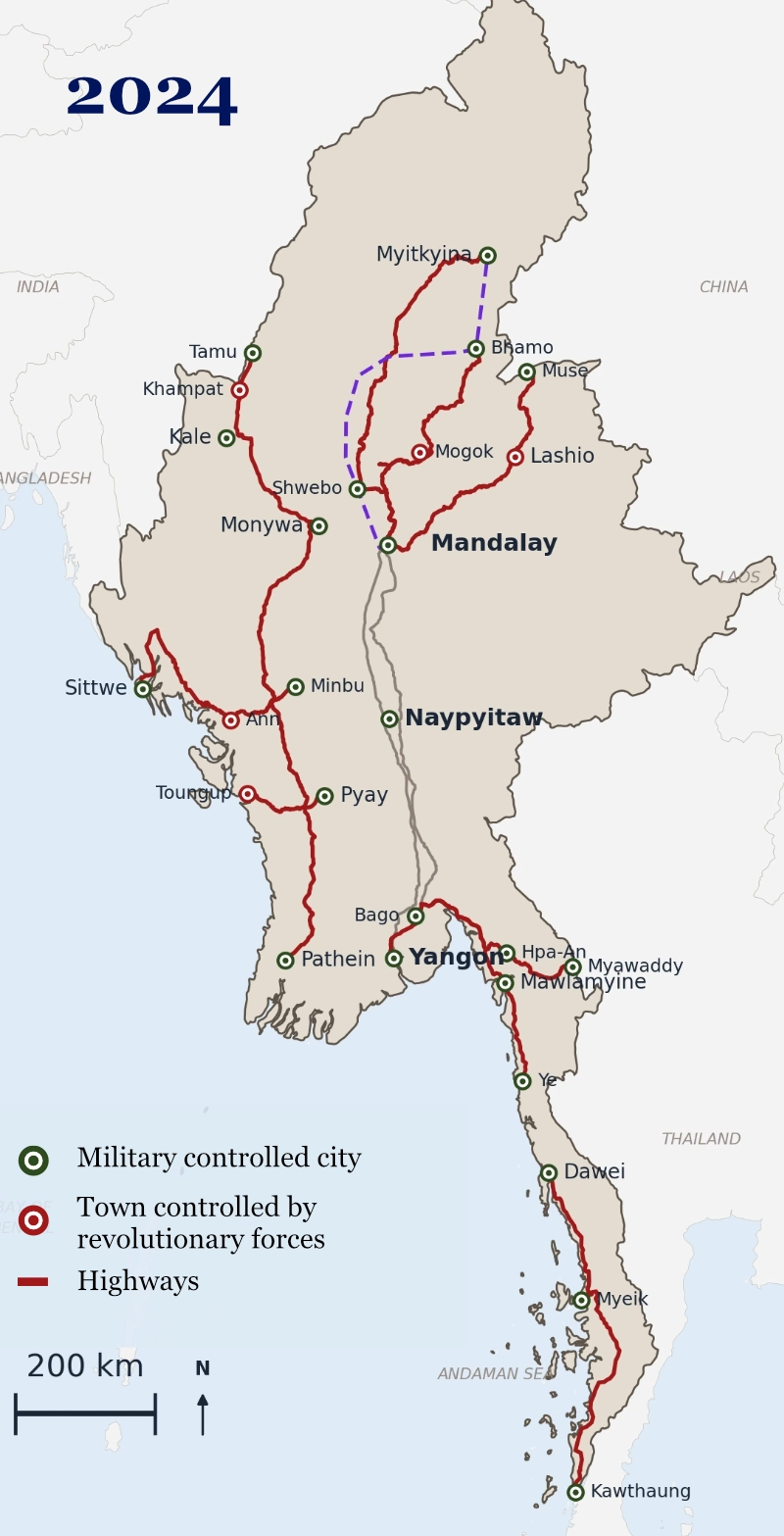
Myanmar’s military is regaining control of key roads across the country, disrupting connections between resistance-held territories and making it harder for anti-junta forces to move fighters, weapons, and supplies, according to resistance officials and sources interviewed by Myanmar Now.
The gains include sections of highways leading towards the borders with China, India, and Thailand, as well as routes connecting resistance strongholds in the north with battlefields farther south.
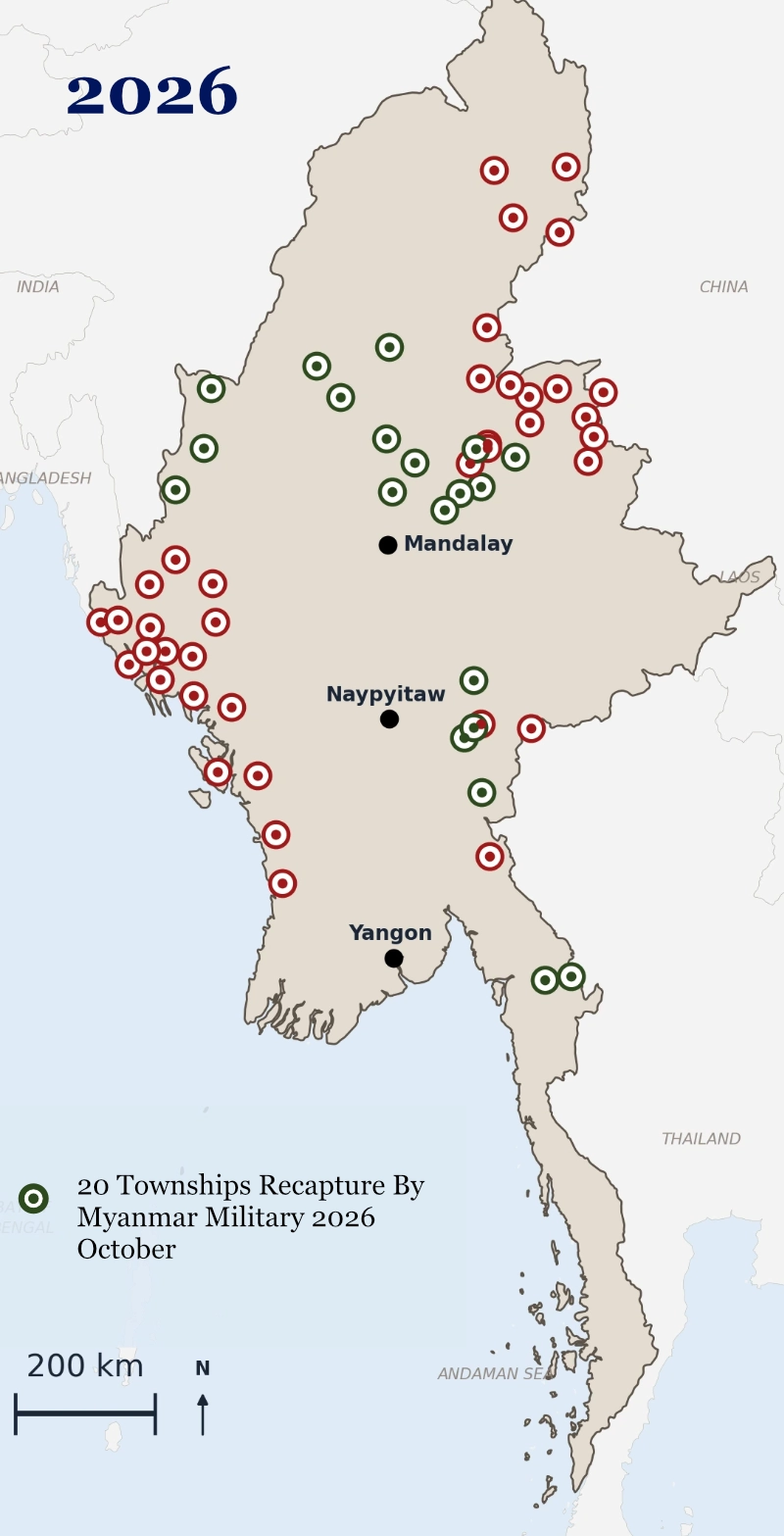
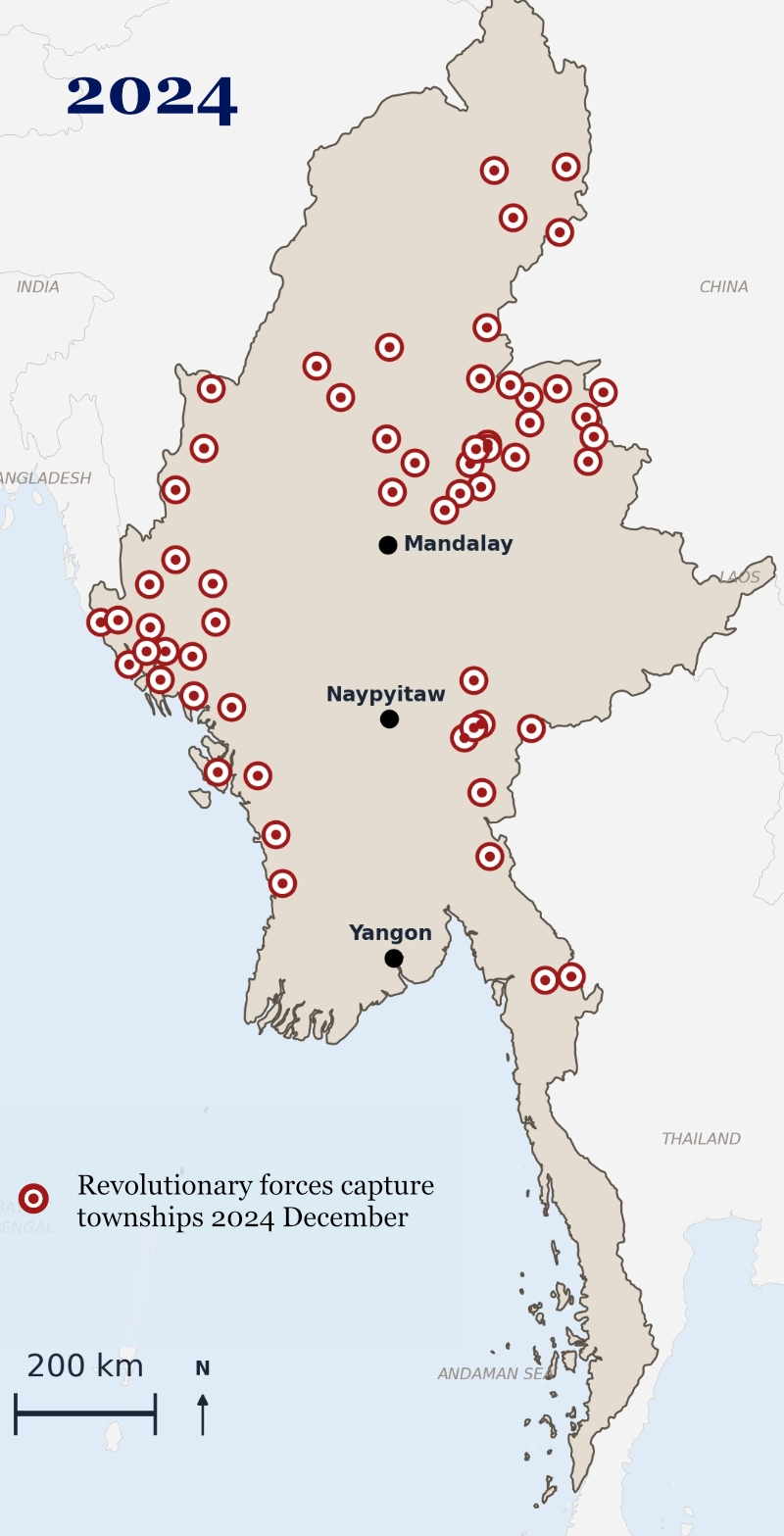
They mark a reversal of some of the territorial advances made by ethnic armed organisations and allied resistance forces in 2023 and 2024. Military counteroffensives intensified in 2025 and have continued this year.
Myanmar Now graphic
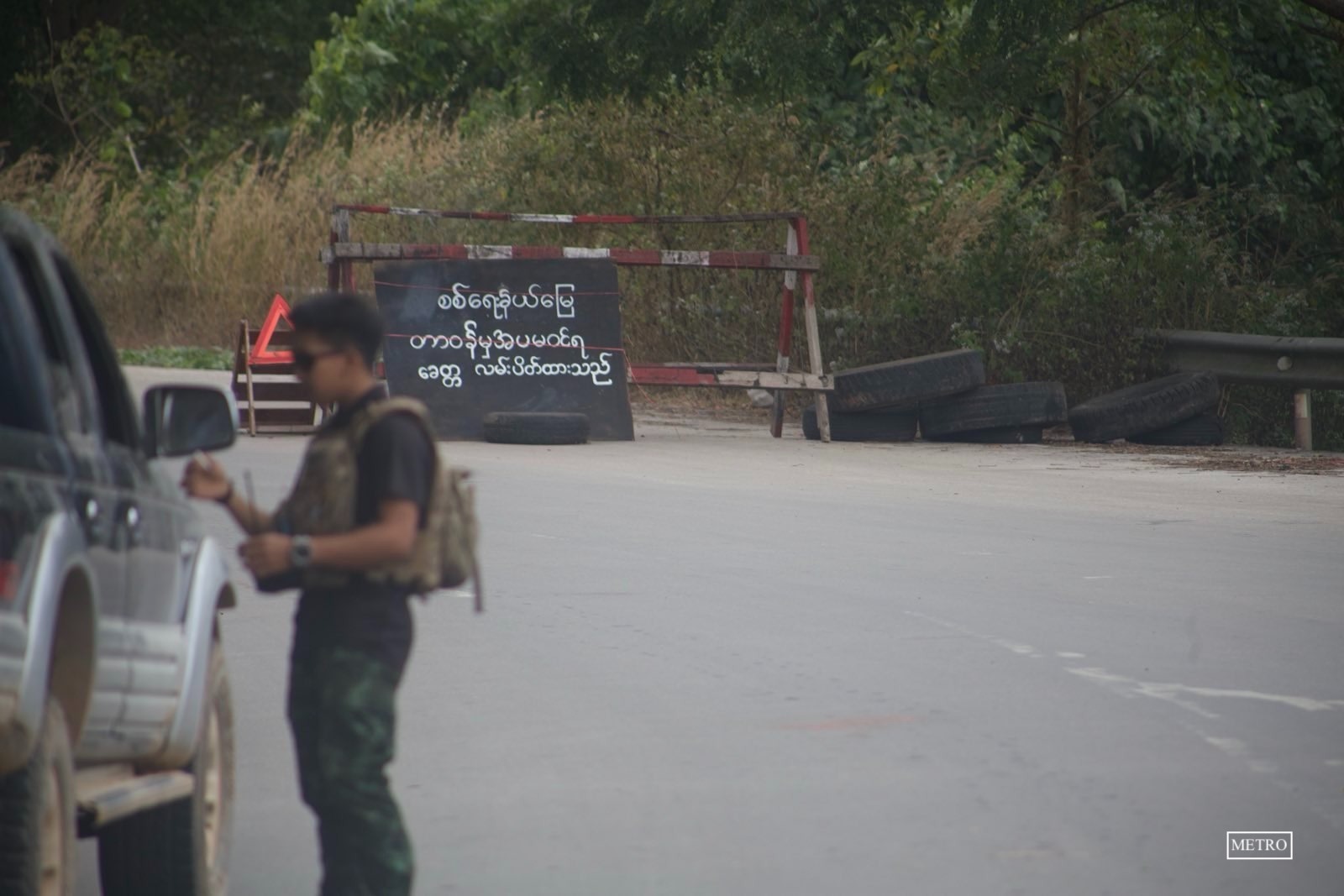
Even partial military control can complicate movement between resistance territories, forcing longer journeys through difficult terrain and increasing the risk of arrest.
A source close to the presidential office of the National Unity Government (NUG), the parallel administration opposing the junta, described how travel between the headquarters of major ethnic armed organisations had changed.
Before the military’s recent gains in northern Chin State and along the Kale-Tamu highway, fighters could travel by motorcycle and car from Camp Victoria, the Chin National Front’s headquarters near India, to Laiza, the Kachin Independence Army’s headquarters near China, in three days.
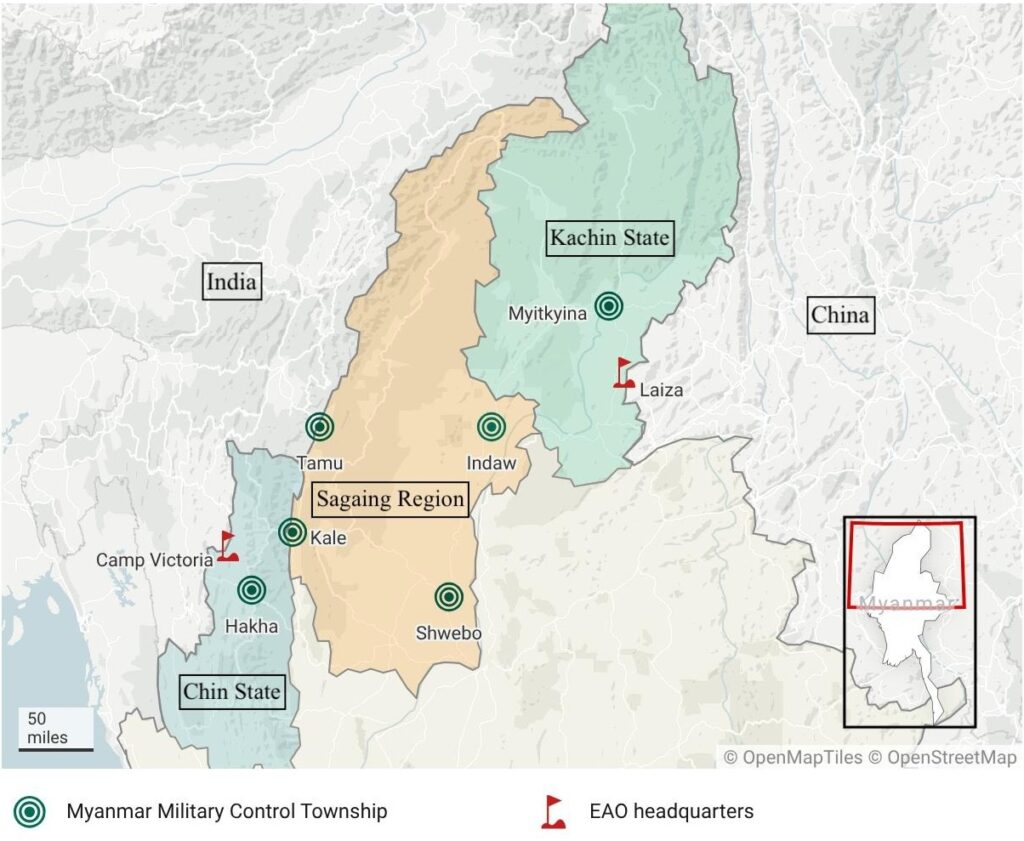
“Now, that is no longer possible. It can take much longer,” the source said.
NUG defence minister Yee Mon disputed suggestions that the resistance had suffered major losses to its essential supply network.
“There is more than one way to move supplies during a revolution,” he told Myanmar Now. Difficulties exist, but supplies are still moving, he said. He declined to discuss specific routes, citing military secrecy.
Myanmar Now graphic
Khaing Khaing Soe, a spokesperson for the military’s presidential office, did not respond to requests for comment by telephone and Signal.
Connections across the north
In western Myanmar, the military announced in May that it had reopened roads connecting towns in Chin State’s mountainous north with Kale in neighbouring Sagaing Region.
Chin resistance forces had captured several towns along those routes in 2024 and 2025. The military subsequently announced that it had retaken Tonzang and claimed control of all northern Chin State.
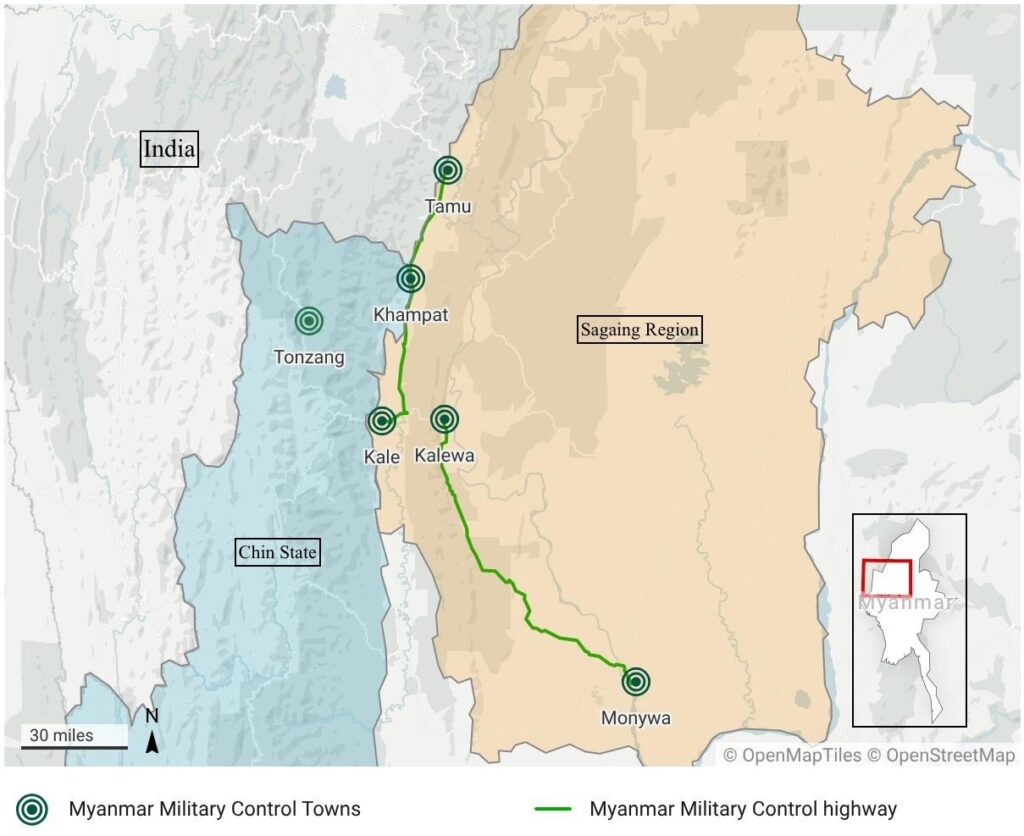
In July, it also announced the reopening of the Kale-Tamu highway towards India and roads connecting Kale with Kalewa and Monywa.
Sources in Tamu Township said the military had lost control of those routes following the emergence of armed resistance to the 2021 coup. Although it retained Kale and Tamu, resistance forces captured Khampat, between the towns, in November 2023. The military has since retaken it.
At an August 28 news conference, the Chinland Council’s secretary acknowledged that military control of major roads was creating difficulties for both resistance forces and civilians.
“If we cannot use this road, we use another. If that one is unavailable, we use a different one,” he said. “That is how we keep pushing forward. But it does create difficulties.”
Farther east, the military’s recovery of towns in northern Shan State has affected connections with resistance forces in central Myanmar.
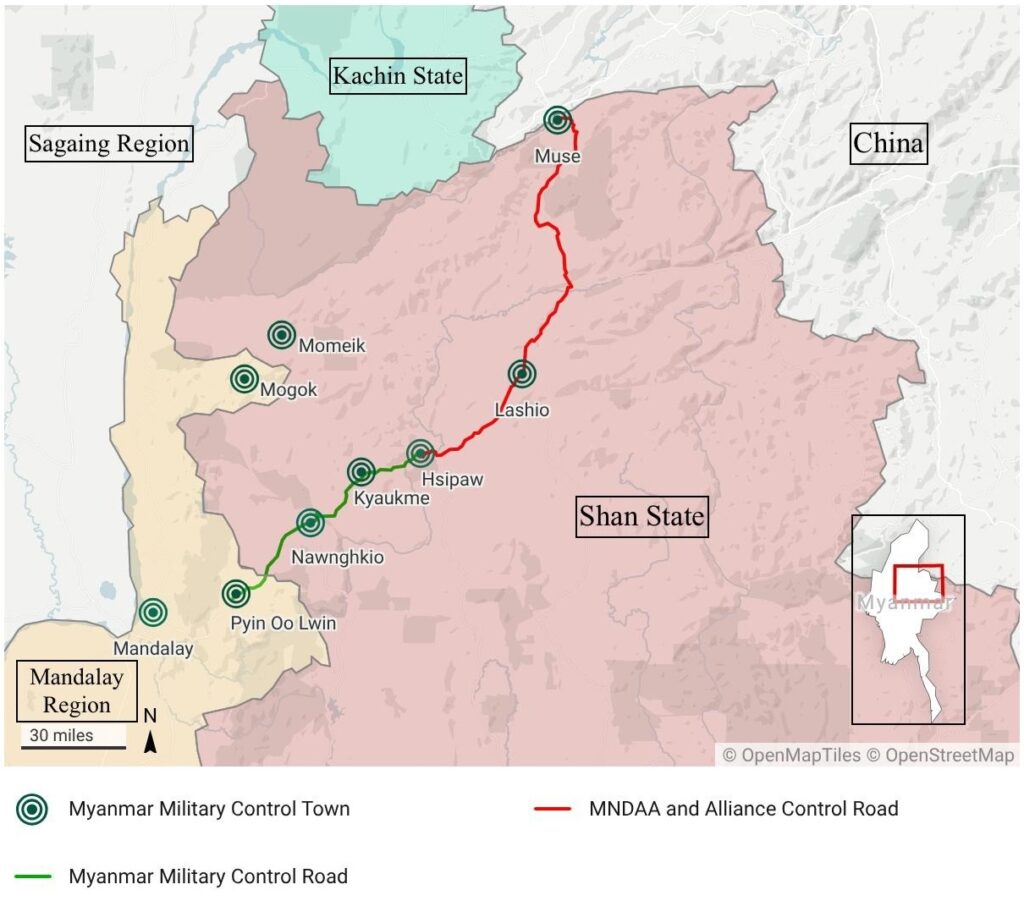
The Ta’ang National Liberation Army (TNLA) and its allies captured Nawnghkio, Kyaukme, and Hsipaw during the second phase of Operation 1027, an offensive renewed in June 2024. Those victories gave them control of an important stretch of the highway linking Mandalay with the Chinese border.
The military announced in October 2025 that it had regained control over the mountainous road from Pyin Oo Lwin in Mandalay Region to the town of Hsipaw in Shan State.
Some of its other gains came through Chinese pressure on ethnic armed groups. The military recovered Lashio from the Myanmar National Democratic Alliance Army (MNDAA), and the ruby-producing town of Mogok and nearby Momeik from the TNLA, without having to recapture them in battle.
Ceasefires with the MNDAA and TNLA also allowed the military to redeploy troops from northern Shan State to other fronts.
But MNDAA still controls much of the territory along the road north of Lashio towards Muse, on the Chinese border. Recovering Lashio and highway towns farther south did not give the military control of the entire trade corridor.
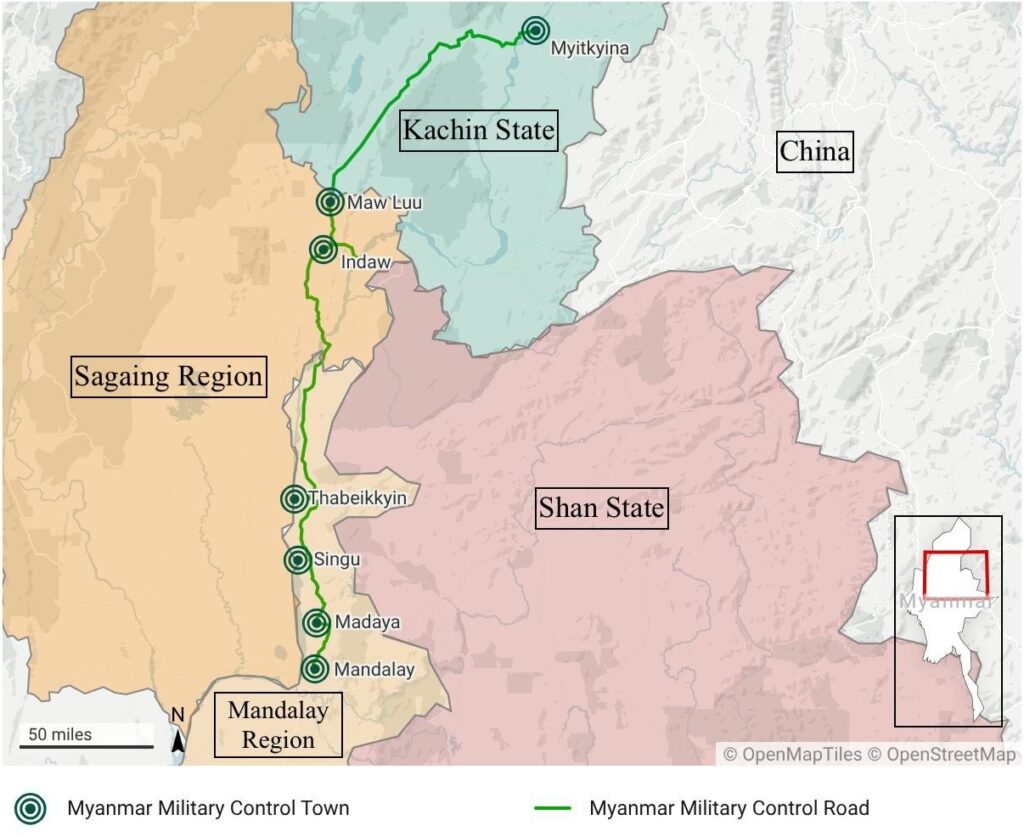
In neighbouring Mandalay Region, the military’s recapture of Madaya, Singu, and Thabeikkyin from the Mandalay People’s Defence Force has made movement between northern Shan State to the east and Sagaing Region to the west more difficult for the resistance groups.
Since May, the military has regained the Mandalay-Myitkyina highway, a major northbound route through Mandalay and Sagaing regions into Kachin State.
Parts of that road had fallen under resistance control during offensives by the Kachin Independence Army (KIA), its allies and resistance forces operating around Mandalay. Allied forces captured Maw Luu in December 2023 and Indaw in April 2025.
After announcing the highway’s reopening, the military said it sent civil servants and goods from Mandalay to Myitkyina in a military convoy on May 9, with the return journey beginning on May 16.
Resistance sources disputed the military’s claim of full control, saying fighting continued north of Thabeikkyin and resistance forces held areas around Indaw and Maw Luu.
Military supplies also remained vulnerable on the Ayeyarwady River, where the KIA said attacks damaged around 20 vessels carrying reinforcements towards Bhamo in August and September of this year.
A journey ends in arrest
The risks of travelling between resistance territories became clear in late November 2025, when a senior official of the opposition government was arrested while heading south.
Kwan Min, permanent secretary of the NUG’s home affairs and immigration ministry, was travelling from northern Shan State towards Karenni when military forces detained him in southern Shan’s Namhsan Township, senior resistance officers familiar with the incident told Myanmar Now.
Members of the Pa-O National Liberation Organisation led by Maj-Gen Khun Thurein were arrested with him, according to sources familiar with the case.
His capture illustrates the danger facing resistance personnel moving through territory where military troops and allied militias can intercept them. Roads that once connected allied forces have become increasingly difficult to cross.
Those connections also carried weapons. Type-81 rifles, their 7.62mm ammunition, and other supplies from armed groups in northern Shan State had reached fighters in Karenni and Karen states and Bago Region. The military’s recovery of approaches to Loikaw, the Karenni capital, has made those movements harder.
The reversal is significant. A Karenni resistance offensive launched in November 2023 had isolated military positions and disrupted their supplies. A military counteroffensive beginning in June 2024 has since restored access along key roads.
Farther south, the recovery of the Asian Highway towards Myawaddy, on the Thai border, has placed another obstacle between resistance territories.
A cross-border freight operator with resistance connections said military checkpoints and troop deployments had multiplied along the highway, which he described as fully under military control.
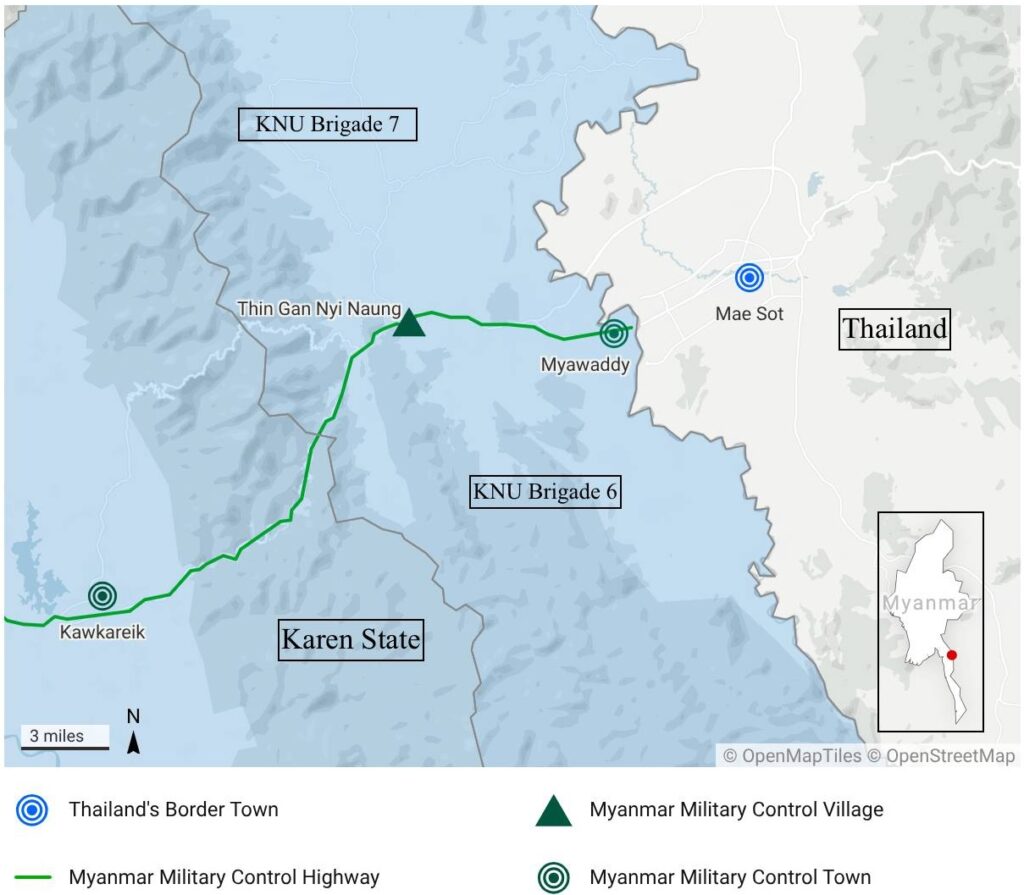
For the Karen National Union, the road separates its Brigade 7 territory to the north from Brigade 6 territory to the south.
Sources in the Thai border town of Mae Sot said fighters were still moving between them, partly through routes on the Thai side, but journeys had become harder since the loss of Thin Gan Nyi Naung, a settlement on the highway.
The resistance remains connected, but maintaining those connections has become more difficult.
Enough control to disrupt
The military does not need to secure every mile of highway to obstruct its opponents. Holding towns, junctions, and crossings can complicate resistance movements even where nearby countryside remains beyond its control.
That distinction also limits what the junta can claim from its gains. Its own convoys remain exposed.
In Karenni, resistance fighters attacked a military convoy between Demoso and Hpruso in September, destroying a vehicle, according to Karenni Nationalities Defence Force spokesperson Ta Eh Soe.
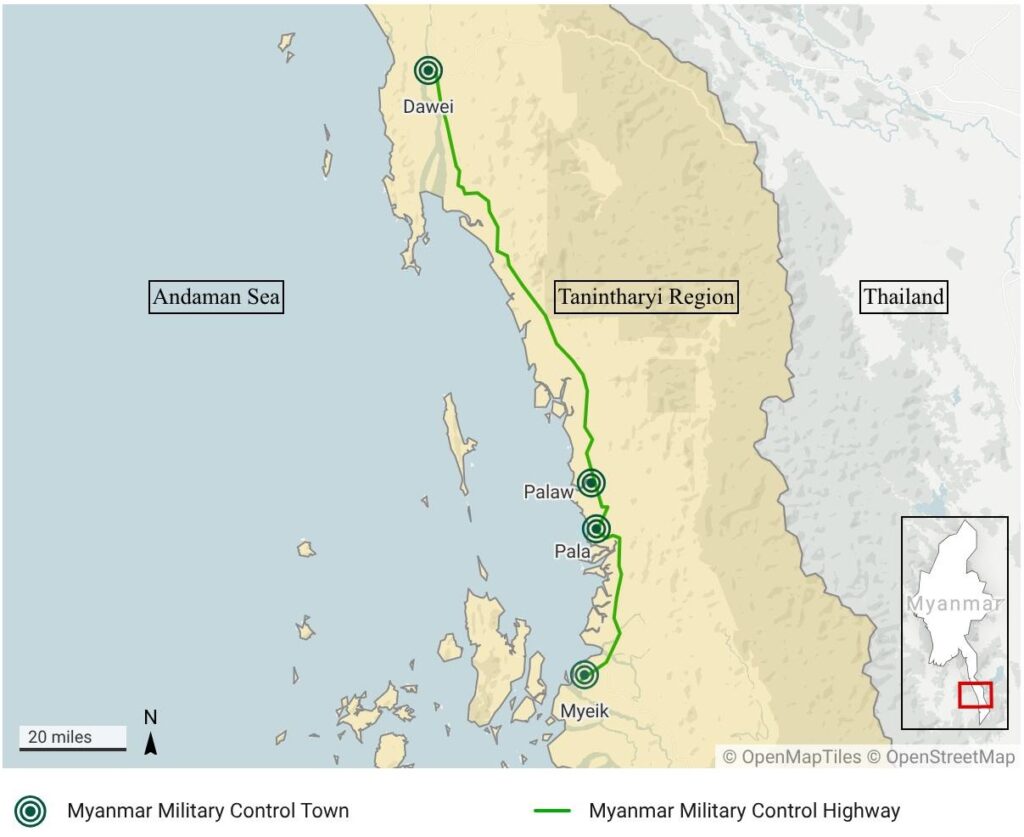
In Tanintharyi, Myanmar’s southernmost region, the military announced in March that it had regained the Dawei-Myeik highway. Yet in June, deputy military chief Lt-Gen Kyaw Swar Lin was still instructing troops to clear resistance forces from the route.
An editor at Fe5 Thanintharyi, a group monitoring local military and socioeconomic developments, said an August offensive recovered some territory between Palaw and Pala but then stalled.