Obo Prison in Mandalay has long had a reputation for being one of the worst places in Myanmar to end up as a political prisoner. New arrivals are routinely subjected to brutal beatings just to instil fear in them. Protests are savagely repressed. And female prisoners are treated just as violently as male detainees.
But even when they are not being physically assaulted or otherwise abused, Obo’s inmates are forced to endure the daily—and nightly—torment of overcrowding.
By late 2021, mass arrests carried out in the wake of anti-coup protests had pushed the prison’s population well past its capacity of around 4,000 prisoners. Since then, however, the number of inmates has more than doubled, to nearly 9,000, according to recently released detainees who spoke to Myanmar Now about current conditions inside the notorious detention centre.
Most prisoners are held in large cells measuring 80 feet by 30 feet, although some are placed in other buildings, including a large storage room used for the prison’s supply of fermented fish paste—a staple of the prison diet. The regular cells now hold at least 200 prisoners. That’s about 12 square feet per prisoner, or barely enough for a grown man to lie on the floor without touching the person next to them.
During the day, inmates can sit or stand to avoid constant contact with their fellow prisoners; but at night, it is all but impossible to preserve any personal space. To make matters worse, the presence of so many sweaty bodies intensifies the heat in the cell, especially for those who find themselves completely surrounded by others.
This is why sleeping spaces next to walls or windows are coveted by prisoners, who must pay for the privilege of being allowed to pass the night in a relatively airy part of the cell.
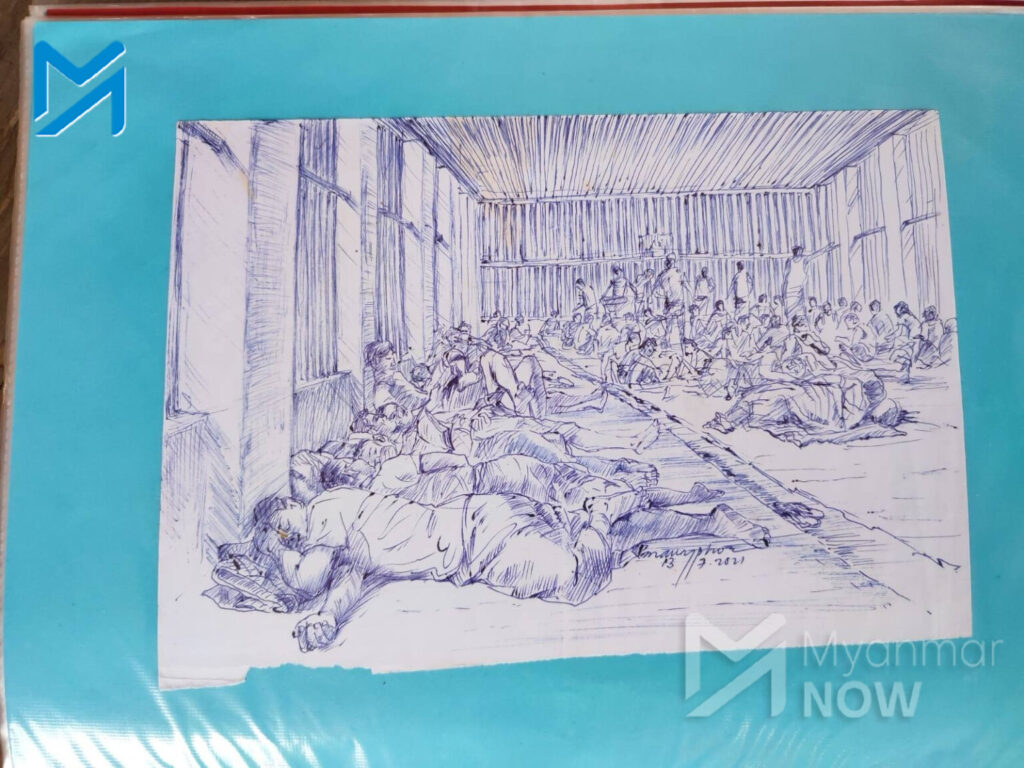
A monk who was released eight months ago said the rate at that time for one of these prime spots along the sides of a cell was 30,000 to 70,000 kyat (US$14-33) a month. More recently, however, inmates say they have to pay prison staff between 100,000 and 300,000 kyat ($47-142) to get some relief from the suffocating heat.
But even if you can afford a place that allows you to breathe a little easier at night, there is no escaping the misery of having barely enough room to move.
“We had to sleep side by side, one person pointing north and the other south, with our feet between those of the next person in line. We couldn’t even twist and turn in our sleep,” said the monk.
A prisoner who was released in February said that many people simply sat up through the night, unable to get any rest.
“During the summer, it wasn’t just the heat but also the scarcity of water that troubled us,” he added. “They wouldn’t turn on the electricity generators to operate the water pumps, so we couldn’t even bathe regularly.”
Roughly a third of Obo Prison’s inmates are political prisoners, including local protesters, monks, doctors, teachers, and lawyers deemed a threat to the regime. According to a statement released by the Assistance Association for Political Prisoners (AAPP) on March 13, a total of 2,967 prisoners are being held there for political reasons.
Prominent detainees include Dr. Zaw Myint Maung, Mandalay Region’s ousted chief minister, who is suffering from leukaemia; Win Htein and other high-ranking members of the deposed ruling party, the National League for Democracy; and Ywet Nu Aung, a lawyer who has represented a number of high-profile clients.
Nationwide, there are at least 20,000 political prisoners still being held in 40 different prisons in Myanmar. Yangon’s Insein Prison, Obo Prison in Mandalay, and Thayarwaddy Prison in Bago Region are among the most infamous for their long records of abuse towards prisoners of conscience.