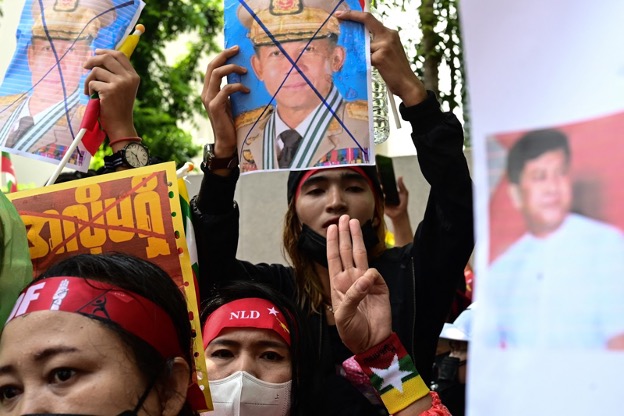
Myanmar’s junta leader Min Aung Hlaing will make an official visit to Thailand next month as Bangkok seeks to bring the pariah state back into the diplomatic fold, the Thai foreign minister told AFP on Wednesday.
Min Aung Hlaing, who led a 2021 coup that deposed democratic leader Aung San Suu Kyi, triggering a civil war, was installed as civilian president in April following highly restricted elections.
Neighbouring Thailand has been leading an effort to begin normalising relations, both bilaterally and through the 11-nation Association of Southeast Asian Nations (ASEAN).
“It’s best to bring Myanmar back into the fold,” Thai Foreign Minister Sihasak Phuangketkeow told a news conference in Bangkok.
“We believe that after five years we need to talk, we need to listen, and they need to explain,” he added.
Afterwards, the foreign minister told AFP that Min Aung Hlaing “will make an official visit” to Thailand “very soon, in August.”
This will be his first trip to the neighbouring nation since his change of position, and follows visits to India, China, and ASEAN member Laos in recent months.
It was not clear who Min Aung Hlaing would meet in Thailand, with Sihasak saying: “We are working on an official programme.”
News of the visit comes after Thailand hosted on Sunday an informal meeting of ASEAN foreign ministers that included Myanmar, a member state.
It was the first such gathering since the coup, after which ASEAN blocked Myanmar’s leadership from high-level summits.
ASEAN has made little progress with its five-point plan to end the civil war in Myanmar through national dialogue with all sides.
Analysts say consensus within the bloc is now fraying between those open to seizing on small concessions by Myanmar and others who want more substantive progress before restoring ties.
There has been speculation that Myanmar’s Foreign Minister Tin Maung Swe may join a formal ASEAN meeting soon.
A diplomatic source from one ASEAN nation told AFP on Wednesday the minister would not attend talks next week in Manila.
But Southeast Asia expert Morgan Michaels told AFP normalisation was coming, and he expected Myanmar’s foreign minister and leader to be reinvited to the bloc at the political level.
“It’s not a matter of if, but when,” said Michaels, of the International Institute for Strategic Studies.
‘Stabilisation’
As its neighbour, Thailand has faced the fallout of Myanmar’s civil war, including fighting that occasionally crosses its border and hosting millions of Myanmar refugees.
“Most observers accept that Thailand has a legitimate position in that it wants to see a de-escalation and a stabilisation of Myanmar,” said Michaels.
Sihasak said that “we have to be realistic—progress won’t be achieved overnight.”
The continued detention of ousted leader Aung San Suu Kyi, now 81, remains a major concern.
In late April, Min Aung Hlaing announced the Nobel laureate would be moved from prison to house arrest—but she has not been seen or heard from since.
ASEAN is pressing for its special envoy to meet Suu Kyi, but so far Myanmar has refused.
After Sunday’s talks in Bangkok, Sihasak said the Myanmar foreign minister had assured his ASEAN counterparts that she was “in good health.”
“We have been told she has been taken care of well but it needs to be proved,” the Thai foreign minister added on Wednesday.
Min Aung Hlaing visited Thailand in April 2025 for BIMSTEC, a regional economic forum, and met then Thai prime minister Paetongtarn Shinawatra.
A decade of reporting at a cost
In 2025, we marked the 10th anniversary of Myanmar Now. In Myanmar’s history, journalists are often the first targets during political repression. We founded this outlet during a brief window of stability, starting with a small team in a modest office in downtown Yangon. Our goal was simple: to report on injustices that had been silenced for decades. In many countries, justice is sought through courts and police. In Myanmar, these institutions have historically been instruments of oppression.
From the start, we committed to reporting without discrimination—regardless of ethnicity, religion, or citizenship. We believe our work should be accurate, deeply sourced, and strong enough to serve as a historical record.
We also believe journalism should be a force for positive change, and that our primary readers should be the people of Myanmar.
That belief came at a cost. Members of our team and others associated with Myanmar Now have endured long legal battles, physical assaults, arrests, and torture. Despite these hardships, Myanmar Now continues to report the news—thanks to the resilience of our team, the courage of our sources, and the trust of our readers.
Please subscribe to support a free press in Myanmar.