The Thutaythaka nunnery in Parami Ward, Sagaing Town, once home to 56 Buddhist nuns, now lies in ruins, abandoned and silent. Among the rubble, stray dogs sift through broken bricks and splintered wood, weaving past fragments of Buddha statues, scattered school books, and tattered pieces of pink robes.
It has been a month since a devastating 7.7 magnitude earthquake struck central Myanmar on March 28, leveling the two-story structure and killing 14 nuns inside. The site remains eerily still, save for the presence of a lone figure.
From a temporary tent just across the road, a fair-skinned nun with gold-rimmed glasses has kept watch over the wreckage. Abbess Thinza Yi, who has spent 36 of her 48 years in monastic life, described the tragedy to Myanmar Now. Trained at Yangon’s Mani Yadanar Nunnery, where she earned her Sāsanadhaja Dhammācariya and Vinayavidu titles, she now lives with the lingering horror of that day.
Each night since the collapse, she says she’s haunted by the voices of the 14 young nuns who died beneath the rubble—calling out her name, crying for help.
“If rescuers had arrived sooner, they could have been saved,” the abbess told Myanmar Now, wiping away her tears. “Maybe not all fourteen, but I believe at least three to five of them might have survived.”
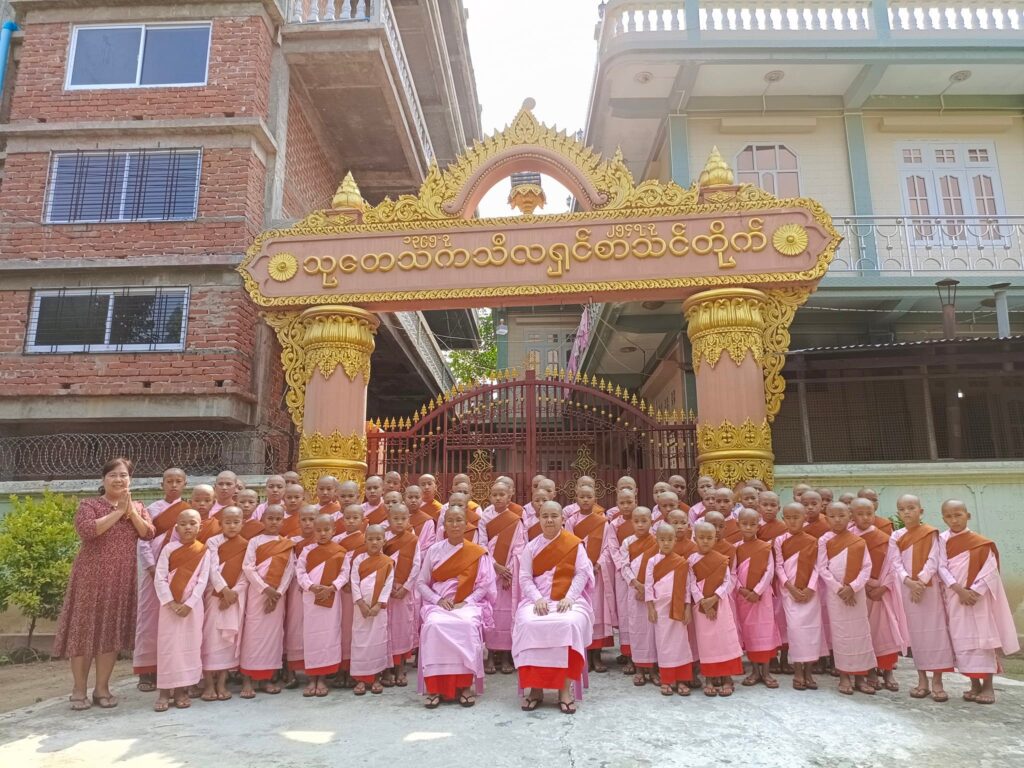
A photo of the nuns taken not long before the earthquake struck. (Photo: Supplied)
‘I could still hear their voices’
Sagaing Hill and Min Wun Hill are located across from Mandalay, the former capital of the last Burmese royal dynasty. The two hills are renowned religious sites filled with Buddhist stupas and monasteries. From the tranquil vantage of Sagaing Hill, one can see the Ayeyarwady River winding through the hills below, with Mandalay City visible in the distance.
But the Sagaing Hill lies directly above the country’s largest seismic hazard—the Sagaing Fault.
The International Buddhist Education Center (IBEC) released a statement in early April, reporting that more than 2,000 monasteries and nunneries on Sagaing Hill and Min Wun Hill had collapsed due to the devastating earthquake.
Of the over 2,000 religious structures that collapsed, 501 monasteries and 254 nunneries were situated on Sagaing Hill. Estimates say that a total of 49 monks, 49 nuns, and 59 displaced persons lost their lives in the deadliest earthquake to hit the country in over a century.
At the time of the quake, 14 nuns from Thutaythaka Nunnery were studying Buddhist scriptures. The oldest was 17, anad the youngest only seven years old. At around 1pm disaster truck. Three of the 14 nuns were inside the newly built four-storey building when the earthquake started trembling the ground violently.
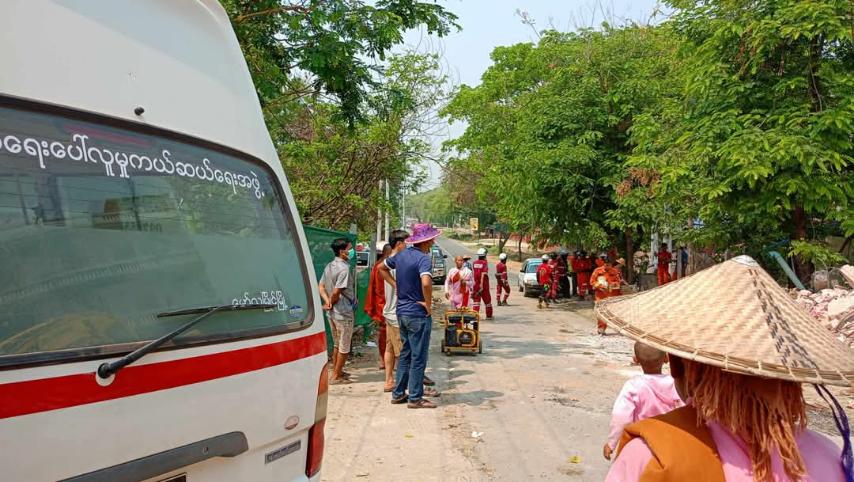
The remaining nuns, including the 14-year-old girl who also perished, were studying Buddhist scriptures in an adjacent two-storey building next door. All the nuns at the scene ran for the exits – 36 nuns managing to escape. The others simply didn’t have enough time. Two hours went by, and by the time rescue teams arrived at around 5pm that evening they were too late. The rescue teams only managed to rescue two trapped nuns.
The deceased nuns were identified as Sandar, Kaymar Thiri, Thila, Awthada, Yu Theingi, Yuzana, Thu Nandi, Thu Sandar, Athuwadi, Thutawadi, Asari, Eindasari, Yu Nandar, and Anandar.
The two survivors were a 53-year-old Dhamma teacher of the nunnery, Kandanyarni, and a 12-year-old nun, Atheingi. Dhamma teacher Kandanyarni suffered a leg injury from fallen concrete pillars, while Atheingi needed to have her leg amputated after an iron rod pierced it in the event.
Abbess Thinza Yi believes that if the rescue teams had arrived just an hour after the earthquake, the nuns might have survived. An identifiable sound could be heard from under the rubble, Thinzar Yi recalls hearing. The trapped nuns were chanting the Patthana sutra while they were trapped under the rubble.
“I could still hear their voices calling out,” she said. “The injured child nun who lost her leg recalled that one of the deceased had held her hand and pleaded: ‘Don’t leave me behind—take me with you.’”
‘Unable to break free’
After the Mongol-Myanmar war in the late 13th century, the Bhikkhuni order, which had existed since the Buddha’s time, vanished from Myanmar along with the collapse of the Pagan Dynasty, which ruled from the 9th to 13th centuries. The kingdom unified much of Myanmar and laid the cultural and religious foundations of the nation through its flourishing of Theravada Buddhism.
Women in Myanmar are barred from full ordination as monks and can only become nuns, typically observing just ten precepts like novice monks. Still, some monks—most notably Venerable Ardessa Wuntha of Pazundaung Township—have openly supported reviving the Bhikkhuni order.
In 1935, Venerable Ardessa Wuntha authored the ‘Beikhuni Sasanaw Padeta’ (Treatise on the Beikhuni Campaign). A centuries-old tradition holds that the Bhikkhuni order, or female monks, existed within the Buddhist Sasana for nearly 700 years. When a treatise calling for its revival was published, it sparked backlash within Myanmar’s monastic community. Venerable Ardessa Wuntha, a key supporter, was penalised and socially ostracised.
The movement faded, though figures like Venerable Saccavadi and Venerable Gunawati briefly gained attention. Saccavadi was arrested in 2005 for impersonating a monk and later exiled; Gunawati died in 2019 in Yangon after decades abroad.
Today, nuns still face deep inequality.
After the quake, nuns like Thitsawadi, ordained at 12 and later earning a Buddhist Master’s in Sri Lanka, faced delayed aid and rebuilding efforts controlled by senior monks.
“Tradition has molded us into this role, and we are unable to break free from these constraints. As nuns, we are still confined within these boundaries,” Thitsawadi shared.
“I desire to break free from these boundaries, and I know we should go beyond them, but we are not able to just yet.”
‘When someone mentions the children, I can’t bear it’
The day the earthquake struck is still fresh on Nun Asari’s* mind. Everyday she remembers the devastation and the widespread suffering that immediately followed. As a refugee fleeing war from a different monastery in Sagaing Region, she moved to Thutaythaka in search of peace.
But a transient moment of solace was ripped apart by Sagaing’s torn fault lines.
She told Myanmar Now that at the time of the disaster, the nunneries on Sagaing Hill were organized into 11 groups, each led by an abbess who oversaw daily routines, religious study, meditation, and charitable work, all under the supervision of monks.
Clashes were escalating between junta forces and resistance groups on Min Wun Hill, phishing the 38-year-old to flee to Sagaing Hill. Yet after the earthquake, the nunnery where Asari had been temporarily staying was destroyed. She has then returned briefly to Mandalay to support the nuns impacted by the disaster.
“The first priority is to provide emergency shelters for those without a place to stay,” she said. “The second stage involves securing funding for clearing and demolishing the damaged buildings, while the third stage focuses on reconstruction. These are the three stages we are working through.”
Asari shared that a list is being compiled of the nunneries damaged or destroyed in Sagaing and Min Wun Hills. Since the quake, she has also been helping to set up temporary shelters for the displaced nuns.
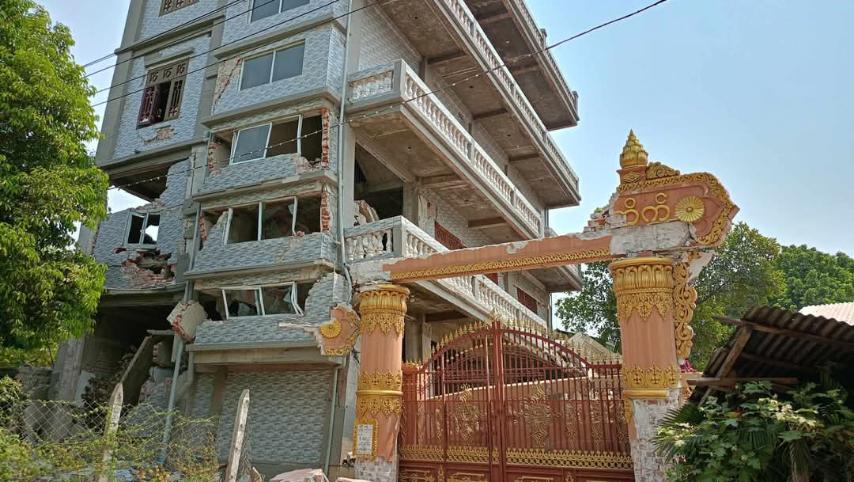
With the four-storey building now damaged, and the two-storey structure totally collapsed, Abbess Thinza Yi is grappling with the overwhelming costs of repairs and rebuilding. Worse still, she is still grappling to come to terms with the loss of the 14 young nuns.
“I don’t care about the material loss,” she said. “I haven’t cried over it, as I’ve already accepted it. But when someone mentions the children, I can’t bear it. I just can’t,” she said, her voice trembling, tears pouring down her face.
Looking at the rubble, the disintegrated buildings, Thinzar Yi says that it would take tens of millions of kyat to clear the debris from the collapsed two-storey building and to repair the four-storey structure. Given the trauma now associated with the complex, she no longer desires to live there.
Thinzar Yi compared her grief to Patacara, Buddhist scripture’s mourning mother who, after losing her family and descending into madness, found enlightenment as a Bhikkhuni.
“We memorised Patacara’s story, studied it in our exams,” she said. “But now, I feel like I’m living her life.”