For anyone old enough to remember past elections in Myanmar, the build-up to the one set to take place this coming Sunday has been a strangely muted affair.
One young woman who witnessed the 2015 election as a trainee reporter recalls the excitement of that historic event, which saw the National League for Democracy (NLD), the party of pro-democracy icon Aung San Suu Kyi, sweep to power in a landslide.
One of her most vivid memories was waiting with others who filled a narrow street outside the NLD’s headquarters in Yangon for a chance to hear Suu Kyi speak after her party’s victory. Although the speech was brief, it filled all who listened with hope and excitement, she said. The crowd roared in support.
Even before that moment, there was enormous enthusiasm, she recalled.
“Campaign events drew massive crowds,” she said. “It was bustling everywhere with large crowds and convoys of vehicles flying red flags. It felt like the whole city was celebrating a festival.”
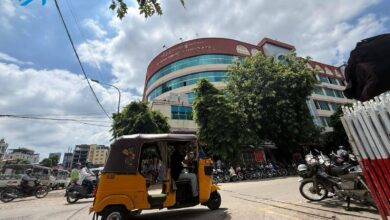
The mood in Yangon this past month could not be more different. Completely absent are the spirit and energy that once defined election campaigns in Myanmar’s largest city.
Instead of lively rallies, the main attractions now are small-scale activities such as selling rice, cooking oil, and eggs at discounted prices, campaigners handing out pamphlets, and vehicles driving through residential neighbourhoods playing election songs. Even these efforts are half-hearted, and the large crowds that once turned out in support of candidates are nowhere to be seen.
Few who spoke to Myanmar Now seemed to care whether their vote was counted, since the outcome is a foregone conclusion: a continuation of military rule, in one form or another. Unlike in previous elections, many say they haven’t bothered to see if their names appear on the voter lists.
“In the past, if my name was wrong on the list, I would go and correct it. Now, it really doesn’t matter to me whether it is correct or not,” said a woman from Yangon’s Dawbon Township.
She added, however, that simply ignoring the election may not be an option, amid widespread fears that the military regime could use violence and intimidation against those who refuse to vote.
“If we can avoid it, we won’t vote. If we can get away with it, we’ll just let it pass. But if the authorities start pressuring us, then we’ll have no choice. We can’t travel abroad like others, so we’ll just have to deal with the situation here,” she said.
Another woman in her 30s, from Tamwe Township in Yangon, was more defiant: “I don’t want to vote. I don’t care about the parties, and I don’t expect any real change. No one in our family will be voting,” she said.

No trust
Resistance to the vote extends well beyond Yangon, both to other cities under junta control and to resistance-held areas where civilians continue to face airstrikes, shelling, and arson attacks by regime forces.
Since seizing power in February 2021, when it overturned the results of Myanmar’s last multiparty election on the pretext of unsubstantiated allegations of voter fraud, Myanmar’s military has faced unrelenting opposition to its rule. This began with peaceful protests that were met with violent crackdowns, marking the start of what later became known as the Spring Revolution.
The armed resistance movement that emerged in the months immediately after the coup has since taken control of wide swathes of the country, after dealing the military serious setbacks on the battlefield. While the regime has managed to claw back some lost territory, it is still in a weaker position than ever in its decades of brutal rule. With its power waning, the junta is pressing ahead with an election confined to areas it still controls, in a desperate bid for legitimacy.
For most young people in Myanmar, the election is nothing more than a scripted political exercise designed to secure victory for the military while preserving a system of violence and repression.
“The result of this election is already obvious. The military will declare itself the winner,” said Nari, a 23-year-old student who joined the Civil Disobedience Movement after the coup.
“Just like before, they will keep repressing people who don’t support them.” She said she has no trust at all in the military-run vote.
Nari and her family were forced to leave Ayeyarwady Region after the 2021 coup, relocating to an area under the control of the Karen National Union. Her father is now involved in the resistance against military rule, a reality that has shaped her view of the junta’s claims of political transition.
“As a political change, this election will benefit the people zero percent,” she said. “It will serve only the interests of the small group that seized power.”
Now a student at the National University of Computer Studies, an institution opened by the education ministry of the National Unity Government, Nari sees the vote not as a step toward reform, but as part of a return to an era before the military loosened its hold on power more than a decade ago.
In areas held by the resistance, fear stretches beyond doubts over the election’s legitimacy. Residents fear that once the ballots are cast, the junta will intensify its violence. Local youths from upper Sagaing Region said the threat of aerial assaults remains high, and many worry that the period following the vote will bring even deeper shortages of basic goods, a consequence of the military’s long-used “four cuts” strategy of depriving anti-regime forces of food, funds, intelligence, and recruits.
“Bombs were dropped day and night. Schools have been forced to close in our area,” said a man in his 20s living in Sagaing. “Now many people are worried that the threat of airstrikes will increase after the election as we live in a resistance-controlled region.”
Internet and phone lines have been cut in many parts of Sagaing Region, leaving civilians living in these areas in a constant state of uncertainty about when the next bombs will be dropped on their homes, schools and hospitals.
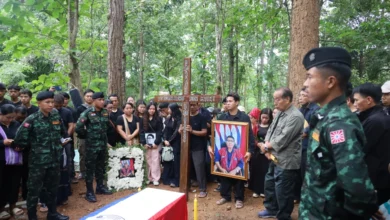
In the weeks leading up to the election, the regime has shown no signs of easing in its assaults on civilian targets, killing hundreds, including children, the elderly, and patients in their hospital beds, and injuring many more.

Pressured to vote
Millions have been forced to flee their homes to escape the constant threat of sudden death, both from above and at the hands of marauding junta soldiers on the ground. Those who are still able to grow their crops also struggle to survive, as closed roads means loss of access to markets. Food and other essentials are scarce for everybody.
No wonder, then, that there is little interest in an election that will do nothing to meet the basic needs of ordinary people, much less their democratic aspirations.
In Dawei Township, in southern Myanmar’s Tanintharyi Region, election posters have begun to appear in neighbourhoods and villages aligned with the military. But even in these places, there are few other signs of political activity beyond the occasional small gathering. Most residents, according to a young local, are far more preoccupied with making ends meet and managing daily needs than with casting ballots.
“It’s just like before. It won’t change a thing,” he says of the election. “But people stay quiet about it because there are oppressive laws they cannot challenge. They live in fear, unable to speak out against the unfair rules and the constant pressure.”
In southern Shan State’s Nyaungshwe Township, military-appointed administrators have prepared voter registration lists in a bid to ensure a respectable turnout. But as in other parts of the country, many here say they won’t play along with the farce.
“Personally, I’ve decided I won’t vote,” said Lemon, a local woman in her early 20s, noting that others she knows have taken the same stance. “Participation in this election is going to be very low.”
She added, however, that some young people opposed to the election might vote to avoid being expelled from their schools.
“There are many students here attending military-run schools,” she said. “If the authorities pressure them to vote, they feel they have no choice but to comply.”
Amid the crack of gunfire, deadly airstrikes, and the anguished cries of civilians, the election in Myanmar offers no real prospect of meaningful change. For most, the future will continue to look bleak for as long as the military remains in control.
“What I remember best is the landslide victory of the NLD,” said one woman when asked what it would take to restore her faith in the country’s future. “That’s the memory I hold dear—that was a moment of hope.”