Humanitarian efforts in Sagaing Region have been severely hindered, with search and rescue operations unable to proceed without the military regime’s approval, residents say.
Victims of the March 28th magnitude 7.7 earthquake in Myanmar are depending on local non-profit emergency response teams for search and rescue efforts, as reported by sources on the ground to Myanmar Now.
The earthquake, which caused widespread damage, has left at least 693 dead in Sagaing Region, according to the National Unity Government (NUG), the elected government of Myanmar in exile.
The death toll continues to rise, with delays in rescue operations due to a lack of heavy machinery and a slow response to trapped residents beneath the rubble.
“Rescue missions are only done by manual labor as there is no heavy machinery, like backhoe, for clearing rubble,” a 40-year-old Sagaing resident told Myanmar Now. “As a result, many people lost their lives unnecessarily.”
Volunteer-led rescue teams must first obtain permission from the military regime by submitting details, including the address of the affected building, to a junta office overseeing search and rescue efforts, local sources say.
Two days after the earthquake, military forces blocked volunteer groups traveling from Mandalay to Sagaing, allowing only those delivering food and water to pass.
“Even if the homeowners seek help from volunteers to clear the rubble, the military soldiers come immediately to intervene,” another Sagaing resident said. “ They demand them to see official approval before allowing any action.”
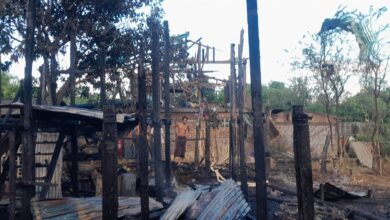
The military regime’s restrictions on rescue efforts have stalled much of the volunteers’ work, leaving countless victims trapped under the rubble of collapsed buildings and homes. The devastation has spread to both central Sagaing and rural areas of the township.
“It’s impossible to fully clear the debris,” another source said. “Some bodies still cannot be retrieved because the destruction is widespread. Only the buildings and houses in the city centre and along the main roads are being cleared.”
On April 5, Vice-Sen-Gen Soe Win, the deputy chair of the military, stated during a meeting in Naypyitaw that every rescue organisation must follow the military regime’s guidelines and collaborate with them.
He also visited Sagaing himself on April 6, just nine days after the earthquake, to assess the damage. Sagaing is a war-torn region, where most of the rural areas are controlled by anti-regime forces, while the military still holds power in Sagaing’s urban centres.
Conscription has significantly impacted relief efforts, as the regime’s enlistment of young people for military service and the arrest of volunteers have drastically reduced the available manpower for search and rescue operations in Sagaing, locals say.
With little manpower or heavy machinery available, Sagaing residents have been left in a state of inaction for three days.
“Many people have already fled the town,” another source said. “Leaving only elderly men and young teenagers behind. This also weakened the rescue efforts.”
The earthquake has further complicated the ongoing conflict, as the junta continues its bombing campaigns and military offensives, making it even harder for affected areas to receive aid.
Another volunteer told Myanmar Now that the death toll is massive, with the number likely to keep rising.
Meanwhile, international rescue teams from Malaysia and China are conducting search and rescue operations in the urban areas of Sagaing Township while local volunteers are facing significant challenges in accessing rural areas.
Some sources have even claimed that military backed militias are extorting money from relief teams at checkpoints, in some cases threatening to confiscate aid. As of Monday, the earthquake has claimed at least 3,564 lives nationwide, injuring 5,012. At least 210 people are still missing.
“They make it incredibly difficult to obtain approval for retrieving dead bodies,” a volunteer told Myanmar Now. “We are required to seek permission from the military. If they would simply grant this permission to volunteers, the situation would improve considerably.”