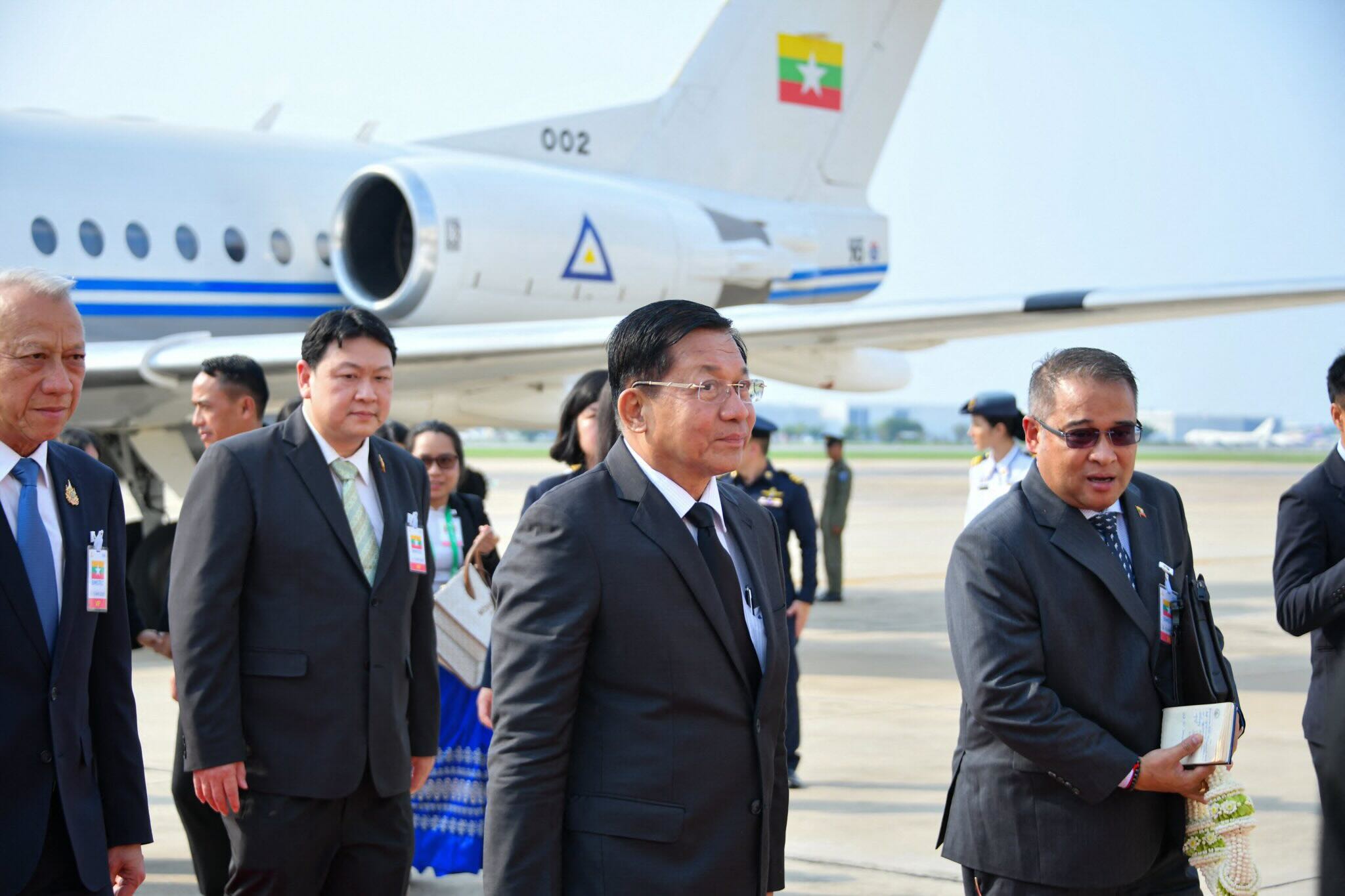
Myanmar’s junta chief Min Aung Hlaing is expected in Thailand on Thursday, making his first trip there since assuming the presidency as he seeks a return to the diplomatic fold for his pariah state.
The former general led a 2021 military coup that ousted democratic leader Aung San Suu Kyi, triggering a civil war estimated to have killed more than 100,000 people on all sides.
He was installed as Myanmar’s president in April following stage-managed elections that democracy watchdogs and Western nations called a sham intended to launder the junta’s image.
Neighbouring Thailand has since been leading an effort to normalise relations with Myanmar, both bilaterally and through the 11-nation Association of Southeast Asian Nations (ASEAN).
The bloc has excluded Myanmar’s leadership from high-level summits since the putsch, but its foreign minister attended an informal meeting with his regional counterparts last month in Thailand.
And Min Aung Hlaing has been on a diplomatic drive since swapping his military uniform for civilian dress, visiting India, key ally China, and ASEAN member Laos in turn.
In the run-up to his Bangkok trip, Suu Kyi–who remains under house arrest–was allowed to meet a representative of the International Committee of the Red Cross on Monday, her first publicised meeting with a foreign official since her ouster.
Independent Myanmar analyst David Mathieson told AFP that Myanmar’s campaign for re- entry into ASEAN was a matter of “pure status” for Min Aung Hlaing.
But Myanmar’s leaders have also refused to buy into the bloc’s Five-Point Consensus to end hostilities through dialogue with all sides.
“He wants to be seen as a responsible member of ASEAN in one way, then paradoxically to totally reject the five-point consensus,” said Mathieson, describing it as an example of “zero sum logic.”
Analysts say Bangkok has cause to pursue restored ties.
Fighting between Myanmar’s military and myriad rebel factions has spilled over the long border with Thailand, which hosts millions of refugees from Myanmar.
Thailand also has to deal with the presence of cyberscam networks and illicit drugs traffickers in Myanmar’s volatile borderlands.
‘Legitimacy’
Thailand’s Foreign Minister Sihasak Phuangketkeow told reporters on Monday that Thailand believed Myanmar, as well as Cambodia, could “do a lot more” to combat scam networks, and the issue would be raised during Min Aung Hlaing’s visit.
In a statement he also welcomed Suu Kyi’s Red Cross meeting, hoping that authorities “will undertake further positive steps towards lasting peace and stability in Myanmar.”
Min Aung Hlaing is set to be welcomed by an honour guard at Bangkok’s Government House on Thursday and then meet one-on-one with Prime Minister Anutin Charnvirakul, a Thai official told AFP on condition of anonymity.
The Myanmar leader will also attend a business forum and state dinner, the official said, with the two sides expected to sign a memorandum of understanding on labour cooperation.
Critics say Bangkok should not be rolling out the red carpet for Min Aung Hlaing, who has been sanctioned by several Western nations and is wanted by the International Criminal Court for crimes against humanity.
Campaign group Justice For Myanmar slammed Thailand for its diplomatic overtures, saying in a statement: “Min Aung Hlaing must be held accountable for his crimes, not awarded false legitimacy.”
A decade of reporting at a cost
In 2025, we marked the 10th anniversary of Myanmar Now. In Myanmar’s history, journalists are often the first targets during political repression. We founded this outlet during a brief window of stability, starting with a small team in a modest office in downtown Yangon. Our goal was simple: to report on injustices that had been silenced for decades. In many countries, justice is sought through courts and police. In Myanmar, these institutions have historically been instruments of oppression.
From the start, we committed to reporting without discrimination—regardless of ethnicity, religion, or citizenship. We believe our work should be accurate, deeply sourced, and strong enough to serve as a historical record.
We also believe journalism should be a force for positive change, and that our primary readers should be the people of Myanmar.
That belief came at a cost. Members of our team and others associated with Myanmar Now have endured long legal battles, physical assaults, arrests, and torture. Despite these hardships, Myanmar Now continues to report the news—thanks to the resilience of our team, the courage of our sources, and the trust of our readers.
Please subscribe to support a free press in Myanmar.