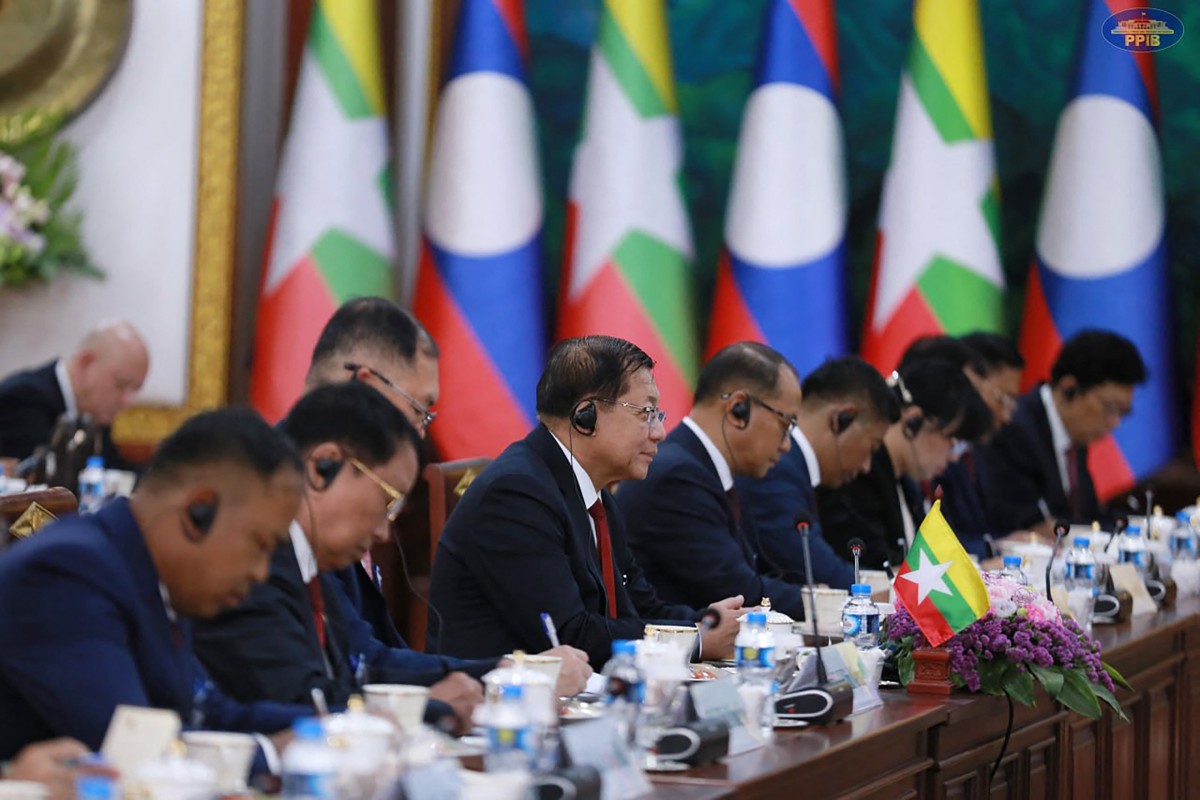
Myanmar’s foreign minister will meet his regional counterparts in Bangkok on Sunday, Vietnam’s foreign ministry said on Thursday, as the pariah state seeks a return to the diplomatic fold.
Myanmar has been largely frozen out of the 11-nation Association of Southeast Asian Nations (ASEAN) since a military coup ousted the elected government of Aung San Suu Kyi in 2021, triggering a civil war.
But junta chief Min Aung Hlaing was installed as civilian president in April following highly restricted elections, and neighbouring Thailand has been leading the charge to begin normalising relations.
While informal, Myanmar Foreign Minister Tin Maung Swe’s attendance at the talks on Sunday represents “another crack in the ASEAN position,” said Richard Horsey, senior Asia advisor at the International Crisis Group.
“It’s diplomatic choreography towards an end which is Min Aung Hlaing standing with ASEAN leaders in Manila in November,” he told AFP, referring to the bloc’s summit.
But he noted that as ASEAN chair, the Philippines would make the final decision on whether to invite Min Aung Hlaing—and was “by no means guaranteed” to do so.
The Bangkok talks follow a state visit by Min Aung Hlaing to Laos at the weekend—a trip Horsey described as the “beginning of the end of ASEAN’s principled position” of refusing to normalise relations with Myanmar.
Vietnam Foreign Ministry spokeswoman Pham Thu Hang said there would be two rounds of talks in Bangkok—one with the Myanmar minister and the other without.
They would provide “an opportunity for the foreign ministers to engage in direct exchanges, strengthen cooperation, and promote dialogue and reconciliation in Myanmar.”
Thailand’s foreign ministry said there would be an informal meeting of ASEAN foreign ministers, including Myanmar, but did not specify the date or location.
A diplomatic source from another ASEAN member state separately confirmed to AFP that the Myanmar foreign minister would attend the talks in person.
Min Aung Hlaing plunged Myanmar into civil war with his 2021 coup, which ended a decade-long experiment with democracy.
He ruled directly as military chief for five years before becoming civilian president in April after staging elections that excluded Suu Kyi’s party and others, and were blocked from rebel-held territory.
His new administration is making a push for international legitimacy, analysts say.
A decade of reporting at a cost
In 2025, we marked the 10th anniversary of Myanmar Now. In Myanmar’s history, journalists are often the first targets during political repression. We founded this outlet during a brief window of stability, starting with a small team in a modest office in downtown Yangon. Our goal was simple: to report on injustices that had been silenced for decades. In many countries, justice is sought through courts and police. In Myanmar, these institutions have historically been instruments of oppression.
From the start, we committed to reporting without discrimination—regardless of ethnicity, religion, or citizenship. We believe our work should be accurate, deeply sourced, and strong enough to serve as a historical record.
We also believe journalism should be a force for positive change, and that our primary readers should be the people of Myanmar.
That belief came at a cost. Members of our team and others associated with Myanmar Now have endured long legal battles, physical assaults, arrests, and torture. Despite these hardships, Myanmar Now continues to report the news—thanks to the resilience of our team, the courage of our sources, and the trust of our readers.
Please subscribe to support a free press in Myanmar.