UPDATED at 1:00 PM Yangon time
The death toll from a devastating 7.7-magnitude earthquake that struck Myanmar on Friday has continued to rise, reaching more than 1000 as rescue operations continue.
The earthquake, which struck around midday on Friday, was centred just west of Myanmar’s second-largest city Mandalay. Its impact has been felt in a number of major urban centres, including the capital Naypyitaw.
Initial reports put the number of dead at 144, but as the leader of Myanmar’s military junta, Senior-General Min Aung Hlaing, arrived in Mandalay early Saturday, revised figures were released putting the death toll at 1002, with 2,400 others injured.
These numbers are expected to continue to climb amid ongoing search-and-rescue operations, with many more still feared trapped under the rubble.
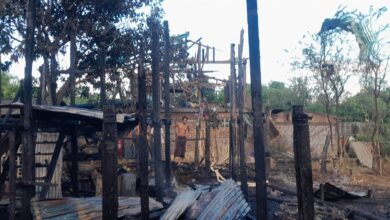
In Mandalay, firefighters reported that the quake triggered major blazes in several neighbourhoods. Residents say that several high-rise buildings have collapsed, while many others have sustained serious structural damage, complicating rescue efforts.
Hospitals in Mandalay, Naypyitaw, and other affected areas have reportedly been overwhelmed as staff try to attend to injured survivors. Witnesses reported seeing patients lying on the ground at Mandalay General Hospital due to a lack of available beds.
“From the entrance to the hospital, all I could see was patients scattered everywhere, covered in blood. Some doctors were sitting, overwhelmed and unable to assist,” one witness told Myanmar Now.
As casualties mount and hospitals fill to capacity, the Myanmar regime has declared a state of emergency in Mandalay, Sagaing, Magway, and Bago regions, as well as the Naypyitaw Union Territory and parts of Shan State.
The junta has also confirmed the cancellation of all flights into and out of the airports in Mandalay and Naypyitaw due to extensive damage to aviation equipment. In Naypyitaw, six people were reportedly killed by the collapse of an air traffic control tower.
The earthquake comes as many in Myanmar struggle to survive four years into a civil conflict that began with a military takeover in February 2021.
On Friday, Amnesty International issued an urgent appeal for the Myanmar military to allow unimpeded access to aid groups and to remove barriers that prevent effective relief efforts.
“This earthquake compounds an already dire situation. Over a third of the population needs aid this year, and with the ongoing conflict and US aid cuts, the earthquake has created a crisis within a crisis,” said Amnesty’s Myanmar researcher, Joe Freeman.