Myanmar’s military junta appears to be widening its campaign against resistance forces by opening a new front in Magway Region, a move analysts say could be aimed at severing key supply routes into Chin and Rakhine states ahead of a larger post-monsoon offensive.
Since May, the military has deployed thousands of troops to Magway’s Saw and Mindon townships, which serve as gateways to resistance-controlled territory across the Chin Hills and the Rakhine Yoma mountain range. The deployments have triggered intense clashes with anti-regime forces based in these areas and coincide with the junta’s broader effort to regain ground lost across western Myanmar.
The military build-up follows recent gains in northern Chin State, where junta forces recaptured Falam and Tonzang after months of fighting. These victories have strengthened the military’s position in the north and, according to analysts, may have freed resources for renewed operations in southern Chin State and neighbouring Rakhine State.
According to resistance analysts, the current campaign appears focused less on immediate territorial conquest and more on disrupting the logistical networks that sustain resistance-controlled areas.
Zin Yaw, a former army captain who joined the Civil Disobedience Movement after the military seized power in 2021, argued that the junta’s recent gains in northern Chin have altered the strategic landscape.
“Since northern Chin State has come fully under junta control, the resistance’s ability to conduct military operations across the north has been significantly constrained,” he said. “In this context, the junta’s strategy appears to be a ‘finishing move,’ launching heavy offensives into southern Chin from the Magway side.”
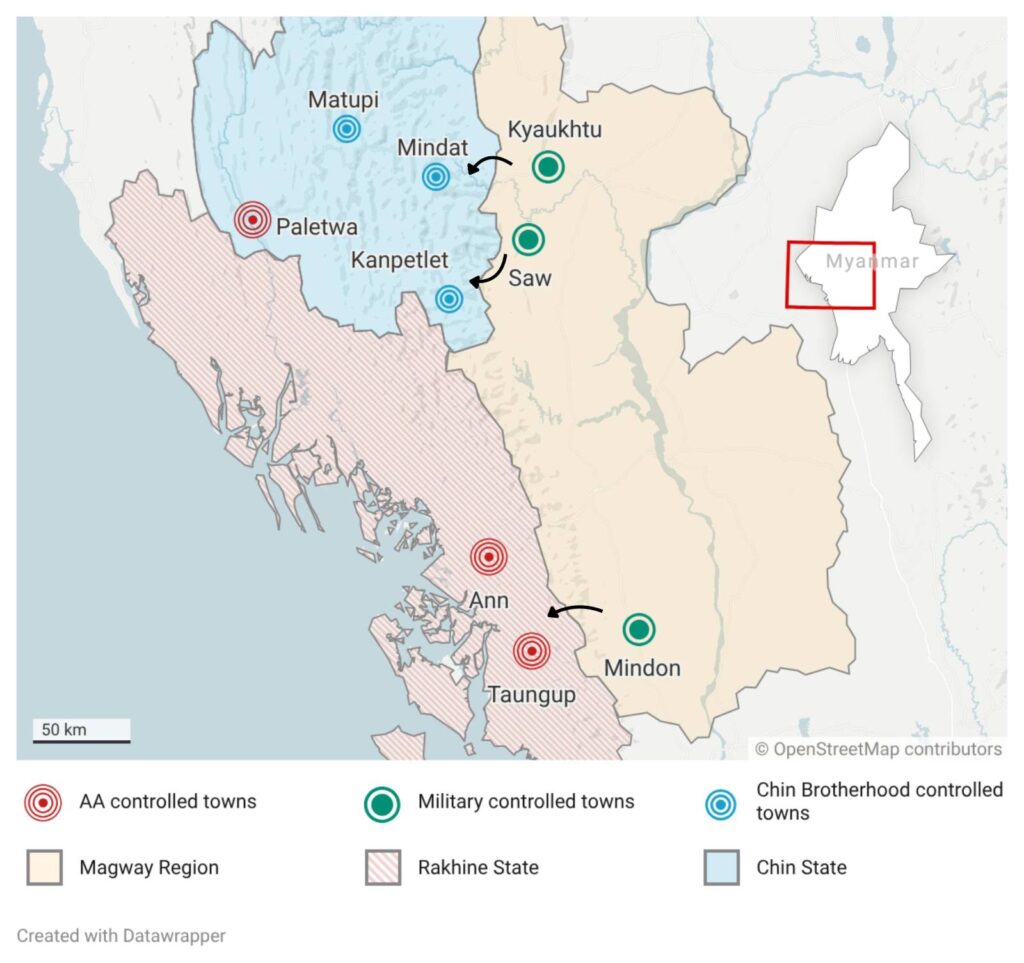
Most of southern Chin State remains under the control of the Chin Brotherhood Alliance, which holds Mindat, Matupi, and Kanpetlet townships and is allied with the Arakan Army (AA), which controls nearby Paletwa Township—a vital gateway into northern Rakhine.
For the junta, these areas represent more than isolated resistance enclaves. Together, they form an important corridor linking Chin and Rakhine states, facilitating the movement of fighters, supplies and humanitarian aid. Analysts believe disrupting that corridor may be the primary objective behind the current military build-up.
“If they manage to capture Mindat, Matupi, and Paletwa in southern Chin, they could more easily control Rakhine,” Zin Yaw said. “That is why, during the pre-monsoon and monsoon periods, they appear to be planning to cut off the Mindat and Matupi areas to block the flow of food, weapons, and medicine.”
Massive movement of troops
This has been particularly visible in Saw Township, a strategic gateway between Magway Region and southern Chin State. The township is connected to resistance-held areas through two main routes—one through the town of Saw and another through Kyaukhtu, a smaller town about 25 miles to the north. Both have become increasingly important as other transport corridors have been disrupted by conflict.
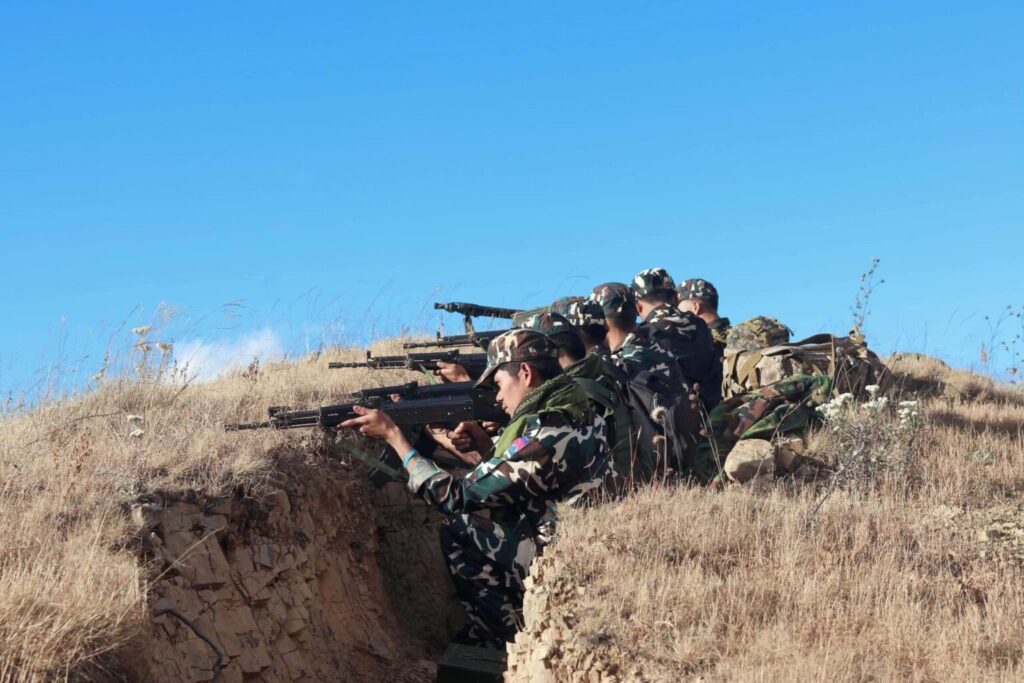
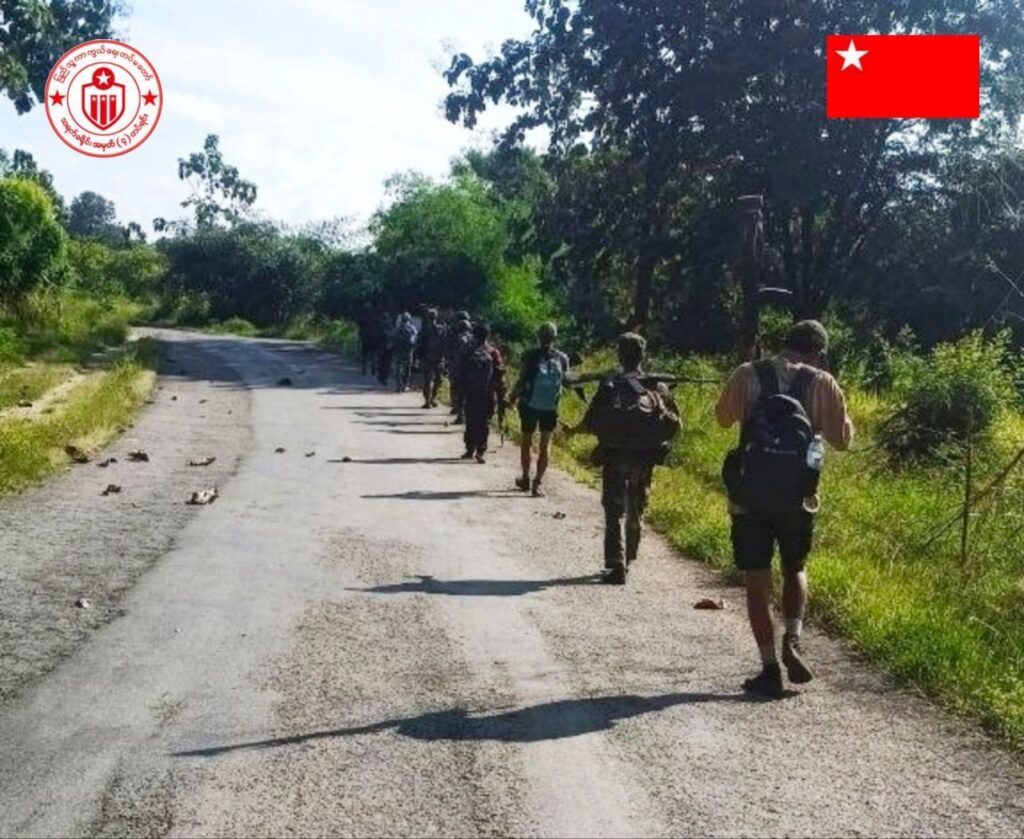
Resistance groups report that the junta has sent multiple reinforcements into the area, including columns numbering in the hundreds and, in some cases, more than a thousand troops. Fighting has intensified around villages and transport routes that are critical to communications between Magway, Chin, and Rakhine.
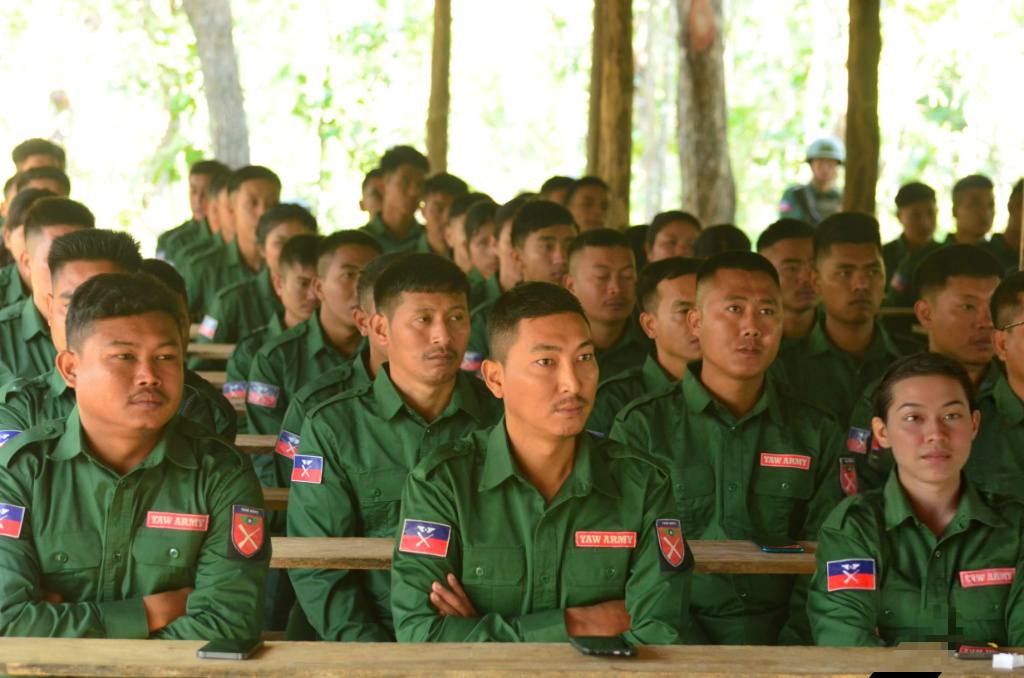
The Yaw Army, one of the resistance groups operating in the region, said clashes involving a large junta force in the Pone Taung Nat Htiek area of the Yaw region, in northern Magway, continued for more than two weeks. According to the group, junta forces suffered heavy casualties and resistance fighters seized prisoners, weapons, and ammunition.
Local residents have also reported the destruction of villages and repeated airstrikes in contested areas, highlighting the increasingly destructive nature of the campaign.
At the same time, another front is emerging further south in Mindon Township, which borders the Rakhine Yoma and provides access to AA-controlled territory in Rakhine State. Resistance groups say the military has reinforced the area with more than a thousand troops drawn from infantry battalions, regional commands, and militia units.
While the junta has previously conducted smaller clearance operations in the area, observers say the scale of the current deployment is unprecedented.
“The incoming force is exceptionally large,” said Ko Myat, information officer for a People’s Defence Force battalion in Magway’s Thayet District. “This is the first time during the revolutionary period that we have faced a troop deployment of this scale. Given the current overall situation of the revolution and the fact that this is along the Rakhine border, I see it as an operation aimed mainly at putting pressure on the Rakhine side.”
Economic pressure point
The strategic importance of the area extends beyond military considerations. On the western side of the Rakhine Yoma lie Taungup and Ann townships, which serve as important links between Rakhine and central Myanmar. Any disruption to these routes could further isolate Rakhine State, which is already experiencing severe economic pressure due to blockades and conflict.
Residents in Rakhine report that supplies from mainland Myanmar have dwindled sharply, contributing to rising prices and worsening living conditions. While imports from Bangladesh and India have helped prevent shortages from becoming critical, many fear that further military pressure on transport routes could deepen the crisis.
“Goods from mainland Myanmar are no longer entering at all, so commodity prices are rising day by day,” one resident said. “With imports from the Bamar region cut off, cash circulation has also declined.”
The military’s western campaign also intersects with broader geopolitical considerations. During his recent visit to India, junta leader Min Aung Hlaing pledged to advance major infrastructure projects, including the Kaladan Multi-Modal Transit Transport Project and the India-Myanmar-Thailand Trilateral Highway. Both projects are strategically important to New Delhi but pass through areas where the junta lacks effective control.
The Kaladan project, in particular, depends on a transport corridor linking the port city of Sittwe with Paletwa in Chin State. The AA currently controls much of that corridor, raising questions about how the project can move forward without major changes on the ground.
Some observers believe the military may view renewed offensives in Chin and Rakhine states as a means of strengthening its position around these strategic infrastructure routes.
Salai Dokhar, founder of the advocacy group India for Myanmar, warned that agreements reached during the junta leader’s visit could have military implications.
“In practical terms, there is little that the junta and Min Aung Hlaing can immediately implement with New Delhi,” he said. “Still, I believe they may use these agreements as a pretext to launch offensives.”
Similarly, Chin National Front spokesperson Salai Htet Ni said growing engagement between India and the junta could increase pressure on resistance groups operating in western Myanmar.
Laying the groundwork
Taken together, the developments suggest that the junta is pursuing a multi-layered strategy that combines military pressure, territorial consolidation, and diplomatic engagement. By securing northern Chin, reinforcing key gateways in Magway, and targeting supply corridors into Rakhine, the military appears to be laying the groundwork for a broader campaign aimed at reversing some of its most serious battlefield setbacks.
Whether those efforts will succeed remains uncertain. Resistance groups continue to hold large swaths of territory, and military analysts note that any advance into southern Chin or deeper into Rakhine would likely encounter fierce opposition from both the Chin Brotherhood and AA forces.
Still, the concentration of forces in Magway represents one of the clearest signs yet that western Myanmar is emerging as a decisive theatre in the country’s civil war. As the rainy season progresses, the battle for control of key transport corridors may prove just as important as frontline clashes in determining the trajectory of the conflict in the months ahead.