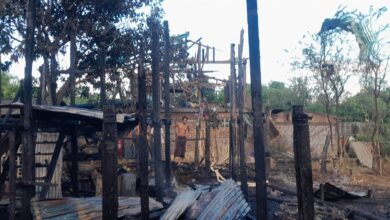
The Myanmar air force has been bombing Sagaing Region’s Tigyaing Township for three consecutive days, killing more than a dozen people including five monks and injuring more, according to resistance and local sources. The airstrikes argeted monasteries, hospitals, and shelters for the displaced in villages outside Tigyaing where there had been no recent battles on the ground. They resulted in 10 deaths in Zee Kone village—some three miles northeast of Tigyaing on the north bank of the Ayeyarwady River—and three among the displaced people temporarily staying near Ni Tar village, around four miles south of Zee Kone on the opposite bank. A junta warplane reportedly dropped two bombs on the Zee Kone monastery compound at around 1pm on Tuesday, damaging buildings on the premises as well as neighbouring houses. At least 10 people sustained injuries in addition to the 10 who were killed, according to a local volunteer assisting the victims. The bodies of a monk and novice killed in the Zee Kone airstrike (Photo: Supplied) The deceased in Zee Kone included two monks, three novices, and four other civilians who died instantly, as well as an eight-year-old girl who died from her injuries while in transit to a medical facility, he added. “The bomb was extremely powerful,” the volunteer said. “The monastery was severely damaged, and the ordination hall completely collapsed. Even though it was solidly built, the structure was practically destroyed. The bomb made a direct hit right in the centre of the compound, where the ordination hall was standing in front of the monastery.” A statement from the Tigyaing Township People’s Administration Team confirmed that the March 10 airstrike had destroyed houses near the compound as well as the monastery and ordination hall. Another air raid occurred the previous evening between Ni Tar and Mya Taung villages—on the south bank of the Ayeyarwady opposite Zee Kone—killing three civilians sheltering in makeshift huts assembled to house the displaced. An aid volunteer said the airstrike near Ni Tar had killed two men in their 40s and one woman as well as injuring others. Three more people were injured in another bombing raid the same day in Sat Sar village south of Mya Taung, and two more were injured in yet another airstrike on the village of Ah Lel Taw north of Tigyaing. Residents of the township said that the hospital serving the area has been closed since the 2021 military coup. Zee Kone villagers walk amid the debris left by the junta’s March 10 airstrike (Photo: Supplied) Sharing borders with Shan State and Mandalay Region, Sagaing Region’s Tigyaing Township functions as an important transit hub, with land and water routes connecting to Kachin State in the north—still a major front in Myanmar’s civil war. Resistance forces attempted to capture Tigyaing in late 2023 but aerial bombing ultimately forced to withdraw after temporarily seizing the junta’s outposts in and near the town. Territory in the township remains divided between junta and resistance forces, according to local residents, and fighting has devastated the area to the degree that tens of thousands of civilians displaced from their homes by the conflict have been unable to return. Regime forces are also positioned to advance and consolidate their control over Tigyaing Township after recapturing the resistance-held town of Tagaung, Mandalay Region some 30 miles downstream on the Ayeyarwady earlier this week. “The junta column moving from Thabeikkyin in Mandalay Region just entered Tagaung Town,” said a Tigyaing township resident helping administer aid to the injured. “As it approaches Tigyaing, they have started airstrikes to intimidate the public.” Six people were also reportedly injured, one critically, in Homalin Township, Sagaing Region around 120 miles northwest of Tigyaing on Tuesday in an airstrike targeting a village near a gold mine. The Myanmar military has been engaged in a multifront counteroffensive to regain control of territory lost to resistance forces throughout the country, supporting advances by ground troops with airstrikes. The aerial bombing is generally indiscriminate, frequently hitting civilian targets like schools, hospitals, monasteries, and churches. According to resistance forces, strikes on civilian targets are likely a deliberate strategy to instill terror among the civilian populace and enable the military to exert control more easily in recently recaptured territory.