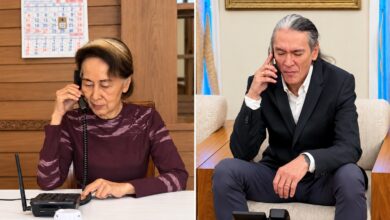
Despite being in the bloodline of Myanmar’s most prominent political family, Kim Aris, Aung San Suu Kyi’s youngest son, has always taken care to avoid the public eye.
However, since his mother was locked up by the same military generals she had served alongside in Myanmar’s parliament, Aris, 47 and born in Britain, has uncharacteristically entered the spotlight.
Driven by a moral obligation to speak out for his mother, and the people of Myanmar at large, Aris urges the world not to forget.
Before interviewing Aris, I had been told that he is wary of the media—he is unsure whom to trust—and I understand why.
The international media became more critical of his mother during her time in government, as she was widely accused of complicity in response to military-led atrocities against the Rohingya population.
By defending Myanmar against genocide charges at the International Court of Justice (ICJ), Aung San Suu Kyi marred her archetypal image as a Nobel Peace Prize-winning heroine in the eyes of the international community.
Aris sees the media’s shift in sentiment towards his mother as contributing to a vacuum of international attention not just on her current imprisonment, but also in response to the ongoing horrors unfolding in Myanmar as a whole.
“Her situation reflects what’s going on in the rest of Burma, the fact that it’s in full-blown civil war. It’s in the worst situation that I’ve seen during my lifetime,” he says, using the older name for Myanmar.
“There’s very little coverage of what’s happening there now, so I feel I need to speak out.”
Without a central character like his mother, the story of Myanmar may be less comprehensible to the rest of the world. This lack of attention has real consequences; with international interest more elusive, political support and much needed aid is scarcer too.
Aris’s decision to step forward stems from the need to remedy this neglect. Despite his wariness, he is using himself as a medium to try to get the world to listen again, and perhaps to think differently about his mother too. His determination is reminiscent of hers.
“Did your mum ever want you to play a role in politics?” I ask.
“Quite the opposite. I think she would rather I stayed out of it,” he replies. “And if I possibly can, I will.”
Contact since the coup
Aris, a carpenter by trade, has the air of a dignified bohemian, which seems distinctly British. His long hair and tattoos suggest an alternative lifestyle, while his angular cheekbones, poise, and eloquent accent reveal his lineage.
We speak over Zoom, with a painting of his mother hanging behind him. Aris uses the affectionate Burmese term “May May” to refer to his mother throughout our conversation.
In the portrait Aung San Suu Kyi is gorgeous. Captured in her 20s, she has a sweeping black ponytail and sits in a long fuchsia skirt with her knees bent demurely beneath her.
The portrait was painted by Aris’s paternal grandmother Josette Aris Vaillancourt, the mother of Aung San Suu Kyi’s late husband Michael Aris.
After exchanging thoughts on Oxford in autumn, the city where Aris grew up and where both of his parents attended university, we turn to the interview.
First, we go over the facts that Aris doesn’t know: his mother’s exact whereabouts and current health condition. Her military captors are tight-lipped with information.
What we do know is that Aung San Suu Kyi is being held in solitary confinement in a Naypyitaw prison; rumours about her being moved to house arrest are unreliable. She is struggling with dental problems and severe osteoporosis. In a Myanmar prison these ailments are no joke.
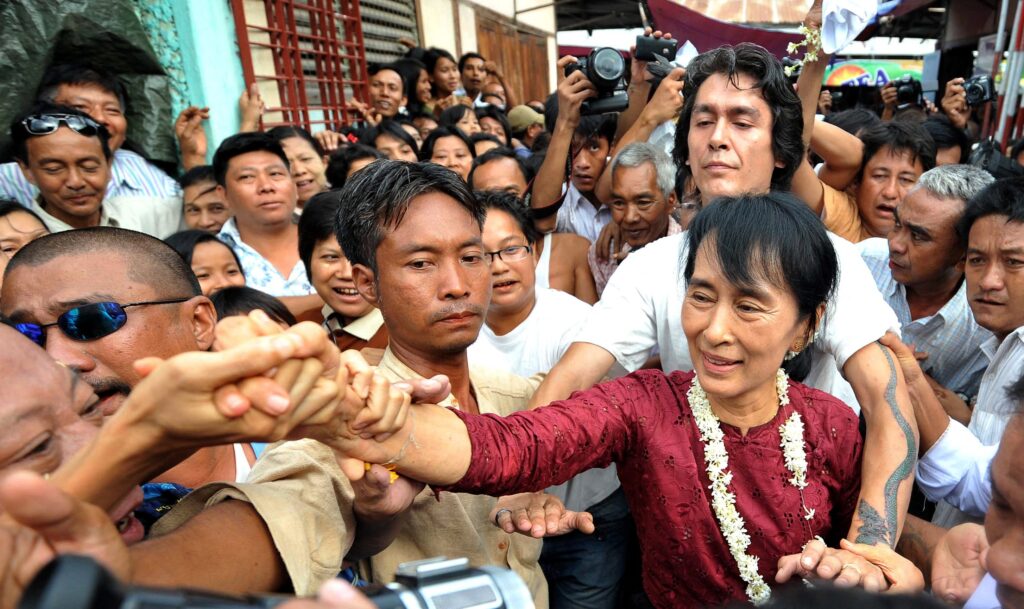
“Since the coup, basically, I’ve had next to no contact with my mother whatsoever. I’ve had one letter from her in all this time, and I’ve been able to get one care package [through] that I know she’s received,” he says.
The last time the two spoke was a brief phone call in January 2021, shortly before the coup; she warned him that “something was imminent.” Aris points out that as phone calls between him and his mother were likely listened to, what they were able to share was limited.
The little contact that Aris has had with his mother since then has been facilitated through the official channels of the British Foreign Office and the International Red Cross.
“Unfortunately, I’ve had very little luck through any of those channels,” he says.
“I do hear things, but it’s very hard to verify anything. Nobody has seen her for almost two years now. I believe [it’s been two years] since her legal team were last allowed to see her.
“When she was under house arrest for the best part of 15 years, I at least had some communication with her during that time, we could send regular care packages, and at points we were even allowed to visit her,” Aris adds.
He fears that his mother, who turns 80 next year, may meet the same fate as countless other political prisoners in Myanmar and die in jail.
“Over the last three and a half, [or] four years, out of 20,000 political prisoners, 2,000 have died,” Aris says, “so I do worry about the conditions she’s being held in and her general health.”
“She’s being kept in what I understand to be a pretty much bare concrete cell with no air conditioning in the heat in Naypyitaw. That could kill anybody.”
Aris sighs as I ask him when he last saw his mother, a detail that he struggles to pinpoint. “Now that’s going back a little way,” he says, “I think it was almost seven years ago.”
“She has been very busy,” he adds, with a slight smile, “[I’ve seen her] when she’s been free.”
Delving deeper
I am interested in understanding more about the relationship between mother and son.
I ask about Aris’s upbringing and get some glimpses of life in Oxford, where his mother studied Philosophy, Politics and Economics, a degree that is a rite of passage for many UK politicians. In the “city of spires” his mother met and married his father Michael Aris, a historian and Tibetologist.
Aung San Suu Kyi left her young family for Myanmar in 1988, aged 42, to take care of her sick mother Daw Khin Kyi, Myanmar’s former ambassador to India and wife of independence leader General Aung San.
When she was in Myanmar, the country was undergoing mass political upheaval as people took to the streets to protest the military dictatorship of Ne Win. Aung San Suu Kyi took up the political mantle, founding the National League for Democracy the same year, which led to her first arrest by the military regime in 1989.
From that time, the mother and son’s relationship has been defined by separation.
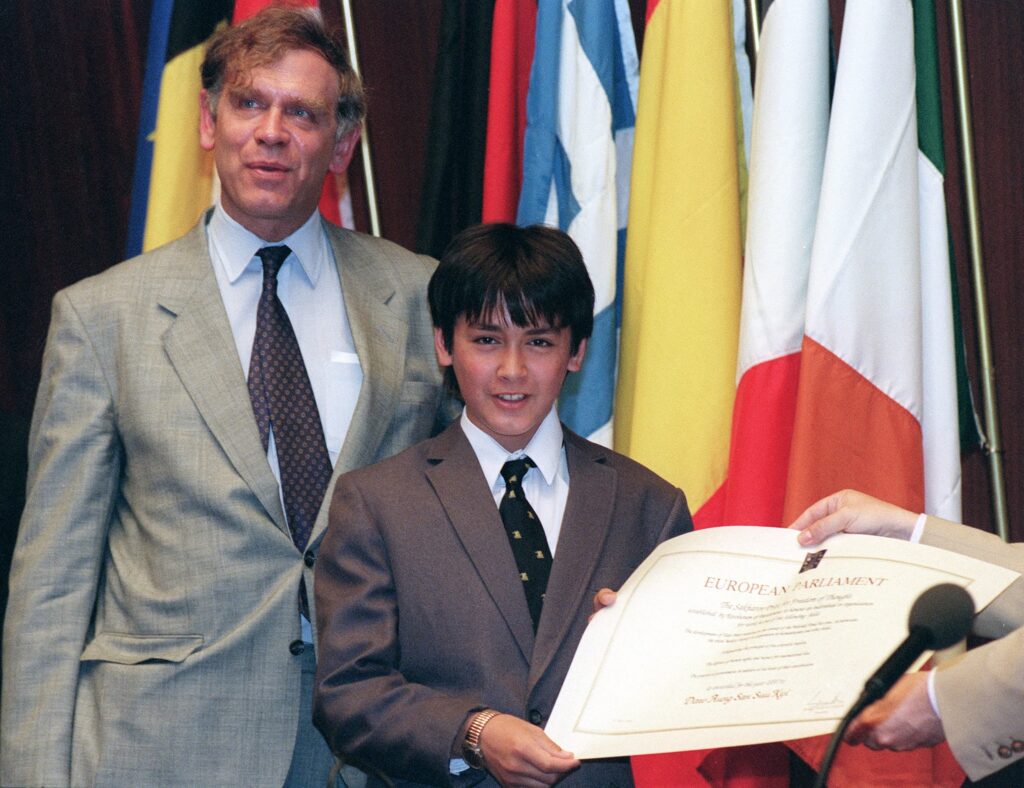
In this context, the questions I have prepared feel probing: “How do you think your mother leaving when you were 11 impacted you and your life trajectory after that?”
“I couldn’t really say,” Aris responds, struggling to put into words how his mother’s departure shaped him. “I am sure it would have had an effect on me.”
“If she was there to help with my upbringing, perhaps I would have done better academically, because having only my father to encourage me… I wasn’t the best student anyway. My mother was quite disciplined, so that would have made a difference,” he says.
I understand the difficulty in articulating the impact of such an absence.
Aris recalls some memories of his childhood, including a Buddhist novitiation ceremony at age 10, where he shaved his head and spent ten days in a Myanmar monastery.
He remembers Burmese dishes, including his personal favourite, pork in black bean sauce, being served at home, and the presence of Burmese relatives who stayed with the family in Oxford at various times.
Aris says that some of his fondest memories are from when his mother was placed under house arrest when he was 12.
“I was with her when she was first under house arrest, it’s one of the few times I’ve had her to myself for some time,” he adds.
A few months later, his father came to Myanmar and brought Aris back to the UK.
“Since then, there haven’t been that many occasions when we’ve had time just to ourselves. There’s always been people around, generally speaking,” he continues.
“It’s one of the burdens you have to bear when you’re in the public eye all the time.”
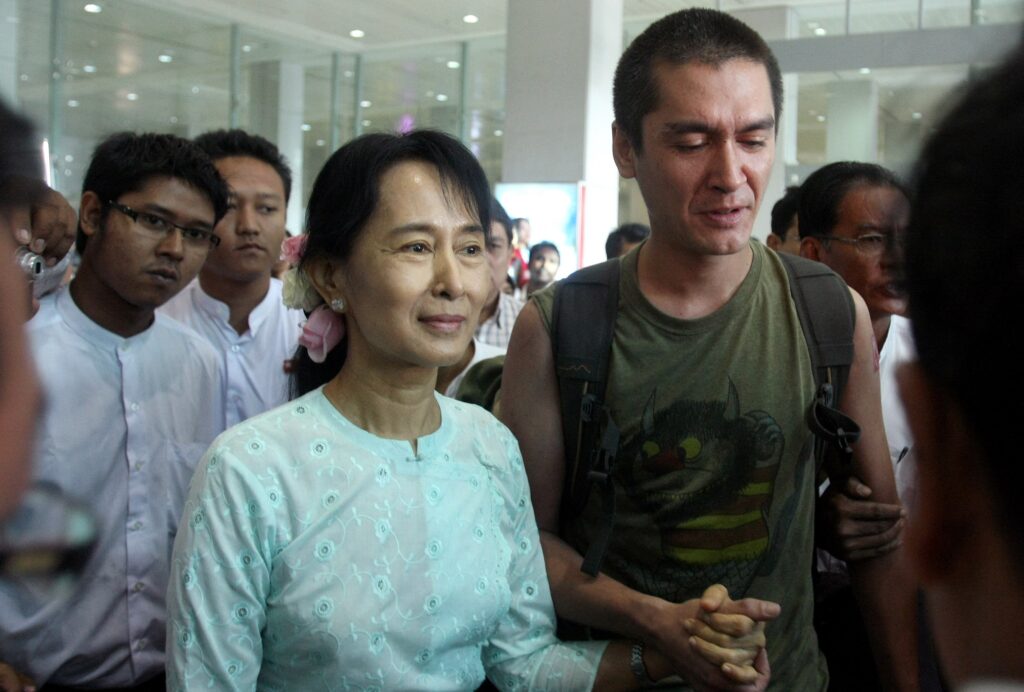
Almost 20 years later, Aris was able to spend some time with his mother during the brief period after her release in 2010.
Emotive images captured their reunion at Yangon airport, showing mother and son arm in arm amongst the crowd. “We’d been waiting for it for many years at that point,” Aris says.
“[It was] before everything got too crazy, though as soon as she was free, her life was very busy,” he adds.
I ask Aris how his mother has influenced him as a person, if he can see her in himself: “I think that she’s always brought me up to respect the rule of law,” he answers.“Even though Burma has no law of its own really, at the moment. She feels like if the government’s doing its job properly and everybody’s happy with the legal system, then we need to follow the rule of law, and that’s what makes people safe in a society.”
However, he continues, “You still need to question the authority behind it, she’s made that very clear over the years.”
His mother also instilled in him an appreciation for other cultures, taking the family to live in Japan for a year when he was eight years old.
The following year, the family moved to India, where his father had a research fellowship in Shimla, the summer capital of British India in the Himalayan foothills.
Asked if he has spent much time in Myanmar visiting his mother, Aris replies, “I have, but not as much as I’d like to have been.”
“Obviously, I go when I know that I’ll have a chance of seeing May May, and that’s not always the case, because she’s off doing whatever she needs to do to try and lead the country,” he says.“I take any opportunity that I can. And when she comes over to Europe, I’ve been able to see her then as well.”
He reiterates that it would have been ideal to spend more time together during the years of her freedom since 2010. “But it was an improvement over the time that she was incarcerated in her own home in Rangoon for so many years.”
Aung San Suu Kyi and Myanmar’s future
In the throes of civil war, I ask Aris what he thinks his mother would make of Myanmar’s current situation.
“I think she’ll be very proud that the people of Burma are not accepting military rule, but at the same time, she’ll be incredibly sad to see how much violence and what state the country is in now,” he says.
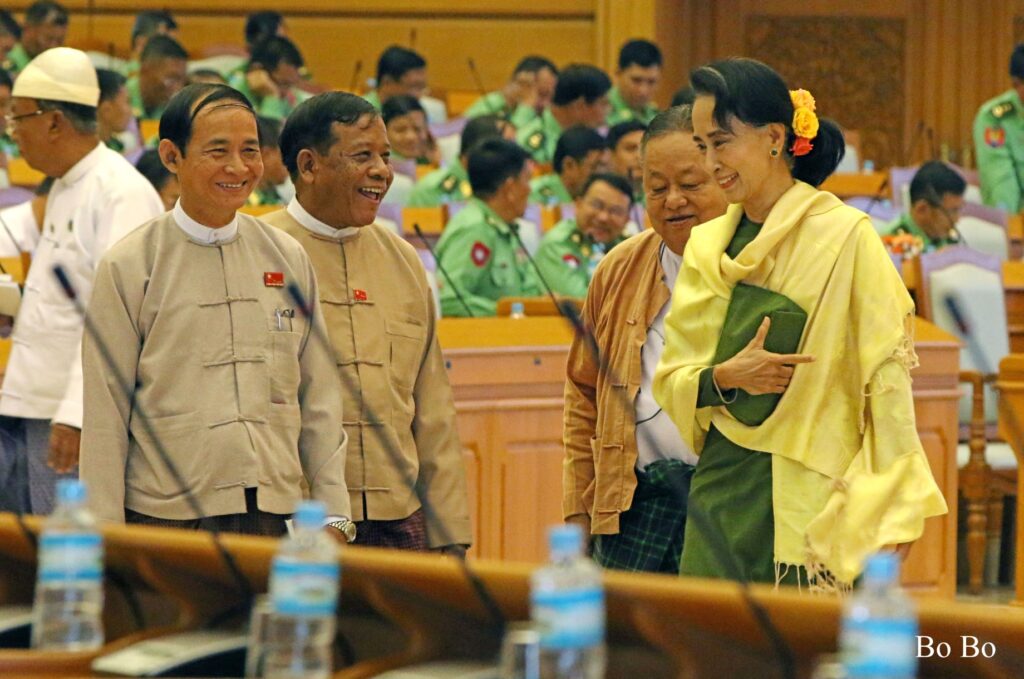
In terms of another leader stepping up, there are few obvious candidates to command the democratic movement with the same authority and influence as Aung San Suu Kyi.
Asked if she could make a comeback if released, Aris replies,“She’s spent pretty much a quarter of her life incarcerated for her peaceful pursuit of democracy in Burma, and I think she deserves a rest myself. But I know that she will want to do what she can to try and help still, whether that’s leading in politics or taking a back seat.”
He sees promise in the new generation.
“I think it’d be better if it wasn’t all put on one person’s shoulders like it has been with May May,” he says. “I think it’d be much better spread across a number of shoulders.”
Given the gains made by the resistance movement over the last six months, the collapse of military rule has become a tangible possibility for the first time.
Asked to comment on this, Aris points out that nearly 20 million people—approximately one third of the country—are in need of humanitarian aid. He also speaks of the obscene number of civilian casualties caused by the junta. He cites an increase of 160% in the number of people killed by airstrikes this year, while stressing the need to maintain hope.
“I would urge the people of Burma to stay strong and to know that they will see a bright future for Burma,” he says.
“You know, I find it hard with some of these questions, because I’m not really a spokesperson. I’m just saying what I feel.”
Aris has been personally involved in fundraising efforts, leading the “freedom tattoo campaign”, an initiative that encouraged people to get tattoos of a Burmese water dragon as a symbol of solidarity and to donate to humanitarian aid in Myanmar. The campaign has raised over £100,000 (US $127,000) since it began in October 2023.
Before we finish our conversation, Aris makes a point to bring up the subject of the Rohingya, a topic that many might expect him to avoid.
In August 2017, violent crackdowns led by the Myanmar military against the Rohingya community led to more than 700,000 people fleeing Rakhine State into neighbouring Bangladesh.
A 2018 United Nations fact-finding mission report documented military-led killings of thousands of Rohingya civilians, mass gang rape, and the burning of hundreds of villages, amongst other crimes. The report called for Myanmar’s top generals to be investigated and prosecuted for genocide in Rakhine State.
Aung San Suu Kyi was stripped of several prestigious human rights awards by organisations including Amnesty International for her “apparent indifference” to the atrocities against the Rohingya. Following her remarks defending the country against genocide allegations at the ICJ in 2019, criticism heightened further, with many citing her avoidance of the term “Rohingya” at the trial as indicative of her government’s lack of respect for Rohingya rights.
“I think had May May’s position not been undermined over the Rohingya crisis, the international community would not be ignoring what’s happening in Burma so much as they are now. She was completely misrepresented during that time; she was actually trying to do everything she could to help the situation,” he says.
“One other thing I’d like to say is, if people wanted to find out what May May was actually trying to do and what she was actually saying at the time of the Rohingya crisis, then they should read the book by Alan Clements and Fergus Harlow, which is called Voice of Hope. It goes through, in chronological order, everything that was said and done at the time,” he added.
Talking to Aung San Suu Kyi’s son brings home the human cost of dedicating oneself to public life and how family connections can be strained by larger political events. I hope they are able to see each other again.