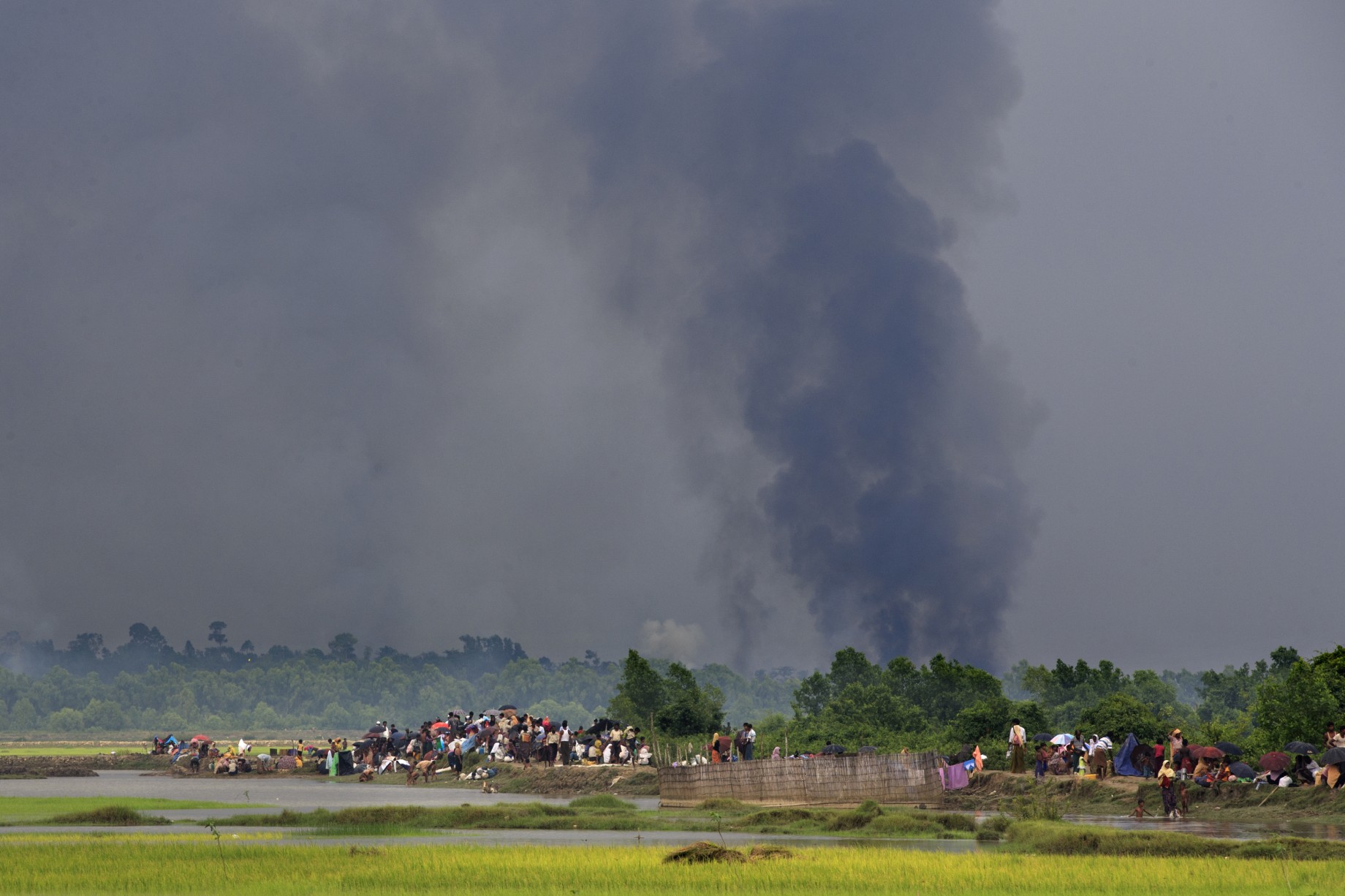
Rohingya people flee to Bangladesh during the military’s “clearance operations” in September 2017 (Photo: Yousuf Tushar / LightRocket via Getty Images)
The International Court of Justice (ICJ) on November 19 found Myanmar responsible for committing genocide against the ethnic Rohingya during the 2016-2017 “clearance operations” carried out by the country’s military. In the landmark ruling in the case brought by Gambia, the ICJ also found that Myanmar violated other obligations under the Convention on the Prevention and Punishment of the Crime of Genocide (Genocide Convention), including the obligations to punish those responsible for genocide and to prevent genocide. The court’s ruling is final and cannot be appealed.
Some governments have reacted swiftly. On November 23, the foreign ministers of Australia, Belgium, Canada, Cyprus, Czech Republic, Estonia, Iceland, Latvia, Luxembourg, New Zealand, Portugal, Spain, Gambia, and the United Kingdom issued a joint statement urging Myanmar to “comply fully with its obligations under international law, including the court’s decision.” On the same day, the UK placed additional targeted sanctions against Myanmar military leaders, while the European Union said “Myanmar must fully implement the ICJ’s ruling without delay.”
However, the Japanese government has remained silent. Sadly, this was not surprising, considering that Japan had previously taken a “wait and see” approach even after Myanmar’s security forces had committed massacres, rape, and arson against the Rohingya in northern Rakhine State in August 2017 that forced more than 700,000 people to flee to neighbouring Bangladesh.
Between 2017 to 2020, Japan abstained from all Myanmar-related resolutions at the United Nations General Assembly and the UN Human Rights Council, including a September 2018 resolution that welcomed a report by the UN Independent International Fact-Finding Mission on Myanmar. The mission found that the violence inflicted on the Rohingya by Myanmar’s military “rise[s] to the level of both war crimes and crimes against humanity.” The following month, the head of the fact-finding mission said the situation amounted to “an ongoing genocide.”
The same resolution, approved by 35 countries, also created the Independent Investigative Mechanism for Myanmar, which continued the mission’s work. Both bodies played crucial roles in the ICJ’s genocide ruling.
At the time, the Japanese government had instead expressed support for the Myanmar-led Independent Commission of Enquiry (ICOE), which included Japan’s former ambassador to the UN, Kenzo Oshima. The Myanmar government had set up similar commissions eight times since violence broke out in Rakhine State in 2012, and none of them had led to justice or accountability for rights abuses.
The latest commission was no different. In its ruling, the ICJ said that, “although the ICOE stated that it had investigated the presence of genocidal intent…Myanmar did not criminalise genocide in any form until 2021. …There was thus no offence of genocide under Myanmar’s domestic law for the ICOE to investigate. Moreover, there were no further investigations into the acts punishable under the Convention after that date.”
Separately, in October 2019, Japanese leaders including then-Prime Minister Shinzo Abe and Foreign Minister Toshimitsu Motegi welcomed Myanmar military’s commander-in-chief Senior General Min Aung Hlaing in Tokyo. By then, the fact-finding mission had already concluded that Min Aung Hlaing should be “investigated and prosecuted” for war crimes, crimes against humanity, and genocide against the Rohingya.
Two months later, Ichiro Maruyama, Japan’s ambassador to Myanmar at the time, reportedly told Myanmar media that Japan “fully” believes that “there is no genocide in Myanmar,” and he “prayed” and “hoped” that the “ICJ will not issue a ruling for provisional measures.” In January 2020, the ICJ ordered such measures against Myanmar.
Japan has also pursued its economic interests in Myanmar with little regard for the egregious human rights situation in the country. In February 2019, Japan and Myanmar co-hosted the Rakhine State Investment Fair, seeking to draw in foreign and national investors while overlooking the rights abuses and displacement of people in the state. Then-Ambassador Maruyama justified hosting the investment fair by claiming that “if there is economic development…there will be no conflict.” Other investment forums on Myanmar were also held in Japan that year.
Japan’s lukewarm approach has continued even after Myanmar’s military overthrew the democratically elected government led by Aung San Suu Kyi on February 1, 2021. While the Japanese government suspended new non-humanitarian aid, it is yet to formally suspend ongoing non-humanitarian aid, and it is the only Group of Seven nation that has not placed targeted sanctions against military leaders and military-owned conglomerates.
Most recently, Japan reportedly allowed US and Myanmar officials to hold talks in Tokyo, and Japan also reportedly urged the Financial Action Task Force to remove Myanmar from its blacklist to make it easier to invest. Japan’s Finance Ministry denied the latter report.
Japan’s approach toward Myanmar, as well as other countries in the region, is apparently motivated by competition with China over regional influence. The Japanese government believes that if it remains relatively reserved on calling out rights abuses by Myanmar, it will be able to maintain or improve bilateral relations with Myanmar, and at the minimum prevent further tilting of the junta leaders toward China.
Yet, such an approach has only emboldened Myanmar’s security forces to continue to commit war crimes and crimes against humanity throughout the country with impunity.
As a democracy that promotes the rule of law, Japan should urge Myanmar to fully comply with the ICJ’s unprecedented ruling, including ceasing its ongoing violations of the Genocide Convention and ensuring the safe and voluntary return of Rohingya refugees to Myanmar. Japan should also use its influence at the UN General Assembly to help adopt resolutions calling for compliance.
The Japanese government should also raise the pressure against the junta by imposing targeted sanctions against Myanmar’s military leaders and military-owned conglomerates, push for a global arms embargo, and formally suspend ongoing non-humanitarian aid.
Teppei Kasai is a senior program officer for the Asia Division at Human Rights Watch.