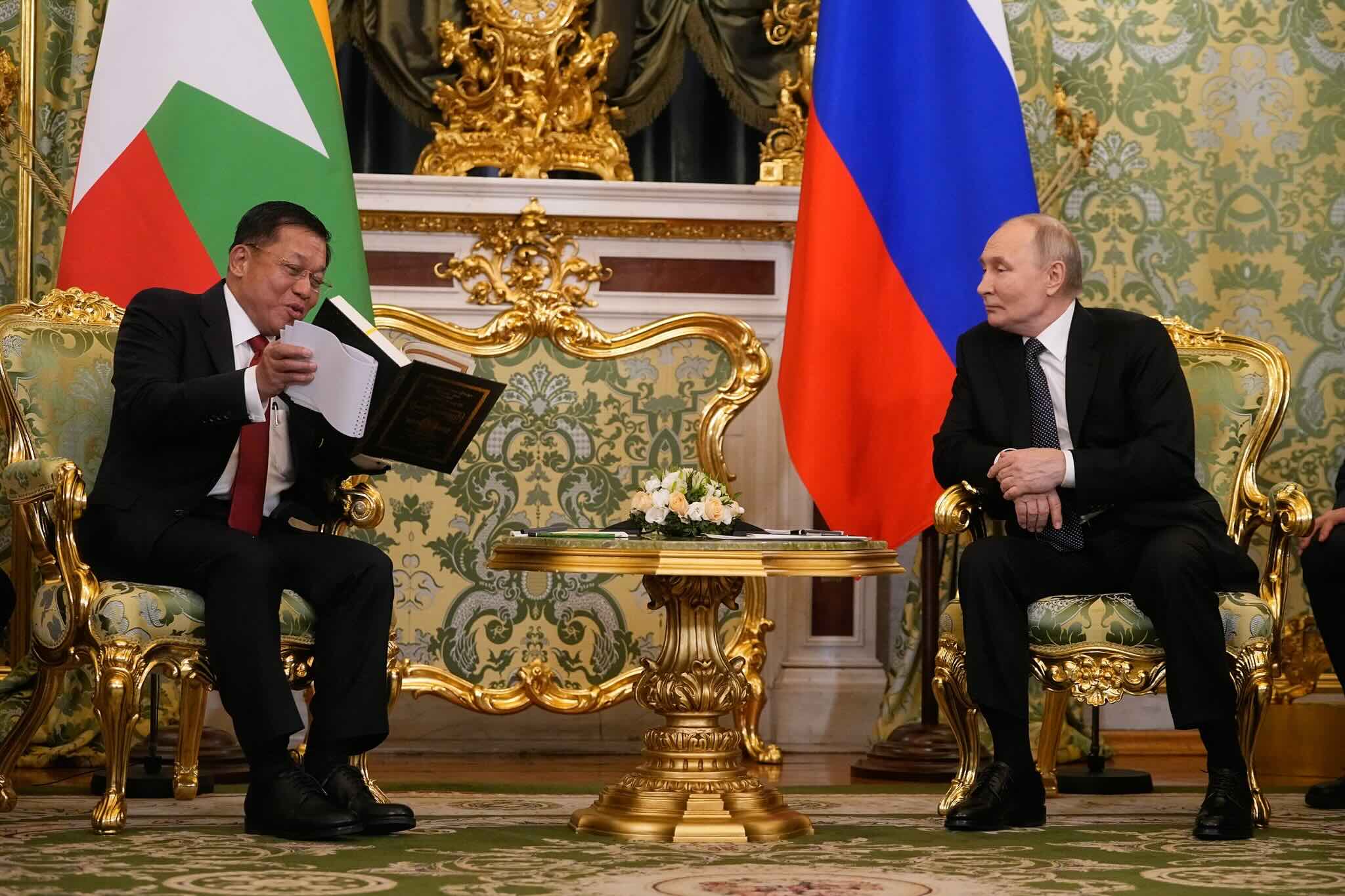
Regime leader Min Aung Hlaing departed Monday for Russia for talks with President Vladimir Putin, the regime said, the first visit to Moscow by the junta chief since he appointed himself president.
Russia was one of the few countries that backed the Myanmar military after its 2021 military coup that ousted the democratically elected government of Aung San Suu Kyi, triggering a civil war estimated to have killed more than 100,000 people.
Min Aung Hlaing was installed as president in April following military-managed elections dismissed as a sham by Western nations and democracy watchdogs.
The Russia trip aims to “further consolidate the longstanding friendly and close relations between Myanmar and Russia and to enhance strategic cooperation,” notably on security and the economy, the regime said in a statement.
The Myanmar military uses Russian-made jets against anti-junta armed groups and is also accused of targeting civilians, in attacks some conflict monitors say amount to war crimes.
The regime and Russia signed a five-year military cooperation pact in February, although details were scant.
Min Aung Hlaing, who is accompanied by other senior officials, flew out of Naypyitaw on Monday morning, his office said.
He will meet Russia’s prime minister, the speaker of the lower house of parliament, the State Duma, and attend a Myanmar-Russia economic forum.
Min Aung Hlaing has made several trips overseas since April, including to China, India, and neighbouring Thailand, as he seeks to bring his pariah state back into the international fold.
A decade of reporting at a cost
In 2025, we marked the 10th anniversary of Myanmar Now. In Myanmar’s history, journalists are often the first targets during political repression. We founded this outlet during a brief window of stability, starting with a small team in a modest office in downtown Yangon. Our goal was simple: to report on injustices that had been silenced for decades. In many countries, justice is sought through courts and police. In Myanmar, these institutions have historically been instruments of oppression.
From the start, we committed to reporting without discrimination—regardless of ethnicity, religion, or citizenship. We believe our work should be accurate, deeply sourced, and strong enough to serve as a historical record.
We also believe journalism should be a force for positive change, and that our primary readers should be the people of Myanmar.
That belief came at a cost. Members of our team and others associated with Myanmar Now have endured long legal battles, physical assaults, arrests, and torture. Despite these hardships, Myanmar Now continues to report the news—thanks to the resilience of our team, the courage of our sources, and the trust of our readers.
Please subscribe to support a free press in Myanmar.