The morning of August 21 began quietly at a monastery in central Myanmar, with more than 100 people gathered for meditation and Buddhist teachings as part of a five-day retreat.
The worshippers, known as yogis, had already completed two hour-long meditation sessions at Zetthavadi Monastery in Swe Le Oh, a village in Sagaing Region’s Myaung Township. It was an observance day during the annual rains retreat, a period when many Buddhists devote themselves to deepening their religious practice.
Then came the warning: A fighter jet had taken off from Tada-U Air Base near Mandalay.
At first, those gathered at the monastery did not believe they were in danger. It was a religious gathering, held at a meditation centre. There was no reason, they thought, for an aircraft to attack them.
Within minutes, that assumption proved tragically wrong.
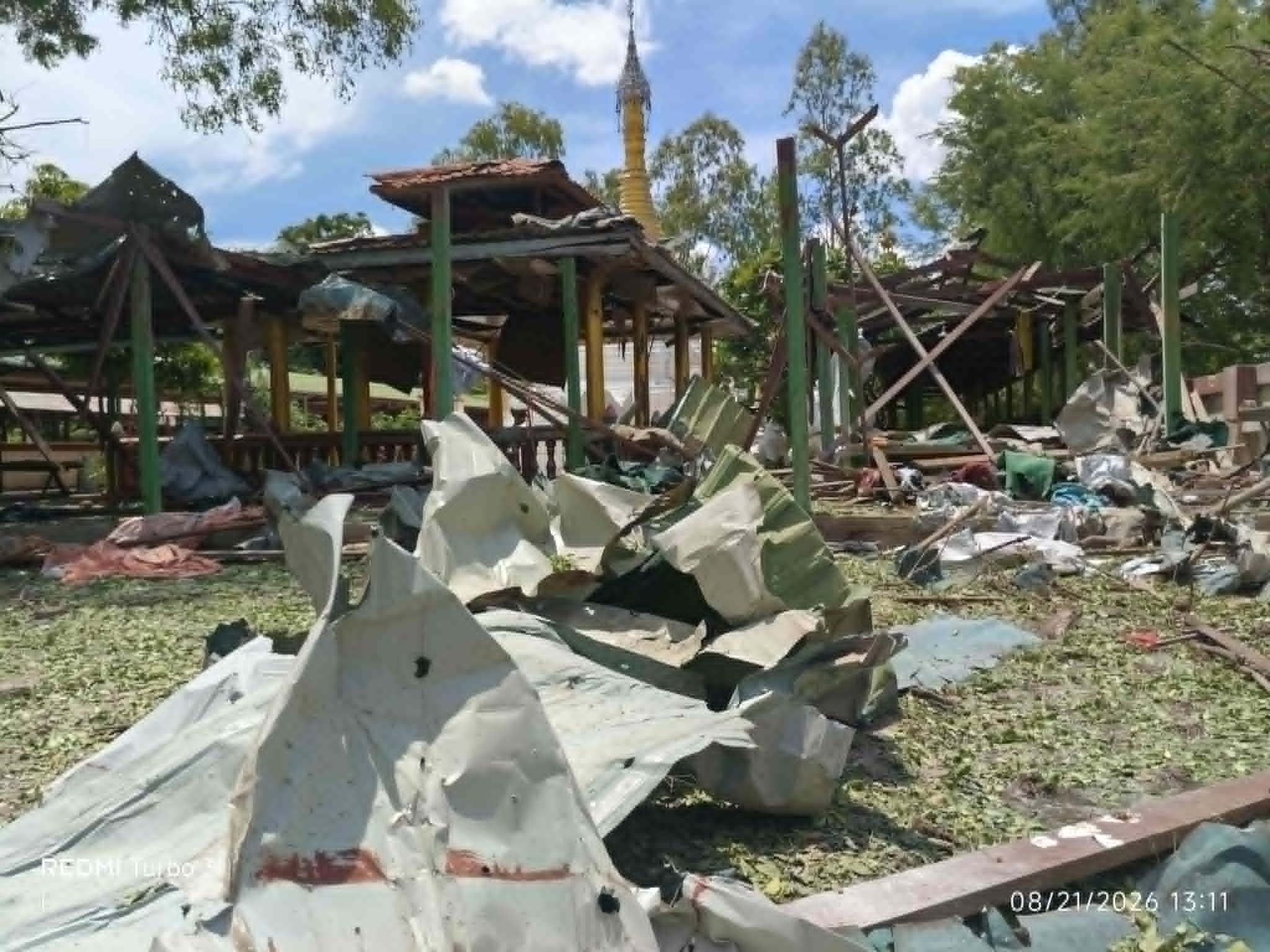
At about 9am, a low-flying aircraft crossed over Swe Le Oh and dropped bombs on the monastery compound at the eastern edge of the village.
Two bombs fell during the first pass. One exploded inside the monastery grounds near the quarters for male yogis. The other landed in an eastern farm field. The blast inside the monastery compound caused heavy casualties among the meditators, according to local residents and rescue workers.
About five minutes later, the aircraft returned. This time, it dropped explosives roughly 100 feet from the monastery, striking the village itself and killing several more people.
“We were helping out in the kitchen area, preparing meals for the yogis to offer to the monks,” a local man in his 30s said. “People started calling out that a jet was diving toward us.”
The villagers initially reassured one another that the aircraft probably would not attack.
“Right as we were standing there, it dropped the bombs,” the man said. “Thinking it wouldn’t hit our side and might be outside the compound, we were about to head toward the male yogis’ hall to help when the jet circled back and struck again.”
“A single aircraft carried out two bombing runs,” he said.
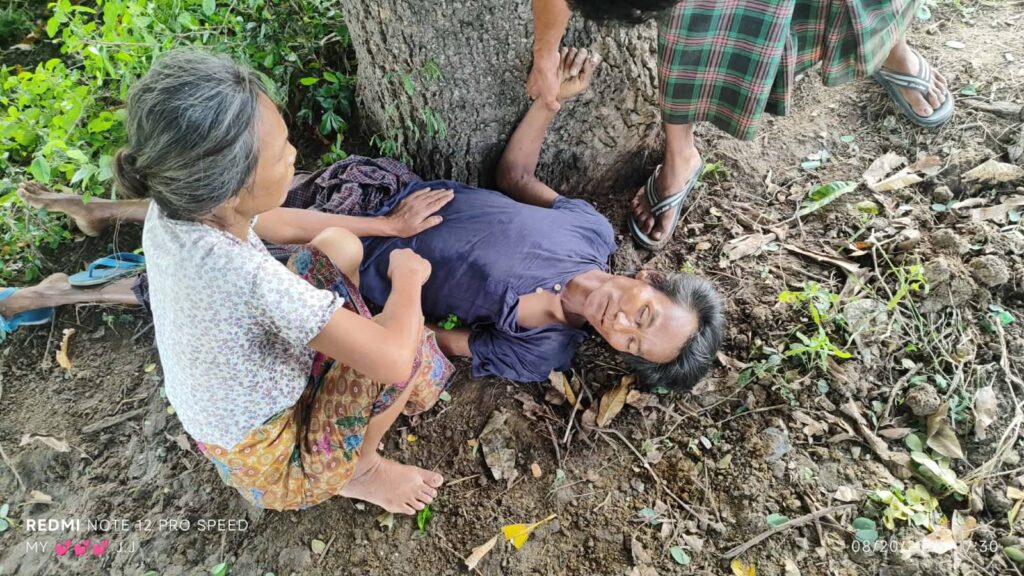
The airstrike killed 14 people that day, including nine yogis, and wounded more than two dozen others. A woman who was critically injured died two days later, on August 23, bringing the death toll to 15.
Residents said most of the victims were civilians from Swe Le Oh and surrounding villages, many between 50 and 70 years old.
Bloodshed at a Buddhist retreat
The attack turned the monastery into a scene of carnage and destruction. Video footage provided by residents shows buildings near the meditation area with roofs and pillars destroyed. Bloodstains are scattered across the grounds, while Buddha statues were damaged in the blast.
Some victims were identified at the scene. Others could only be identified later, after the relatives of people taking part in the retreat were contacted, according to a local resident.
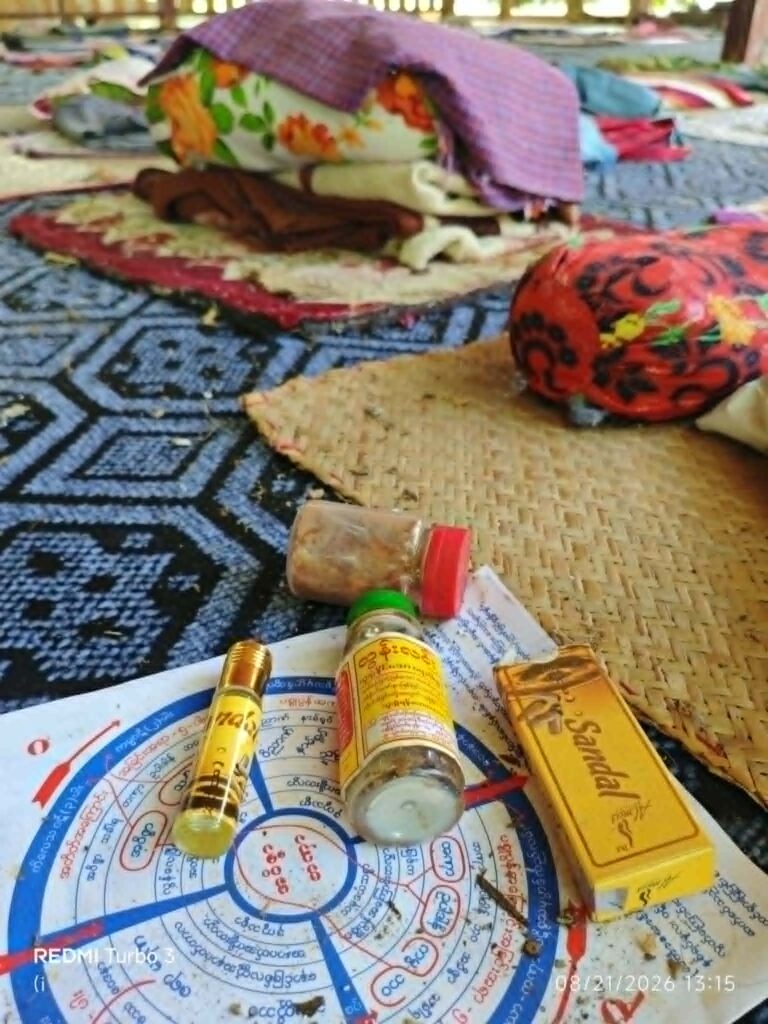
The injured were treated in areas controlled by resistance forces. Some were taken home by relatives for further care. At least four of the more than two dozen wounded people required amputations, residents said.
Myaung Township lies at the southern end of Sagaing Region, near the confluence of the Irrawaddy and Chindwin rivers and about 138 miles west of Mandalay.
The township sits in an area where Sagaing, Mandalay, and Magway regions meet. Most of its rural areas are controlled by resistance forces, while the junta’s control is largely limited to the town of Myaung and Kyauk Yit, a village that hosts a military base.
Swe Le Oh lies along the Myaung-Parimma road, south of Myaung. Residents say the village has been under resistance control since 2022.
For years, its monastery had hosted an annual meditation retreat.
Starting in 2015, the tradition was suspended in 2019 amid the COVID-19 pandemic, but was revived by residents last year.
The latest retreat began on August 20, drawing about 110 yogis from around the area.
“This retreat wasn’t organised by any armed group. It has been led by local religious youth groups since the beginning,” a male resident said.
Residents and local resistance groups rejected claims from pro-military Telegram channels that the monastery had been attacked because resistance fighters were using the meditation hall and collecting ransom money.
Nway Oo, spokesperson for the Myaung-based Civilian Defence and Security Organisation Myaung, said there were no People’s Defence Force (PDF) fighters present at the monastery.
“Not a single PDF member was among the casualties, nor were any PDFs staying there,” he told Myanmar Now. “It was not a PDF camp.”
Retaliation from the air
The bombing came days after resistance fighters assassinated a junta military commander who was getting a haircut at a salon near the military base in Myaung.
The August 17 killing was followed by a series of airstrikes on villages along the Myaung-Parimma road, residents said.
On August 19, two days before the monastery attack, six bombs struck Hlay Tin Oo, another village south of Myaung, killing two civilians and wounding 16 others, according to residents. The Swe Le Oh strike was just the latest and deadliest in a series of attacks in the area.
“If they target the groups or individuals responsible for attacking them, we consider that standard conduct between enemies and expect it, so we wouldn’t criticise that heavily,” Nway Oo said. “But targeting places populated strictly by civilians like this is simply inhumane.”
Myanmar Now attempted to contact Maj.-Gen. San Nyo Win, head of the military’s information unit, and Aung Zaw Oo, the junta-appointed minister of planning, economy, and finance for Sagaing Region, for comment. Neither responded.
Nay Phone Latt, spokesperson for the National Unity Government (NUG), also did not respond to requests for comment.
The military has increasingly relied on air power as fighting has spread across the country since the February 2021 coup.
According to data released by the NUG, military airstrikes across Myanmar killed more than 5,000 civilians and wounded more than 10,000 in the more than five years after the coup through the end of July.
The NUG says the attacks have also destroyed hundreds of civilian sites, including more than 780 religious buildings, 500 schools, and 100 hospitals and clinics.
A report by the United Nations Independent International Fact-Finding Mission on Myanmar identified Russia and China as the junta’s primary suppliers of fighter aircraft and military equipment, with India also providing aviation-related military supplies.
The attacks have intensified amid the military’s efforts to consolidate control through elections that began late last year, according to opponents of the junta and rights groups.
Like the dozens killed in Sagaing’s Chaung-U Township during a candlelight procession held to mark another major Buddhist holiday late last year, the victims of this latest attack did not imagine that they would ever become the targets of a deadly assault by a regime that professes to be a defender of their ancient faith.
They had gathered to meditate, listen to Buddhist teachings, and observe the rains retreat. Instead, within minutes, the peace they strove to bring into the world was shattered, as the monastery became just another site of a mass-casualty airstrike by a brutal regime.