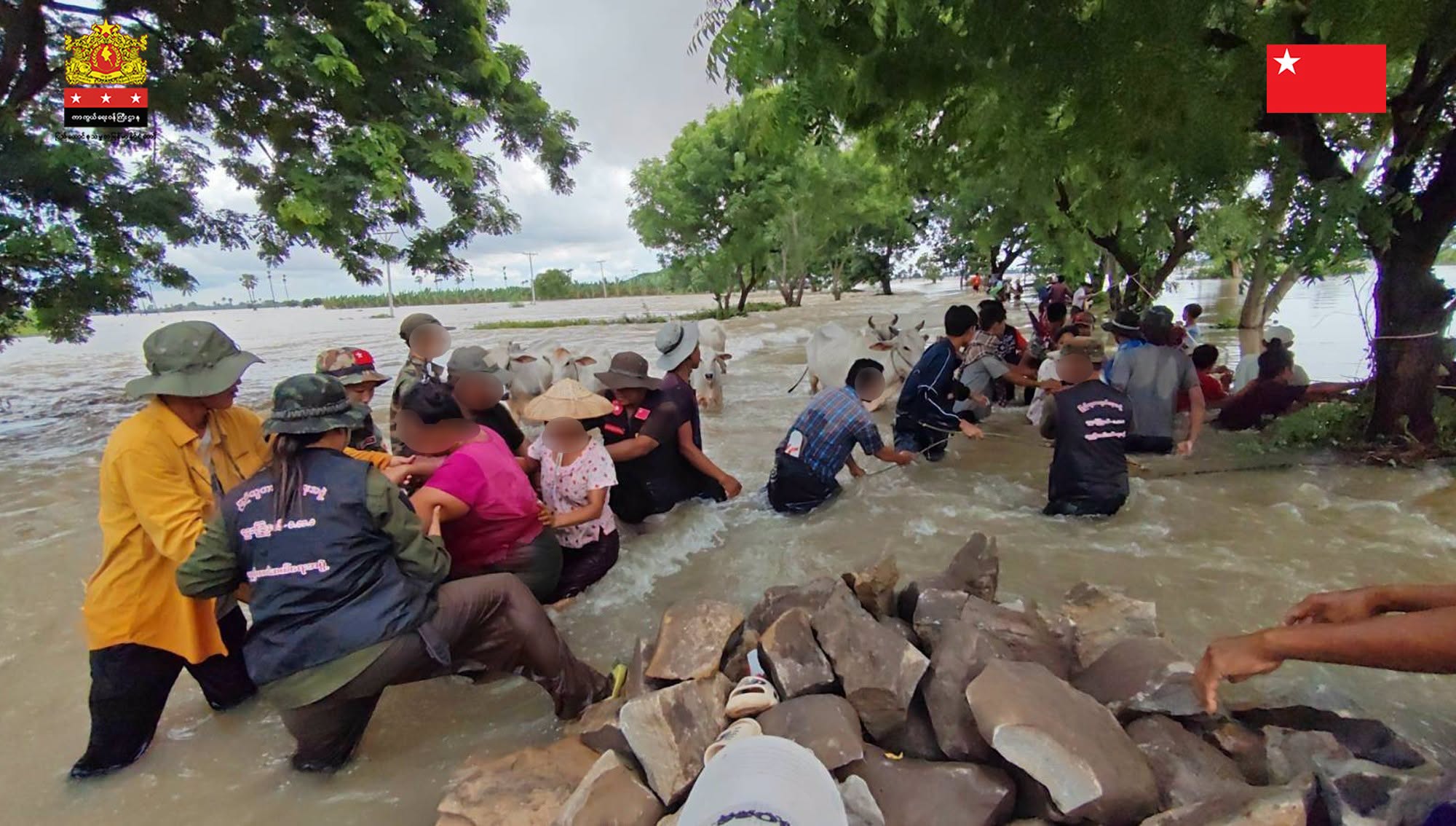
Flooding has killed at least 16 people and affected more than 400,000 across 15 townships in Sagaing, Mandalay, Magway, and Ayeyarwady regions since late last week, forcing many already displaced by conflict to flee again amid rising water levels, according to the National Unity Government (NUG).
The worst-hit areas have been along the Mu River in Sagaing’s Taze, Ye-U, Khin-U, and Depayin townships, where tens of thousands of people have sought higher ground and emergency supplies are in short supply, the NUG’s Ministry of Social, Labour and Humanitarian Affairs said in a statement on Sunday.
The crisis in these areas intensified after water levels at the Thaphanseik Dam in Kyunhla Township approached capacity. The dam, which supplies irrigation water to several townships in central Sagaing, reached 543.75 feet on August 6, just below its 545-foot full-capacity level, according to local authorities.
On the same day, 10 female agricultural workers returning from transplanting work in the village of Chaungyoe in Depayin Township were swept away by suddenly rising creek waters. Only four survived, according to residents and a statement from the Depayin Township People’s Administration Organisation (PAO).
Five bodies were recovered that day and a sixth was found the following morning, residents said.
A resident of the area noted that the sudden surge in water levels came completely without warning: “Thaphanseik Dam is very far from here—three townships away—so it was impossible to know when the water would arrive.”
The resident said continuous rainfall had also caused rain-fed creeks to swell rapidly.
The NUG, which administers many of the affected areas, has reported a total of 16 deaths related to the flooding, with most being in Sagaing, including seven in Depayin Township, three in Kawlin, and one in Khin-U. At least two others have been reported missing in Kawlin Township.
According to the NUG, flooding has devastated at least 40,000 acres of agricultural land in Sagaing and Ayeyarwady regions, raising concerns about how local farmers will recover from the loss of their crops.
Forced to flee again
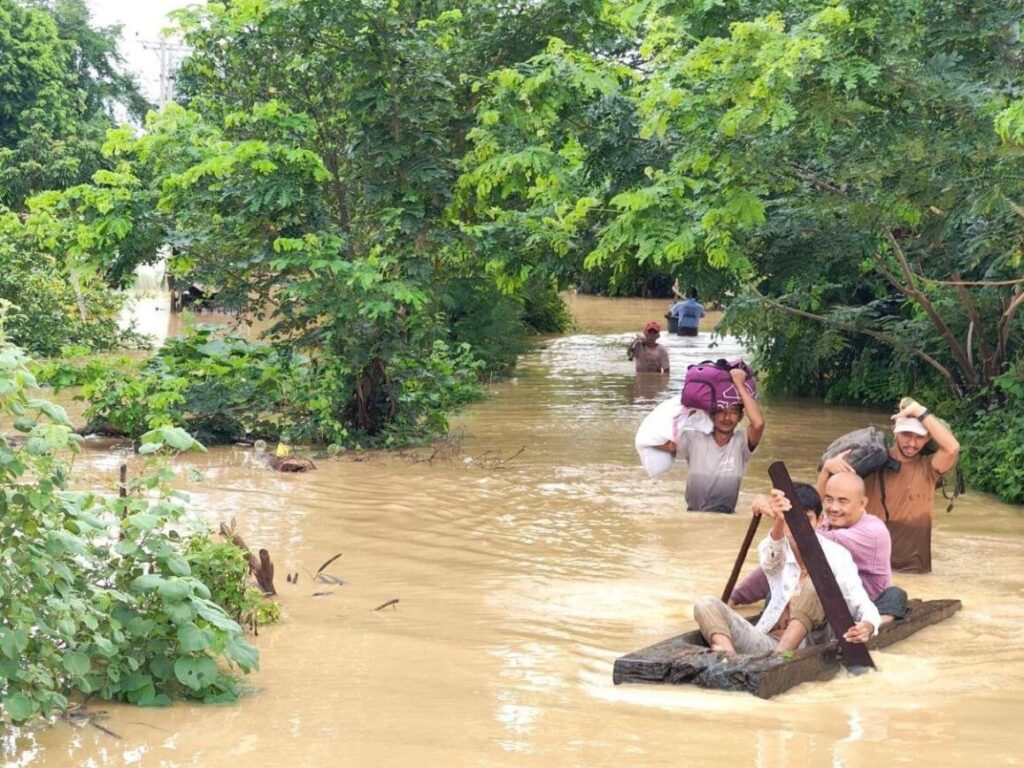
At least 100 villages in Kawlin Township and another 30 in neighbouring Wuntho Township have been affected by the flooding, according to Myo Zaw Aung, head of the Kawlin District PAO, noting that the impact has been greatest among those already forced to flee fighting in other areas.
“Mainly, the displaced people are suffering. Most of them were already just living day-to-day,” he said. “Now that it’s flooded, day labourers are facing extreme difficulties.”
In Khin-U Township, water began entering villages along the Mu River at about 1am on August 7. Residents said more than a dozen villages were affected, with floodwaters reaching waist height in some areas and submerging machinery and other equipment that could not be moved.
Residents have fled from villages including Uyin, Kyuntawgyi, Yartaw, Magyioke, Thayetpinsu, Karseik, Myindaung, Innpat, Ywathit, Mutha, Thetpay, Zeetaw, Letpankwet, and Tartaing.
In Taze Township, a bridge over Paungkadaung creek was damaged and floodwaters overflowed sections of the Mu River embankment. More than a dozen villages have reported worsening conditions.
In Ye-U Township, residents from more than 50 villages have fled to safer locations, according to local sources.
An official with the Ye-U Township People’s Defence Organisation said the flooding was caused by a combination of heavy upstream rainfall, efforts to lower water levels at Thaphanseik Dam, and breaches in upstream embankments in Taze.
The official said water levels began rising significantly around August 5 and warned that conditions could worsen if heavy rain continues in upstream areas including Kawlin, Wuntho, and Pinlebu townships.
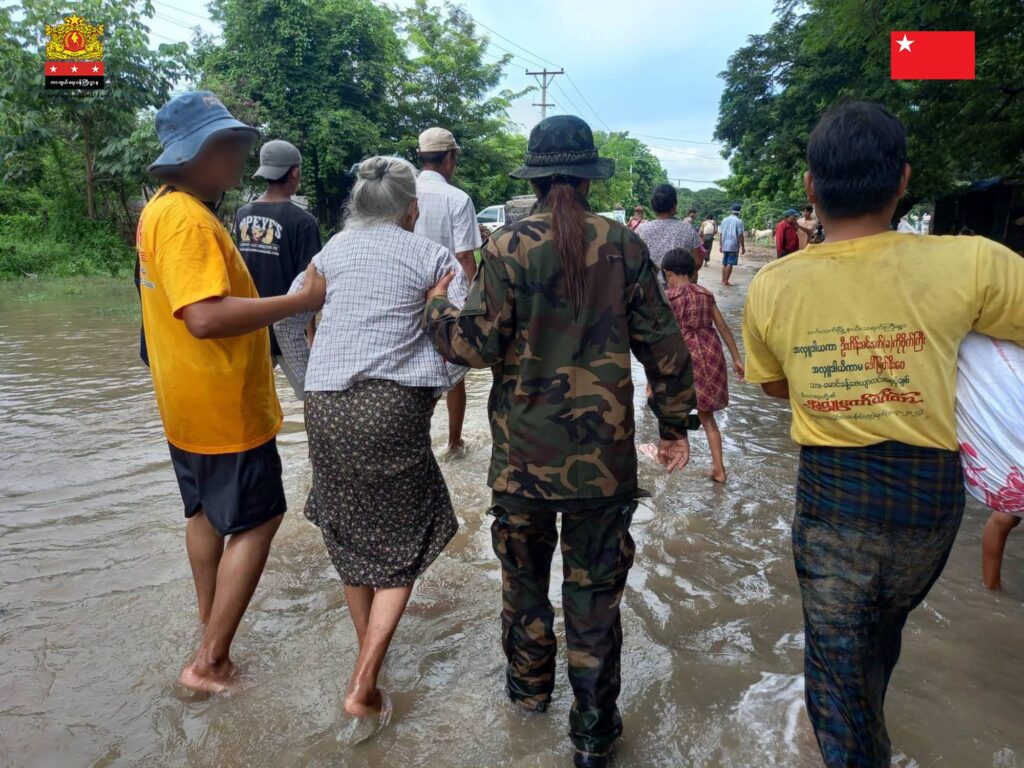
Local relief groups say they are struggling to obtain food, medicine, clothing, and other basic supplies. Rescue workers also say motorboats are urgently needed to reach submerged villages.
Toe Wai Aung, minister for humanitarian assistance, rehabilitation, and emergency management of the Sagaing Federal Unit under the NUG, said heavy rainfall and the opening of floodgates after water levels exceeded critical marks at Thaphanseik, Kintat, and Karboe dams had affected more than 75,000 people in over 150 villages across nine townships.
He said rescue boats, tarpaulins, food and medical supplies were among the most urgent needs, particularly for children and elderly residents.
Junta attacks
Flood victims are also facing continued violence. While western Khin-U was dealing with rising floodwaters on August 7, sources said air attacks by Myanmar’s military using suicide drones struck the eastern side of the township. A resistance member said livestock were harmed and there had been no fighting in the area.
Around 11:30pm August 6, an airstrike hit a school in Kanhpyu, a village in Wetlet Township, destroying two school buildings and three houses and killing 13 cattle, according to local sources.
The flooding has also damaged infrastructure. A local relief organisation, the S&C Fire, War and Education Support Group, said rising Mu River waters had affected about 12,000 households in roughly 30 villages in Depayin, Shwebo, Ye-U and Taze townships.
Some floodwaters have begun receding in parts of Khin-U and Depayin townships, but local sources said water levels were still rising in other villages.
To address the ongoing crisis, the NUG and Sagaing Federal Unit Interim Government formed a Joint Emergency Response Committee on August 9 to coordinate assistance.
Because many of the worst-hit areas are controlled or contested by resistance forces, local groups have largely been relying on their own resources for rescue and relief operations.