Myanmar’s military-backed election—held without the participation of major opposition parties—began on Sunday morning, with reports from Yangon, Mandalay, and Naypyitaw indicating sparse voter turnout, administrative irregularities, and an overwhelming security presence at polling stations.
Junta chief Min Aung Hlaing—who seized power in February 2021 and later appointed himself “acting president”—is widely expected to be installed as president by a military-dominated, rubber-stamp parliament formed after the election.
Speaking to the media after casting his vote at a polling station in Naypyitaw early Sunday, the military strongman, dressed in civilian clothes, said his future role would be decided by parliament.
He also insisted that the elections would be “free and fair,” despite being run by the same regime that overturned the results of the last election in 2020.
“We guarantee it to be a free and fair election,” he told reporters after casting his ballot. “It’s organised by the military, so we can’t let our name be tarnished.”

Sparse turnout
In downtown Yangon, most voters seen at polling stations early in the day were family members of civil servants working under the military administration, according to local residents.
In Naypyitaw’s Pyinmana and Zabuthiri townships, only a few people were seen lining up as polls opened at 6am. Some polling stations were reportedly not fully prepared at opening time, residents told Myanmar Now.
At one polling station in Zabuthiri Township, ballot boxes were only brought in by local administrative officials after voters had already arrived, eyewitnesses said.
Several voters there encountered problems with voter lists, including missing names, incorrect voter numbers, and the need to recheck registration details on the morning of the vote.
“There was no one to help even when the voter numbers didn’t match,” a resident of Zabuthiri Township said.
Across at least eight polling stations in Pyinmana and Zabuthiri, residents reported seeing only between 20 and 50 people waiting to vote at each location.
A man from Zabuthiri Township who cast his ballot said some voters did not bring identification cards, and that voting proceeded quickly due to the low turnout, with no long waiting times.
Residents also said government departments arranged overnight ferry transport for earthquake-affected civil servants, enabling hundreds of staff members to vote.
“In Pyinmana, there were very few people—extremely few,” said a man who visited both townships. “But at polling stations near government staff housing, hundreds were lining up.”
Security was visibly tight at polling stations, with more than 10 personnel deployed at some locations, including police, plainclothes administrative officials, and armed members of the junta-backed Pyu Saw Htee militia.

In Naypyitaw’s Zeyathiri Township, where the military’s central headquarters is located, security was particularly strict, with army and police vehicles patrolling the area, residents said.
At some polling stations in Pyinmana and Zabuthiri, voters were reportedly prohibited from bringing mobile phones or taking photographs.
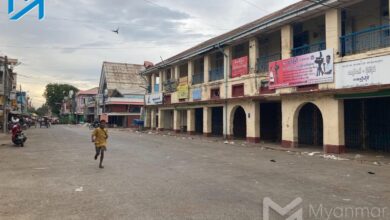
Security seemed to be especially tight in Myanmar’s second most populous city, Mandalay, where arrests have intensified in recent months.
In the city’s Aungmyaythazan and Chanayethazan townships, roads leading to polling stations were blocked from more than 200 metres away, with soldiers stationed at checkpoints, residents said. Voters were reportedly required to surrender their mobile phones to soldiers before being allowed to enter polling stations.
Plainclothes armed Pyu Saw Htee militia members, police officers, and soldiers were also deployed near voting sites, according to a local resident.
“Even before dawn, anyone who came out was told to turn back unless they were going to vote,” he said. “All the shops along the streets were ordered to close.”
Parties handpicked to serve the regime
The junta has permitted only six political parties—including the military-backed Union Solidarity and Development Party (USDP)—to contest the election nationwide. The parties are widely seen as aligned with, or dependent on, the military and expected to deliver a prearranged result.
They include the USDP, the National Unity Party (NUP), the People’s Pioneer Party, the People’s Party, the Myanmar Farmers Development Party, and the Shan and Ethnic Democratic Party.
While the USDP is led by former senior army officers, the NUP traces its roots to the former military dictatorship of Ne Win. The remaining parties function largely as proxies of or maintain close ties to the armed forces.

The People’s Pioneer Party is led by Thet Thet Khine, who served as a cabinet minister under the junta after the 2021 coup. Ko Ko Gyi, leader of the People’s Party, has repeatedly criticised the armed resistance movement and argued for a dominant role for the military in Myanmar’s political system.

Only these six parties are allowed to contest constituencies for the Union parliament, which has the authority to form a government. The remaining 51 registered parties are restricted to competing at the state and regional level.
The junta has announced that voting will be held in three phases, beginning on December 28 in 102 townships. A second phase is scheduled for January 11 in 100 townships, followed by a third phase two weeks later.
No real rivals
After overturning the results of the widely accepted 2020 general election, the military systematically dismantled the country’s major opposition parties ahead of its own poll.
More than 40 opposition parties—including the National League for Democracy (NLD) and the Shan Nationalities League for Democracy—were dissolved in 2023 for failing to re-register under restrictive new rules. Even parties that attempted to comply, such as the Arakan National Party and the Zomi Democratic Party, were rejected.
In the 2020 election, the NLD won 920 parliamentary seats nationwide, while the USDP secured just 71. The military justified its coup by alleging widespread voter fraud—claims that were repeatedly rejected by domestic and international observers.

The junta has claimed that international observers are monitoring the vote. According to state media, election observer delegations have been sent by China, India, Belarus, Russia, Laos, Cambodia and Kyrgyzstan.
The military has cited the presence of these delegations as evidence of the election’s credibility. However, the United Nations, Western governments, and independent observers have rejected the process, noting that the vote excludes major opposition parties and is taking place amid widespread conflict, repression and displacement.
Aung Kyi Nyunt, a senior NLD official, told Myanmar Now that the election serves no other purpose than to justify continued military rule.
“The election has no legal basis,” he said. “It is being staged to satisfy some foreign countries that want to see an appearance of legitimacy for the military’s continued hold on power.”
In a statement this week, UN High Commissioner for Human Rights Volker Türk warned that the military-controlled ballot is unfolding amid intensified violence, intimidation, and arbitrary arrests, leaving no space for free or meaningful participation.
“These elections are clearly taking place in an environment of violence and repression,” Türk said.
“There are no conditions for the exercise of the rights of freedom of expression, association or peaceful assembly.”
Related story: