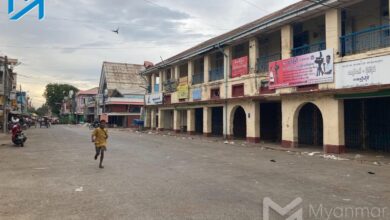
Less than a week ahead of elections scheduled for this Sunday, residents of the Sagaing Region capital of Monywa showed little interest in voting and the town was noticeably bare of campaign posters and billboards.
The first round of the planned three-phased election will take place on December 28 in 102 of Myanmar’s 330 townships including Monywa, and locals who spoke to Myanmar predicted a low turnout.
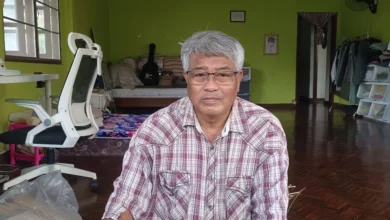
Monywa’s residents generally still regard the military regime that seized power in February 2021 with fear or bitter discontent and are uninterested in participating in the regime-organised election, a local university lecturer said on Thursday.
“The public has received no information whatsoever about the elections. Why? Because who’s going to take the lead? Not to mention in villages, even in town, those who could lead don’t dare to do so,” the lecturer said.
“They’re holding the elections under high security, that’s true, but they can’t provide security for these people for their entire lives,” the lecturer continued, referring to people the regime had tasked with implementing preparations for the vote. “Right now, no one even knows where the polling stations are located.”
He confirmed that even in Monywa’s urban centre, there are few campaign billboards to be seen.
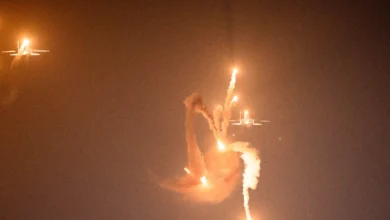
Residents said the junta has continued to escalate its military operations—such as the airstrike that hit Wetlet Township this week—and abuse civilians in Sagaing Region even while making a show of campaigning in some towns.
Candidates from the military’s proxy Union Solidarity and Development Party (USDP) are campaigning with heavy security in the town of Sagaing, which lies on the bank of the Ayeyarwady River opposite Mandalay.
Locals said that, among all the parties fielding candidates in the election, only the USDP campaign has any real visibility, including in videos of party activities posted on Facebook.
USDP candidates held a public meeting on Tuesday at the 700th Anniversary Stadium in Sagaing’s Parami Ward, mobilising people to attend via the ward’s administrators, who allegedly promised entertainment, 10,000 kyat in cash, and motorcycle fuel money to anyone who came, a vendor in Sagaing said.
“I didn’t go. I heard people talking while selling at the market. They gave money, gave shirts and such,” she said, referring to USDP campaigners. “Now those who went and listened didn’t dare to talk about taking any money for it.”
The USDP held a rally at which one of its candidates for the people’s assembly of Sagaing Township—retired Lieutenant General Thet Pone—and the party’s vice-chair Hla Tun appeared.

Thet Pone, who was a notorious major participant in the 2021 military coup that led to the brutal killing of protesters and touched off Myanmar’s ongoing civil war, is now urging people to participate in the electoral process.
“Everyone over 18 years old should vote as responsible citizens,” he said.
The first phase of the planned three-stage election is scheduled for Sunday and will include 12 of Sagaing Region’s 37 townships, namely Sagaing, Monywa, Shwebo, Kale, Tamu, Katha, Kanbalu, Hkamti, Homalin and the three Naga townships: Leshi, Lahe, and Nanyun.
In Monywa Township, which is home to the military’s Northwestern Regional Command as well as Sagaing Region’s administrative seat, only two of 54 rural village tracts will have the capacity to hold elections. Even in the city itself, recent skirmishes and shootouts have broken out between resistance forces and junta troops, according to locals.
Recalling a recent clash in Monywa’s Leti Ward, a resident said, “This election is really going to be a fraudulent election.”

The People’s Defence Organisation—armed resistance fighters under the command of the publicly mandated National Unity Government (NUG)—arranged on December 15 to put up anti-election banners and pass out leaflets in the towns of Shwebo and Monywa, both of which are controlled by the junta.
Despite the risk of a crackdown by junta authorities, armed and uniformed resistance members appeared on the streets themselves to put up the posters.
Resistance forces throughout the country have urged the public not to participate in the junta-organised elections, declaring an election boycott during the weeks of preparation and campaigning between October 28 and December 31.
The challenges for holding elections are likely to be even greater elsewhere in Sagaing Region, where the military’s hold is more tenuous than in major towns like Monya, Sagaing, and Shwebo.
“In Kalay, people are saying there are no polling stations yet,” said a resident of Kalay, located at the region’s northwestern border with Chin State. “But the USDP passed out leaflets for about half an hour in front of the airport store near their office.”
Similarly, authorities have yet to notify residents where their polling places are in Tamu Township, also located on the Chin State border, a problem complicated further by recent bomb blasts near the USDP headquarters and town gates.
The competing candidates seem reluctant even to state their names in public, a Tamu resident said.
“There was an explosion on December 18. The townspeople still don’t know themselves where the polling stations will be,” he said.
Soe Win Swe, a member of the Federation of the Sagaing Forum, which coordinates activities among the region’s resistance groups, predicted that few polling stations would be ready by election day.
“Even in places where they say they can hold [elections], are they really certain they can actually hold them?” he said. “Even the places they’re saying they can, they will have only the semblance of an election.”
The regime announced earlier this month that voting would not be held in more than 2,900 wards and village tracts across the 202 townships scheduled for the first and second phases of the election. These included unsecured wards and village tracts in the junta’s administrative capital, Naypyitaw, and the country’s economic hub, Yangon.
Most jurisdictions excluded from the election, however, are in Sagaing Region, a relative stronghold of the anti-junta resistance. The total number of excluded ward- and village tract-level territories excluded in Sagaing Region is 847, spread across 20 of the region’s 37 townships.
The junta has permitted 57 parties to participate in the elections. Six of these are competing throughout the country, with the rest fielding candidates only in specific state, regional, or local elections.
The parties competing countrywide are the USDP, National Unity Party, People’s Pioneer Party, Myanmar Farmers Development Party, Shan Nationalities Democratic Party (also called the White Tiger Party), and the People’s Party.
The regime’s military operations have escalated in the run-up to the first phase of the vote. The military conducted 184 airstrikes in November, killing at least 130 civilians and injuring 262, according to data collected by the NUG’s human rights ministry.