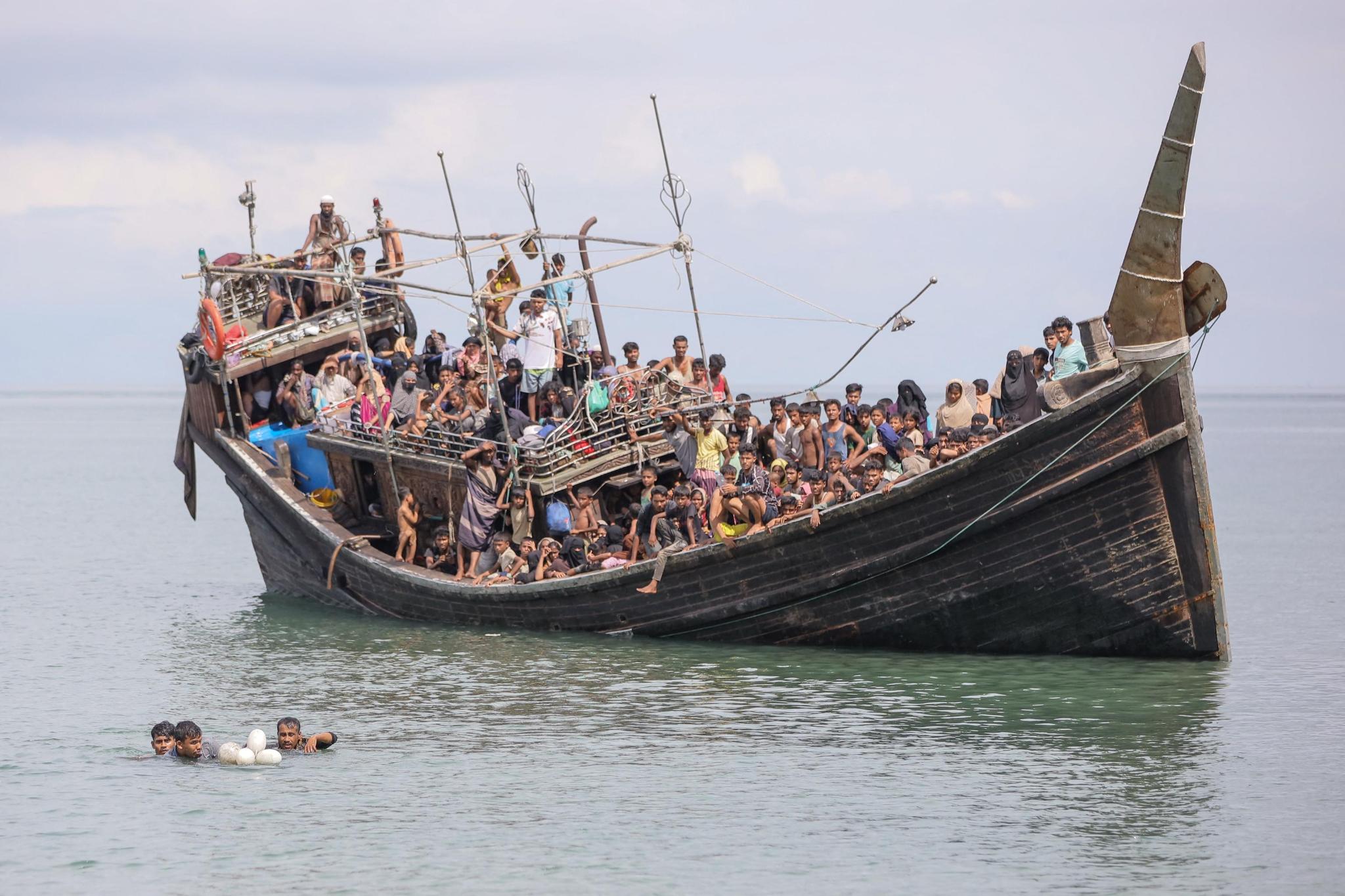
The United Nations warned Thursday that more than 500 people were feared dead following reports of two large shipwrecks off Myanmar since late June.
The UN’s International Organisation for Migration (IOM) and its refugee agency UNHCR voiced alarm in a joint statement at reports “that two boats carrying more than 500 people may have capsized off the coast of Myanmar in recent days.”
Preliminary information indicated that the two vessels in question departed from war-torn Myanmar’s Rakhine State in late June, with mainly members of the country’s mostly Muslim Rohingya minority onboard, the statement said.
Some had reportedly travelled from the huge camps in Bangladesh’s Cox’s Bazar, where more than million Rohingya refugees who have fled from Rakhine live in squalid conditions.
The statement said that one boat, believed to have been carrying around 250 people, lost contact shortly after departure.
A second boat, reportedly carrying some 280 people, is meanwhile believed to have sunk off Myanmar’s Ayeyarwady coast on July 8.
“While the incidents and casualty figures have yet to be officially confirmed, UNHCR and IOM are gravely concerned by the potentially devastating loss of life,” the statement said.
The UN agencies highlighted that the journeys “took place outside the regular sailing season, when maritime conditions are typically more hazardous.”
“Recent torrential rain and flooding across the region have further increased the risks associated with such sea movements.”
The statement cautioned that “if verified, this tragedy would add to the nearly 300 people reported to be missing or to have lost their lives in the Andaman Sea and Bay of Bengal so far this year, including Rohingya refugees and Bangladeshi nationals.”
Exploiting desperation
The Rohingya undertake perilous sea journeys every year in search of better living conditions, travelling aboard rickety boats often operated by trafficking networks.
According to UNHCR, nearly 900 Rohingya refugees were reported missing or dead at sea in the northern Indian Ocean last year alone—out of more than 6,500 who had attempted such perilous sea crossings.
Thursday’s statement stressed that the latest reported tragedies “underscore the devastating impact of protracted conflict and displacement, as well as the continued lack of sustainable solutions for Rohingya communities.”
“Escalating conflict and a worsening humanitarian situation in Myanmar, along with limited assistance and opportunities in refugee camps in Bangladesh, contribute to increasing numbers of people attempting perilous sea journeys in search of safety and protection,” they pointed out.
“The reported incidents also highlight the persistent risks posed by smuggling and trafficking networks, which continue to exploit the desperation of people seeking safety,” they added.
IOM and UNHCR called for “enhanced search and rescue efforts, access to asylum and protection, and actions against smuggling and trafficking networks.”
The agencies hailed Bangladesh for its “remarkable generosity in hosting Rohingya refugees for many years,” but stressed the need for “sustained international support” for the refugees and host communities, as well as “greater efforts to address the underlying drivers of forced displacement.”
A decade of reporting at a cost
In 2025, we marked the 10th anniversary of Myanmar Now. In Myanmar’s history, journalists are often the first targets during political repression. We founded this outlet during a brief window of stability, starting with a small team in a modest office in downtown Yangon. Our goal was simple: to report on injustices that had been silenced for decades. In many countries, justice is sought through courts and police. In Myanmar, these institutions have historically been instruments of oppression.
From the start, we committed to reporting without discrimination—regardless of ethnicity, religion, or citizenship. We believe our work should be accurate, deeply sourced, and strong enough to serve as a historical record.
We also believe journalism should be a force for positive change, and that our primary readers should be the people of Myanmar.
That belief came at a cost. Members of our team and others associated with Myanmar Now have endured long legal battles, physical assaults, arrests, and torture. Despite these hardships, Myanmar Now continues to report the news—thanks to the resilience of our team, the courage of our sources, and the trust of our readers.
Please subscribe to support a free press in Myanmar.