News

Myanmar military pushes to retake oilfields and cut resistance revenue

In the dry hills of central Myanmar, resistance fighters are defending oilfields that help fund their war against the military regime
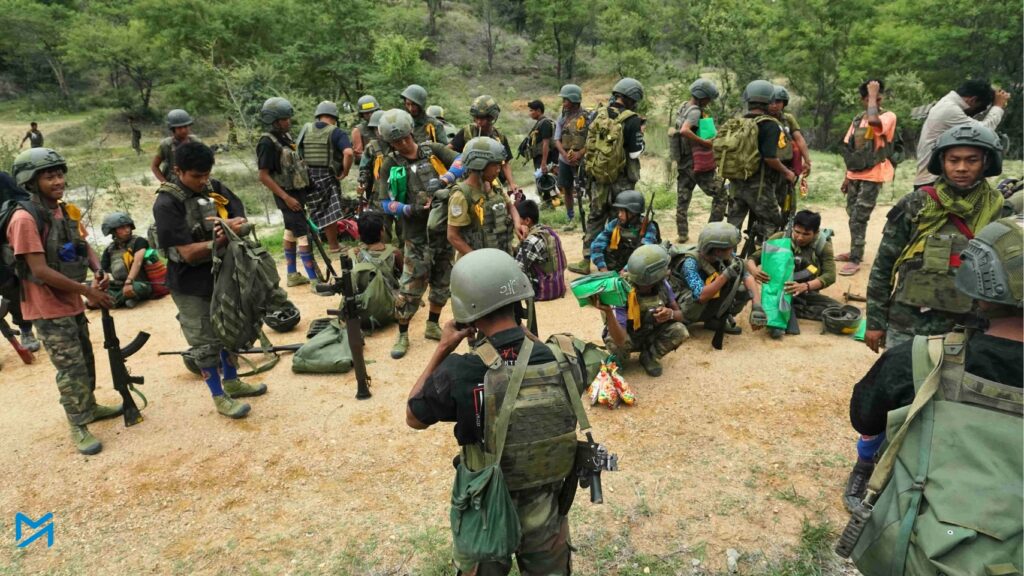
Anti-junta resistance fighters battle an advancing military column in Myaing Township on August 14. (Photo: Tin Soe/Myanmar Now)

As junta leader Min Aung Hlaing cozies up to his regime’s benefactors in Russia and Belarus, some of the fiercest fighting back home is unfolding over a resource that has long been integral to the country’s economy: oil.

Junta forces have been mounting a three-month offensive in the central Magway Region, attempting to recapture oil-producing areas around Myaing Township that are controlled by anti-junta resistance groups.

The battle highlights the economic dimension of Myanmar’s civil war.

Control of natural resources and the revenue they generate has become increasingly important to fund both the junta, and resistance forces fighting to end military rule following the February 2021 coup.

Myaing lies about 77 kilometres (48 miles) north of Bagan, Myanmar’s ancient temple city and one of the country’s best-known tourist destinations. The surrounding region, part of Myanmar’s central dry zone, has become a major stronghold of armed resistance

The gathering comes as Min Aung Hlaing intensifies his efforts to win international acceptance for his regime following military-organised elections held earlier this year. Thailand, as a fellow member of the Association of Southeast Asian Nations (ASEAN), has said it supports Myanmar’s “full and equal participation” in regional bloc’s mechanisms.
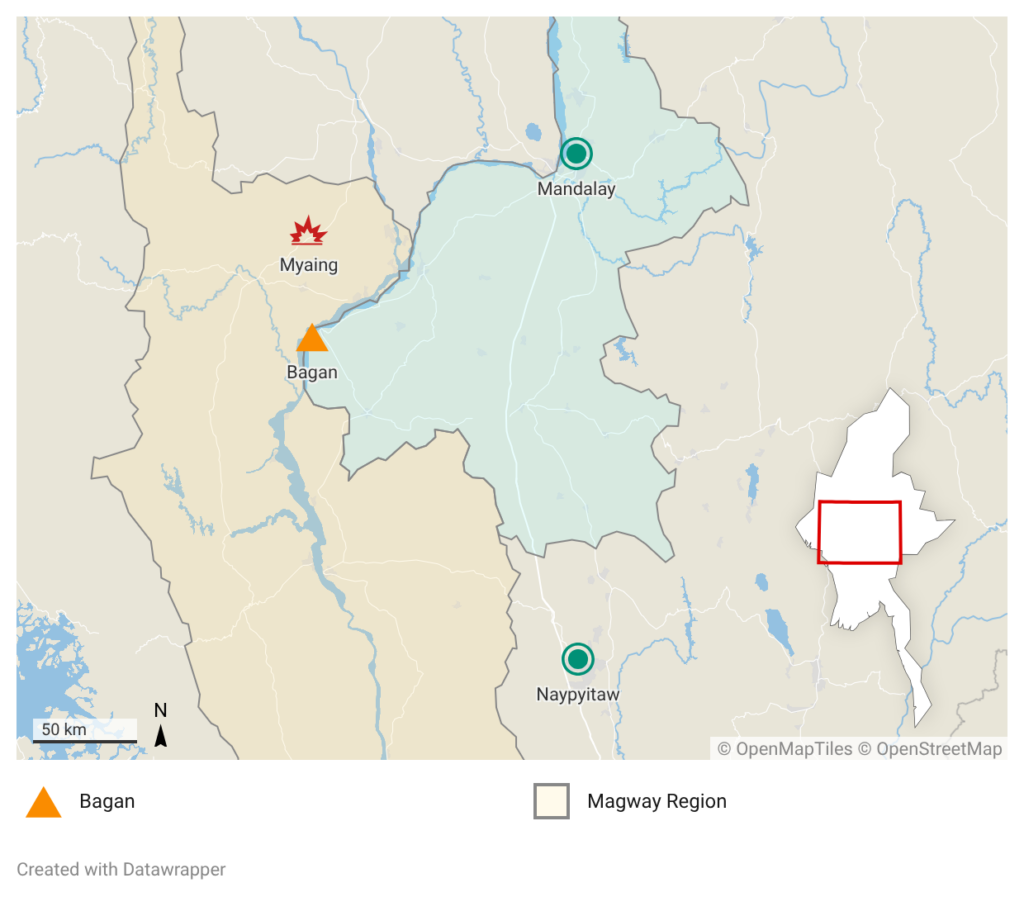
Caption: Map showing the location of Myaing Township in Myanmar’s Magway Region, where fighting between junta and resistance forces has intensified

The latest fighting comes as Min Aung Hlaing strengthens ties with Russia and Belarus, two countries that have maintained close relations with the regime despite its international isolation. He met Russian President Vladimir Putin at the Kremlin on August 18—aptly discussing even larger Russian involvement in the regime’s oil industry—before travelling to Belarus.

Russia in particular has become an important diplomatic and military partner for the junta and a major source of military equipment as its forces battle resistance groups across the country.
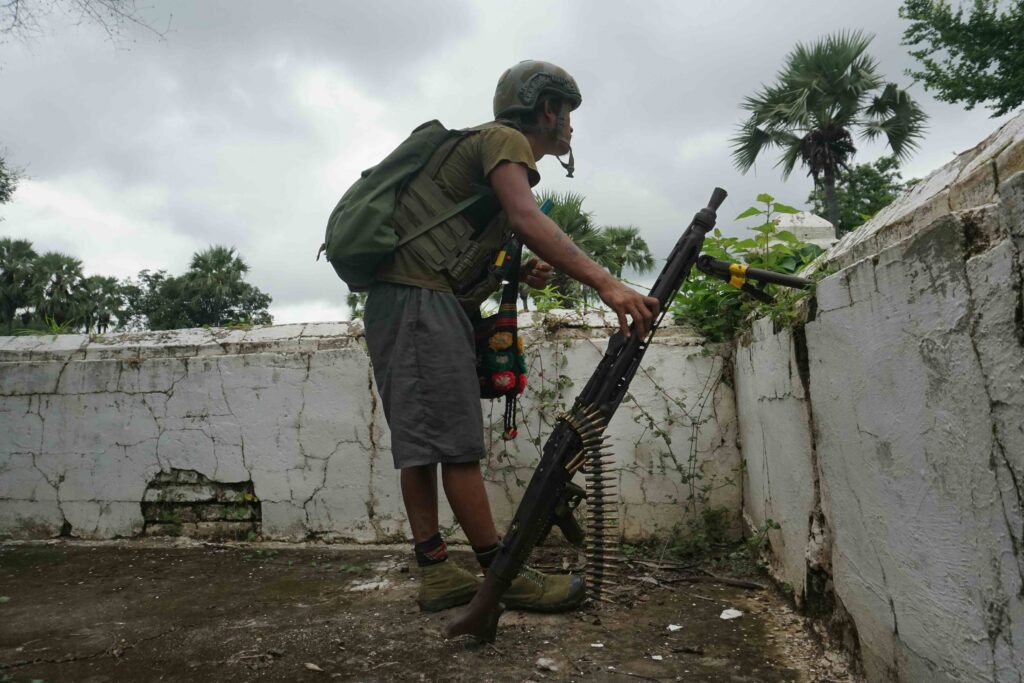
Anti-junta resistance fighters battle an advancing military column in Myaing Township on August 14. (Photo: Tin Soe/Myanmar Now)

Battle for the oilfields

A junta column of several hundred troops began an offensive in mid-May across several townships in Magway, according to resistance sources.
By mid-August, the troops had reached villages near a major oil-producing area in Myaing Township, where they encountered resistance from a coalition of armed groups.

The coalition includes forces aligned with the opposition National Unity Government, as well as the All Burma Students’ Democratic Front, the Bamar People’s Liberation Army and several locally based armed groups.

A Myanmar Now reporter covering the fighting on the ground in Myaing saw dozens of resistance fighters operating in the dry, wooded terrain around the township.
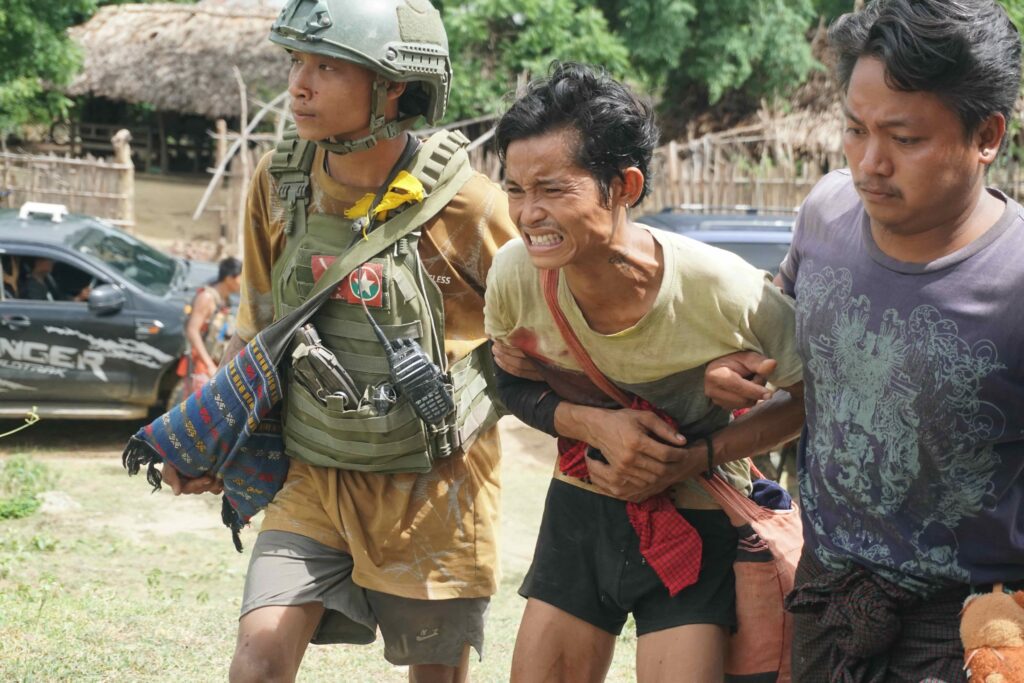
Caption: A resistance fighter wounded during clashes with junta troops in Myaing Township on August 14, 2026. (Photo: Tin Soe/Myanmar Now)

Their clothing and equipment vary considerably. Some wear helmets, body armour and camouflage, while others are dressed in T-shirts, longyi and other civilian clothing.

One fighter was seen carrying a makeshift mortar over his shoulder — reflecting the improvised nature of resistance forces that have emerged across Myanmar since 2021.

Pro-military media outlets have claimed that junta troops have regained control of the Myaing oilfield area, but resistance forces dispute that account.

Pyae Phyo Kyaw, a spokesperson for the resistance coalition fighting in the area, said junta troops remained around Taung Son village, about three kilometres (two miles) from the oilfield, and had not established themselves inside the main oil-producing area.

“They are still in the villages at the foot of the oilfield,” he said. “The enemy column has not yet been able to enter the oilfield itself. They are preparing to enter.”

He said junta forces had suffered significant casualties. The claim could not be independently verified.

For the resistance, control of the oilfields is important not only militarily, but also financially.

Hundreds of barrels of oil are produced daily from wells in the area, according to local sources. Resistance authorities collect taxes from oil production, providing revenue that can be used to support their operations.

A Myaing resident said small-scale private oil production had existed in the area for years, with operators paying landowners a share of the oil they extracted.

Since resistance forces took control of most of the area following the coup, they have imposed taxes on oil production and related businesses, the resident said.

The oilfields have therefore become an important source of revenue for the resistance—and a target for the junta as it seeks to weaken its opponents financially.

Junta forces attempted to advance into the area last year but were forced back after encountering strong resistance, according to anti-military groups.

The current offensive is larger, and junta ground forces have been supported by heavy weapons and repeated air strikes as they attempt to break through resistance positions.

Civilians displaced

The offensive has also taken a heavy toll on civilians.

More than two dozen civilians, including elderly people and those displaced by earlier fighting, have reportedly been killed since the operation began in mid-May. Over 300 homes have been burned and tens of thousands of residents from more than 20 villages in Myaing Township have fled, according to local sources.

Myanmar Now contacted junta spokesperson Col. Myo Aung over allegations that regime forces had killed civilians and burned homes, but he said he was travelling and was unable to comment.

The struggle for the Myaing oilfields is part of a broader military campaign across Magway and neighbouring Sagaing Region in Myanmar’s central dry zone.

The region is strategically important as it provides routes towards Chin and Rakhine states in western Myanmar, where the military has faced significant battlefield pressure.

Resistance groups believe the current offensive has two main objectives: cutting off oil-field revenue to resistance forces, and securing routes that could allow the junta to reinforce operations farther west.

They said that the junta is sending additional reinforcements into the region. One resistance fighter said a convoy carrying about 1,000 soldiers from a division normally based in southern Shan State was moving towards central Magway.