Myanmar’s military is using an increasingly sophisticated digital surveillance system to track fuel shipments across the country as part of an effort to prevent petrol and diesel from reaching areas controlled or contested by anti-junta forces, according to meeting records and a technology proposal obtained exclusively by Myanmar Now, as well as statements published by military authorities.
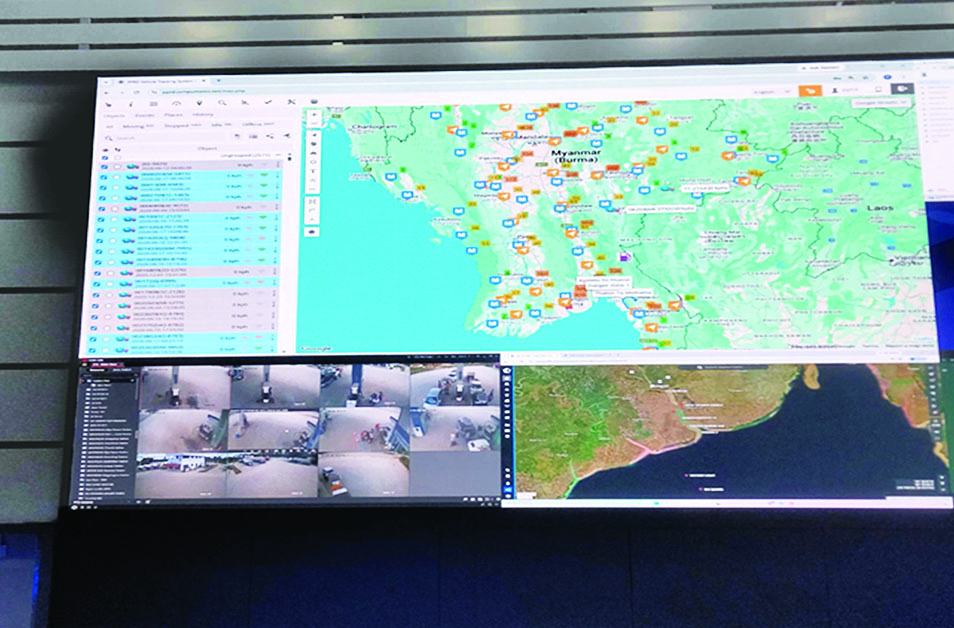
The system allows officials to monitor fuel tankers around the clock and automatically flag vehicles that stray from approved routes or stop for suspicious periods.
The measures amount to a technology-driven expansion of the military’s longstanding efforts to restrict supplies reaching territories where armed resistance groups have gained influence since the 2021 coup.
Under the system, a tanker that leaves its designated route or operating area can trigger an automatic warning at a control centre operated by the Petroleum Products Regulatory Department, under the regime’s Ministry of Electric Power and Energy in Naypyitaw.
Minutes from a June 11 meeting involving department officials and technology companies show plans to establish geographical limits within which fuel tankers are permitted to travel.
The Yangon-Mawlamyine highway, a crucial transport artery towards Mon and Karen states in southeastern Myanmar, was selected as the initial focus.
A source familiar with the system said its principal objective was not to tackle the broader illicit fuel trade but to prevent supplies from being diverted to armed groups fighting the military.
“They are using the fact that resistance groups also buy fuel as the justification for controls, inspections, and the use of technology,” the source told Myanmar Now.
“In practice, they are not going after the real sources of the black market. What they are worried about is fuel reaching the resistance.”
The use of fuel and other essential supplies as leverage against armed opponents is not new to Myanmar’s conflict—and has also been employed by the junta’s most powerful international backer, China.
In northern Shan State, Chinese authorities have restricted cross-border trade, including supplies of fuel, medicine, and food, as Beijing sought to pressure ethnic armed organisations fighting the junta. Myanmar Now reported in 2025 that the Ta’ang National Liberation Army (TNLA) faced such restrictions ahead of China-mediated ceasefire talks with the regime.
China also exerted pressure on the Myanmar National Democratic Alliance Army (MNDAA), or Kokang army, as Beijing pushed the group to halt its offensive against the junta. That pressure was followed by a Chinese-brokered ceasefire and the MNDAA’s eventual withdrawal from Lashio, the strategically important northern Shan State city it had captured from the military.
The junta itself has similarly sought to control the movement of goods into and out of resistance-held territory. The new fuel-monitoring system extends that approach to domestic distribution networks, giving the authorities the ability to use GPS tracking and automated surveillance to follow one of the most important commodities for both armed groups and civilians.
The surveillance has since expanded substantially.
From the third week of August, authorities began tracking fuel movements along routes connecting Yangon with Mon and Karen states, southern Shan State, and Mandalay, Sagaing, Magway, Bago, and Ayeyarwady regions, according to the source.
Tracking tankers from the port
The technology proposal obtained exclusively by Myanmar Now provides a detailed picture of how the surveillance system is designed to work.
Hap Eye Co., Ltd., a Yangon-based technology company, submitted the proposal to the Myanmar Petroleum Trade Association, or MPTA, to develop a system capable of tracking fuel tankers from the moment they leave the Thilawa port complex outside Yangon.
The proposed “Bowser Management System” would allow authorities to determine where tankers are heading after leaving Thilawa, whether they pass designated checkpoints, and whether they ultimately arrive at their authorised petrol stations. GPS data for the system would be supplied by a company identified in the proposal as Compumatics.
The proposal also describes a “Blocking Business Rule” that could prevent a tanker from collecting fuel at Thilawa if its GPS device has been switched off or is not functioning.
The technology therefore gives the authorities a mechanism not merely to observe fuel movements but potentially to stop shipments before they leave one of the country’s most important fuel-import hubs.
Tankers flagged and operators threatened with punishment
The junta has publicly acknowledged parts of the monitoring operation.
Military-controlled media reported that the Petroleum Products Regulatory Department is using an Online Monitoring Center to watch GPS-equipped fuel tankers and check whether they follow approved routes and whether fuel reaches unauthorised destinations.
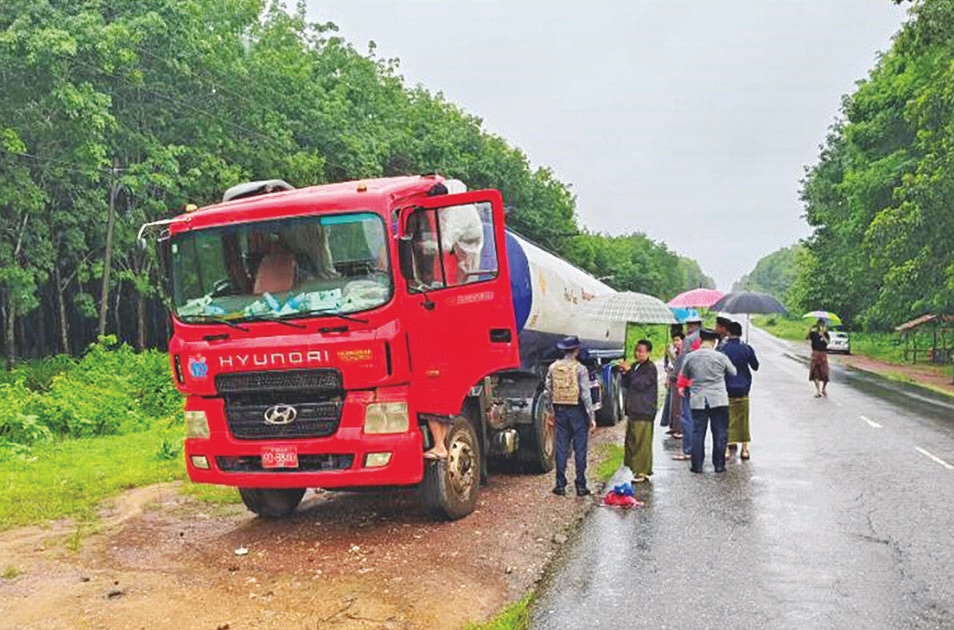
On June 22, junta-controlled newspapers reported that authorities had taken action against a tanker carrying fuel from Thilawa to the Karen State capital Hpa-an.
The tanker allegedly failed to follow its designated route, remained near Kyaikto for an extended period, and transferred fuel before reaching its stated destination. Authorities opened a case under Section 5 of the Essential Supplies and Services Law.
Another tanker bound for Myeik in southern Tanintharyi Region was detained for inspection after making prolonged stops near Kyaikto and Bilin, according to the same reports.
The authorities said artificial intelligence was being used to identify route deviations and unusually long stops, which trigger alarms at the control centre.
Vehicles that violate the rules can have their operating licences immediately suspended, while owners and others involved could face further action, regime newspapers warned.
The surveillance extends beyond tanker movements.
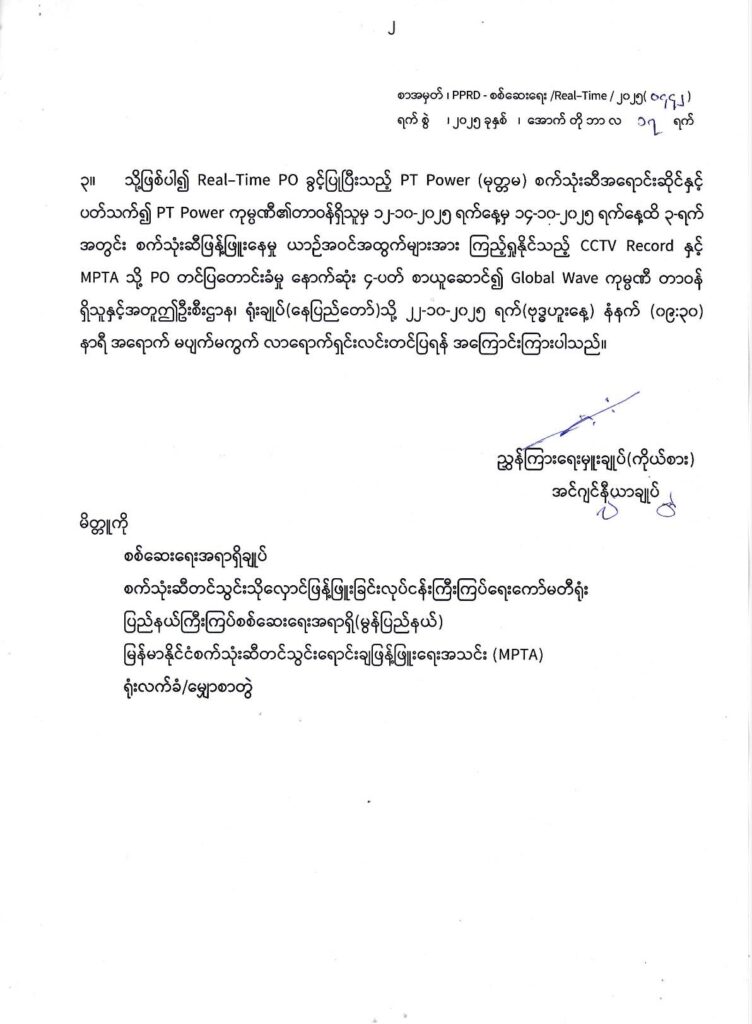
Documents obtained by Myanmar Now show that authorities summoned representatives of two PT Power petrol stations last October after accusing them of failing to comply with fuel-distribution requirements.
Officials demanded records of fuel stocks, sales, and daily transactions, as well as four weeks of CCTV footage showing vehicles entering and leaving the petrol stations.
Fuel prices surge behind resistance lines
The restrictions come as resistance forces face growing difficulties maintaining supply lines in several parts of the country, particularly after the junta regained control of some strategically important routes in northern and northwestern Myanmar.
Nay Phone Latt, a spokesperson for the National Unity Government, said it would be fair to say that the new measures were making it more difficult for resistance groups to obtain supplies, but described them as an extension of a longstanding military tactic rather than an entirely new strategy.
He said the junta had always sought to cut off and block logistics and supply lines used by resistance forces.
Those pressures have intensified as the military has regained control of some routes it previously lost in northern and northwestern parts of the country, making the overall supply situation increasingly difficult for resistance groups, according to Nay Phone Latt.
The tighter fuel controls are adding to those pressures.
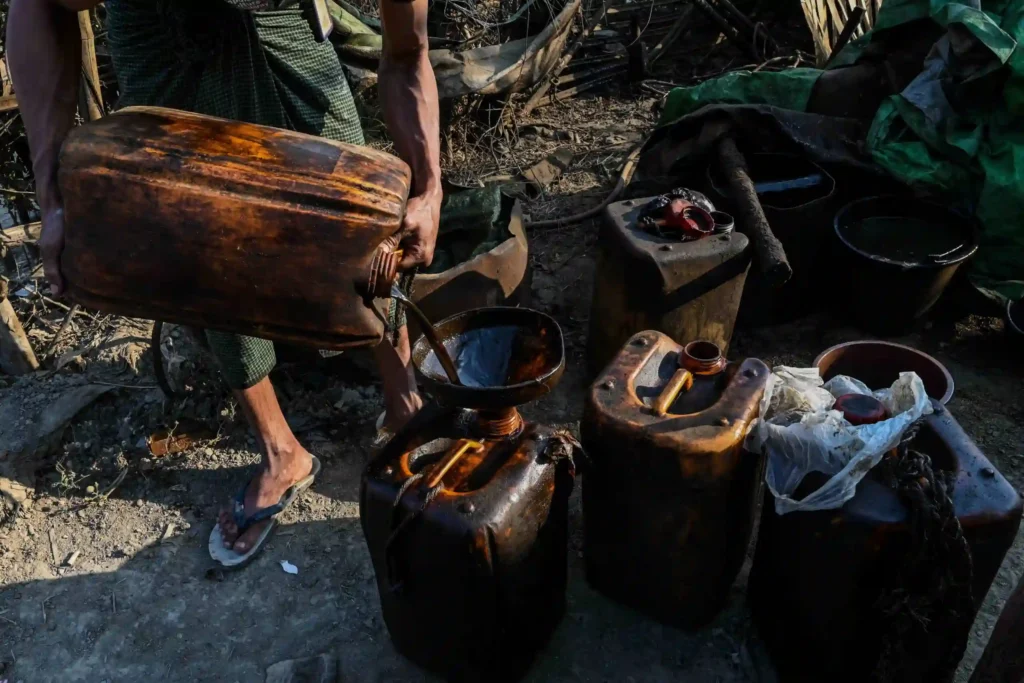
Resistance fighters interviewed by Myanmar Now in western Magway Region, western Bago Region, Mon and Karen states, and Tanintharyi Region said obtaining fuel had become more difficult and expensive, although conditions varied significantly between areas.
In western Bago Region, a resistance fighter said fuel could no longer be bought normally from petrol stations. Fighters instead rely on local residents to acquire small quantities through informal channels.
“If we explain exactly how we obtain it, those routes could be shut down, too,” said the fighter, who requested anonymity for security reasons.
“We collect small amounts with the help of local people and use that. At the moment, we basically have to buy it on the black market.”
The group pays about 35,000 kyat (around US$8.50) for a gallon of diesel and around 7,500 kyat ($1.80) for a litre of petrol, he said.
In the Yaw area of western Magway Region, petrol costs around 12,000 kyat ($2.90) per litre, according to another resistance fighter.
The fighter said the high prices had increased debts among resistance groups and financial pressure on civilians, although they had not yet seriously disrupted military operations.
By comparison, junta-controlled newspapers on September 1 listed an average official fuel price of about 4,000 kyat (less than $1) per litre in Mon and Karen states and Bago, Sagaing, and Tanintharyi regions.
The gap is even wider in parts of southeastern Myanmar.
Saw Dar Ko, a commander with People’s Defence Force Strategy 33 operating in Ye Township in Mon State and Yebyu Township in Tanintharyi Region, said petrol was selling for about 15,000 kyat ($3.60) per litre and diesel for around 13,000 kyat ($3).
Even at those prices, fighters cannot always obtain as much as they need, he said. In some areas, fuel is unavailable altogether.
But Saw Dar Ko said the restrictions were hurting civilians even more than resistance forces, particularly farmers and plantation owners who depend on fuel to operate machinery.
“They are suppressing villages near resistance forces because they are afraid they will support us,” he said.
“It is essentially a Four Cuts strategy. Resistance groups try to find whatever ways they can, but it is local civilians who suffer the consequences.”
The “Four Cuts” strategy has long been associated with Myanmar’s military. It seeks to isolate armed opponents from civilian populations by cutting off their access to food, funds, intelligence, and recruits.
Aye Min Htun, deputy commander of a resistance force in Mon State, said fuel prices in areas with difficult transport links were now between 10,000 and 15,000 kyat ($2.50-3.60) per litre.
Conditions are somewhat different in parts of Karen State, where fuel can also enter from neighbouring Thailand.
A Karen National Liberation Army military source operating in Kawkareik Township said fighters can obtain fuel through local residents in barrels or smaller five- and 10-gallon quantities when necessary.
Fuel bought from village shops costs around 30,000 to 35,000 kyat ($7.20-8.50) for roughly six litres, the source said, although buyers often cannot determine whether it originated in Myanmar or Thailand.
Myanmar Now contacted junta spokesperson Khaing Khaing Soe and officials at the Ministry of Electric Power and Energy for comment on the fuel-tracking system and its use to restrict supplies reaching resistance-held areas, but had not received responses at the time of publication.