On a cold January night in Magway Region’s Gangaw Township, as temperatures plunged sharply, a group of guards arrived at the Yaw Defence Force (YDF) Prison.
Without a word, the guards dragged him away from the prison. He was taken deep into the forest to a remote interrogation camp, far from the main YDF base. Here, the night’s questioning sessions often stretched endlessly, sometimes from midnight until dawn.
That night’s interrogation ended around midnight, sources told Myanmar Now, but instead of returning to his cramped cell, Htun Kyaing was locked inside a nearby shed used for storing, less than 20 meters from the prisoners’ dormitory. His cellmate, a YDF member named Thar Nge, heard Htun Kyaing’s cries for help from the shed. But total darkness prevented him from seeing the distressed detainee clearly.
Htun Kyaing cried out in agony from the wounds inflicted during the interrogation. When he asked for a medical examination, the prison guards accused him of faking his injuries and responded with further abuse. Hours later, when he begged for medical treatment, he was only met with more violence.
At dawn, Phoe Thar Lay, another prisoner being held by the YDF, found Htun Kyaing gravely injured—his face, back, and legs battered, his body cold and stiff. They tried to warm him by the stove, but despite their efforts, he did not survive.
“We placed him on woven propylene bags by the stove, warming and massaging his hands and feet,” Pho Thar Lay said. “It wasn’t long before he died in our arms.”
Htun Kyaing’s body was quietly buried before dawn to keep other prisoners from discovering it. Prison authorities then threatened Phoe Thar Lay and the other witness, silencing them into silence.
During the information blackout, no one knew for sure that Htun Kyaing was gone for good. But the prison authorities spread false reports that he was receiving medical treatment to those on the outside.
Htun Kyaing, a YDF soldier from Sagaing Region, died at the hands of his own resistance comrades in Yaw, Magway Region—nearly 200 miles from his hometown—without anyone’s knowledge. This was the first reported death caused by torture in a YDF detention facility.
Facing relentless brutality, and killings by Myanmar military, many youth in Yaw region chose to take up arms against the junta. The Yaw Defence Force was formed in May 2021 and has operated independently.
Myanmar’s Yaw region includes towns in Pakokku and Gangaw districts in northern Magway Region—such as Gangaw, Saw, Kyaw, Htilin, and Kyaukhtu—and shares borders with Chin State and Sagaing Region, making it a strategically significant area. The Mindat–Pakokku Road, which connects the Chin Hills to central Magway, also passes through Yaw.
The YDF, an ally of the Arakan Army (AA), has carried out joint operations with other allied resistance groups in the Yaw region as well as in Rakhine and Chin States.
In late 2023, the YDF forged an alliance with the Generation Z Army (GZA), a group that was previously active in Wetlet Township, Sagaing Region. The GZA set up an office in Yaw Region too, home to the YDF, and commenced joint military operations with the YDF and the AA.
Towards the end of last year, the YDF constructed a prison facility in Gangdaw Township, where they still maintain control. Today, the prison houses detainees including YDF members, GZA members, and some civilians.
A month after Htun Kyaing’s death, another detained civilian was killed. On March 30, the YDF chief warden opened fire inside the prison, Phoe Thar Lay told Myanmar Now.
“I kept speaking to him, urging him to stay conscious as I warmed him and called his name repeatedly,” Pho Thar Lay said. “Despite everything we did to help, he passed away.”
A series of arrests
Over the past year, senior YDF members had pushed for internal reforms, criticising growing mismanagement and a shift toward centralised decision-making. As morale declined and public support waned, calls for collective leadership were dismissed. Those pushing for change, including battalion commanders and political officers, were accused of various offenses and jailed.
On May 8, dozens of members defected from the force. In response, YDF labeled them fugitives, accusing them of insurrection, weapons smuggling, and other crimes. Some of the defectors were later recaptured following a manhunt.
Earlier on February 26, members of YDF arrested resistance fighter Ye Lin and his group. And in the following days, they were transferred to the YDF prison. The men, all from Sagaing Region, included his comrades Ko Moe and Ye Lin. They were held without being told the reason for their detention or the length of their sentence.
The men were not affiliated with the YDF. Rather they had joined the Generation Z Army —an ally of the Arakan Army (AA)—in Chin and Rakhine to obtain weapons, agreeing to fight for a few months. But as the fighting dragged on, they returned home and were detained by the YDF on their way back to the Yaw.

After they were detained, they were reportedly forced to perform hard labor from dawn to dusk and were regularly punished and beaten by the guards.
Forced to begin at 6 am and granted just a half-hour break for lunch, they labored for 12 grueling hours each day, shackled in heavy iron restraints. Their work ranged from digging trenches and latrines to climbing steep, forested mountains to cut bamboo. Any pause or delay was swiftly punished with violent beatings.
Ko Moe, one of the men who was detained, recalled to Myanmar Now that they were often given unrealistic deadlines for completing tasks.
“If we were ordered to dig a five-by-five-foot hole by morning, we had to complete it within that time or face 10 to 15 lashes,” he said. “At times, they forced us to stand at attention and struck our faces. They punched us, made us hold push-up positions while beating us, and inflicted punishment whenever they pleased.”
“The torture was so severe that I even considered ending my life. Each day was filled with hard labor, confinement, and beatings,” Ko Moe shared. “The food provided wasn’t enough to satisfy our hunger.”
Among the worst cases of abuse took place in solitary confinement in an underground dugout, which also served as a bomb shelter. Sources told Myanmar Now that YDF Sergeant Sai Zaw Win, an infantry platoon commander from a smaller resistance group, underwent interrogation before being placed in an underground cell.
Blindfolded and restrained with handcuffs and leg shackles, he was forced to kneel as the prison warden Ye Lay and his team conducted the interrogation.
Sai Zaw Win was beaten regardless of whether his answers were right, wrong, or incomplete, sources say. Interrogators forced him to hold a push-up position during questioning, then seared his abdomen with an open flame. After enduring hours of brutal torture, his body was marked with burns and deep wounds, he was thrown into an underground cell, cut off entirely from the other prisoners.
The cell, measuring about 56 square feet, had only one entrance above, secured with logs. Inside, it was completely dark. When confined, he was blindfolded, handcuffed, and his legs were shackled to the floor.
He was denied a blanket at night and forced to sleep wearing only his shirt and longyi after being made to remove his jacket. He was given only three handfuls of rice and a cup of water twice daily, once in the morning and once in the evening. With no access to a toilet, he was given an empty plastic bottle to relieve himself.
Sai Zaw Win allegedly endured 17 days in the cold, dark underground cell.
Ye Lin, one of Sai Zaw Win’s comrades, said the underground cell was his greatest fear, worse than the beatings or forced labor. That looming threat drove him and the others to take their chances, rather than live under constant dread of interrogation or isolation.
“We weren’t affiliated with YDF or GZA and were wrongfully imprisoned by other resistance groups,” Ye Lin said. “That’s why we chose to escape—we would rather die with dignity than endure unjust detention.”
In the final week of March, the three men along with several non-YDF soldiers from Sagaing seized the opportunity to escape. They had secretly loosened their leg shackles beforehand. When ordered to chop bamboo in the mountains, they made their break, fleeing east through the forest along a route they had previously scouted.

They traveled east, planning to cross the Alaungdaw Kathapa Reserved Forest to reach Mingin in Yinmarbin Township, Sagaing Region. Fearing pursuit, they hurried through the forest as quickly as they could. And for four days they sustained themselves by foraging for food.
“Having gone two days without food, one member of our group collapsed, his eyes sunken from hunger,” Ye Lin recalled. “We caught fish trapped among the rocks, grilled them, and fed him, along with small lizards.”
After a long, exhausting journey, the men finally encountered members of the district defense force stationed deep within the reserved forest, signaling the beginning of their return home.
Ye Lin later condemned the Yaw Defence Force, recounting how they detained and tortured him for over a month, calling their actions unlawful.
“They shouldn’t act this way simply because they hold weapons,” Ye Lin said. “There are no laws or rules guiding their actions. A person should only be arrested for a valid reason—not arbitrarily, just because someone says so.”
Shadowy killings
After realising the prisoners had fled, the prison warden and his team launched a frantic search through the forest. A few days later, on March 30, they managed to recapture Thar Nyi, an escapee from Sagaing who uses a revolutionary alias.
Although Thar Nyi was not affiliated with the YDF, the prison warden Ye Lay and his men subjected him to a nearly hour-long beating starting at noon. Following this, Thar Nyi was locked back in the cell, while prison warden Ye Lay and his guards spent the entire day drinking.
That night, around 7 pm, Thar Nyi was dragged from his cell and beaten once more.
He shouted that inmates had one minute to escape, warning that after the time expired, he would pursue and shoot anyone who ran. At that moment, YDF prison warden Ye Lay appeared near the cells, exchanged a few words, and then started firing into the prison cells.
Shortly after, more soldiers arrived and kept firing at the prison cells.
Sources allege that a pattern of abuse and negligence has been running rampant in the prison. And according to Thar Nge, a former official at YDF, the prison is spiraling out of control.
Thar Nge initially served as the treasurer of YDF, but after completing military training in Rakhine and returning in 2023, he was appointed as the head of logistics. About six months after his return to the Yaw region, in early December last year, Thar Nge and two other YDF leaders were arrested and jailed.
He was held in detention for over four months without explanation, only released the day before Thingyan festival. During his confinement, he witnessed multiple incidents of violence, including the brutal torture and killing of Htun Kyaing in late January, as well as the reckless gunfire into prison cells on the night of March 30.
Thar Nge recalled a night when five prison guards fired indiscriminately for nearly half an hour, turning the prison into a scene of chaos and deafening noise, he recalled.
“The prison warden initiated the shooting,” Thar Nge told Myanmar Now. “Once he opened fire, the other troops lost control and began shooting wildly.”
During a shooting inside the prison, Hla Gyi Maung, a young education staffer from Gangaw Township, was fatally shot in the neck. Two other inmates were injured. Detained earlier this year at the Yae Myet Ni checkpoint for refusing to join the Civil Disobedience Movement, Hla Gyi Maung died before any interrogation or sentencing. Despite this, no action has been taken against prison warden Ye Lay for the earlier death of Htun Kyaing or other incidents.
Ye Lay, the prison warden, was temporarily detained at a central base as disciplinary action for the fatal shooting. But after just 20 days, he was returned to his former post.

Junta-like tactics
According to sources interviewed, the fighters were not the only ones at risk. A large YDF force reportedly conducted raids on the homes of several escaped members and carried out arrests and attempted arrests of the innocent family members
Additionally, the homes of Kaung Kaung and Thar Gyi were also raided, but their family members managed to escape to safety. Thar Nge said that the tactic of going after family members when they cannot capture their targets, is cut from the same playbook as the junta, describing it as “utterly reprehensible.”
Currently, the whereabouts and conditions of the twelve recaptured individuals remain unknown. The YDF has released a statement warning that necessary measures will be taken against any groups found to be assisting the fugitives.
Myanmar Now has reached out to the YDF about the deaths in custody and alleged human rights abuses in their prison, but has not received a response.
Both Yaw resistance troops and residents hope to see the internal conflicts within the YDF resolved. The group was once a strong resistance group with a substantial armed presence and widespread public support. But now many say it appears to be misguided, going down a dangerous path. It’s a sentiment shared by Koe Moe, one of the men who survived YDF’s torture and abuse. Others, he said, weren’t so lucky.
“I survived by reminding myself that I am a man, a soldier—I wasn’t meant to die yet.”


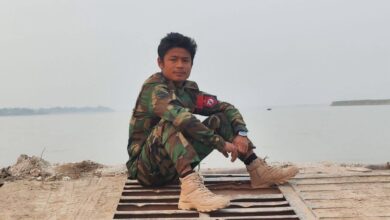
Individuals declared fugitives by YDF (Photo: YDF)