Japanese envoy’s visit to Rakhine state raises prospect of by-election

The trip comes amid calls to extend vote to northern townships excluded from the November 8 election

Published on Dec 2, 2020
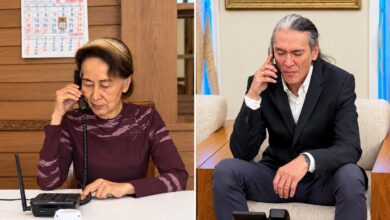
Japanese special envoy Yohei Sasakawa and State Counsellor Aung San Suu Kyi meet after the November 8 election. (Myanmar State Counsellor Office/Facebook)

Japan’s special envoy to Myanmar, Yohei Sasakawa, travelled to northern Rakhine state on Saturday to meet with political parties in areas where voting was suspended during the November 8 election due to conflict.

Sasakawa, who is also the chair of the Nippon Foundation, flew to the state capital Sittwe via military jet on Saturday morning and met with party representatives in the afternoon.

“He expressed a desire to meet with Rakhine parties,” Tun Aung Kyaw, an advisor to the Arakan National Party (ANP), told Myanmar Now.

On the agenda, he added, were “issues surrounding the election and what the Nippon Foundation could do to help Rakhine.”


The trip follows meetings earlier in the month with senior government and military leaders in Naypyitaw. 

Sasakawa met with the commander-in-chief of the armed forces, Senior General Min Aung Hlaing, both before and after the election and with State Counsellor Aung San Suu Kyi on November 10.


In an interview published on November 21, Japan’s ambassador to Myanmar, Ichiro Maruyama, said that Sasakawa had called on the leaders to “hold elections as soon as possible in Rakhine state where elections could not be held in November 8.”  

Voting had been suspended in parts of the state due to clashes between the military and the Arakan Army (AA), which issued a statement on November 12 calling for by-elections to allow local people in the affected areas to vote.  

A major sticking point is the status of the AA, which has been designated by the government as a terrorist organization. 

“To have a fair election, it’s of extreme importance for the election to be held in the remaining nine townships. So I hope it does happen,” said Japan’s special envoy to Myanmar, Yohei Sasakawa

At a press conference last Friday, military spokesman Brig-Gen Zaw Min Tun said that there had been precedents of this status being revoked after negotiations. He added that while no direct negotiations had taken place, there had been “personal or organizational interventions.” 

He also noted that no clashes had taken place in Rakhine since the election.

In its statement, the AA said the military should end offensive operations, announce a nationwide ceasefire, and hold a by-election as soon as possible. It also said that it was willing to cooperate to create favourable conditions for such an election.

The military welcomed the AA’s statement and said it would do its best to negotiate for a by-election in these regions.

Speaking to reporters in Sittwe after returning from Kyauktaw and Buthidaung townships, Sasakawa said that he would discuss the matter with the Union Election Commission (UEC).

“After observing the region in person, I’ll have a meeting with the UEC once I get back to Naypyitaw today and propose to them that the election should be held in the nine townships. I will inform them that the public in these areas are waiting for the day of the election,” he said.

He added that the Tatmadaw commander-in-chief was also eager for the by-election to take place, and that his trip to Rakhine was planned by the military.

“To have a fair election, it’s of extreme importance for the election to be held in the remaining nine townships. So I hope it does happen,” he said.

He said he had requested that both the military and the AA suspend their military operations in northern Rakhine so that the election can go ahead.

The ANP, which won the most seats in the parts of Rakhine state that were included in the election, said that the envoy had informed them of his plans.

“Mainly, we were told about the negotiations between the military and the AA to hold an election in the townships that were left out of the 2020 election. He’ll present what he heard and saw to Naypyitaw,” ANP spokesperson Aye Nu Sein told Myanmar Now.
Phadu Tun Aung is Reporter with Myanmar Now. He is based in Sittwe, Rakhine State.

Announcement came as court postponed the 82-year-old’s third hearing, meaning his request for bail on health grounds was not considered 

Published on Mar 19, 2021
Win Htein arrives for the opening ceremony of the second session of the Union Peace Conference in 2017 (EPA-EFE)

Detained National League for Democracy party stalwart Win Htein is to be tried by a special tribunal of two judges following an order from the military-controlled Supreme Court, his lawyer said on Friday. 

“It was just one judge before, and now there’s two,” Min Min Soe told Myanmar Now. 

“District judge Ye Lwin will serve as chair, and deputy district judge Soe Naing will be a member of the tribunal,” she added.

Win Htein faces up to a 20-year prison sentence for sedition under section 124a of the Penal Code.

His third hearing, scheduled for Friday, was postponed, with the court citing the internet shutdown as the reason because it made video conferencing impossible, Min Min Soe said.

“The arguments will be presented at the next hearing, we applied for bail but since they’re setting up a tribunal for the lawsuit, that will be discussed at the next hearing as well,” she said.

At the second hearing on March 5, Win Htein requested an independent judgement, a meeting with his lawyer, and bail due to his health issues, but the court said those requests would be heard on March 19.

Win Htein, 82, uses a wheelchair and suffers from breathing problems that means he often requires an oxygen tank. He also suffers from diabetes, high blood pressure, hypothyroidism and benign prostatic hyperplasia. 

Min Min Soe was allowed a brief call with her client on Friday to tell him that his hearing had been postponed until April 2.

Aye Lu, the chair of the Ottara district administration council in Naypyitaw, is the plaintiff in the lawsuit against Win Htein. Ottara district is where the NLD’s temporary headquarters are located. 

Aye Lu filed the charge on February 4 and Win Htein was arrested that evening at his home in Yangon. He has been kept in the Naypyitaw detention center and denied visits from his lawyers. 

He was detained after giving media interviews in the wake of the February 1 coup in which he said military chief Min Aung Hlaing had acted on personal ambition when seizing power. 

On Wednesday the military council announced that it was investigating Aung San Suu Kyi for corruption, on top of other charges announced since her arrest.

Many other NLD leaders, party members and MPs have been arrested or are the subject of warrants.

Kyi Toe, a senior figure in the NLD, was arrested on Thursday night in Hledan, Yangon.


Myanmar Now is an independent news service providing free, accurate and unbiased news to the people of Myanmar in Burmese and English.

Continue Reading

The country’s military leaders have acted with impunity for decades, but now there is a mechanism to bring them to justice

Published on Mar 19, 2021
Nationwide protests against the coup have been responded with murders, torture and mass arrests by the military regime. (Myanmar Now)

On March 8, U Ko Ko Lay, a 62-year-old teacher, bled to death on a street in the Kachin state capital Myitkyina. He had been shot in the head while protesting the military coup of February 1. That same night, U Zaw Myat Lynn, an official from the National League for Democracy, was taken from his home in Shwepyithar on the outskirts of Yangon and tortured to death. The list keeps growing.

In the more than six weeks since Senior General Min Aung Hlaing seized power, images of soldiers and police officers shooting, beating, and arresting protesters have flooded social media and Myanmar and international news outlets. So far, the regime’s forces have killed well over 200 people (more than half of them in the past week) and seriously injured many more. The junta has also arrested nearly 2,200 people, some of whom, like U Zaw Myat Lynn, have died in custody.

Each day, Myanmar human rights organizations update lists with names, dates, locations, and causes of death. Around 600 police and a handful of soldiers have decided they do not want to be involved in such actions. They have left their posts and even joined the anti-coup movement.

Many soldiers, police officers, and commanding officers are acting with impunity now. But they can face prosecution, not only in Myanmar’s courts but also internationally. Like any country, Myanmar is subject to international law. Because of its history of atrocities, most recently against the Rohingya people, Myanmar is also already subject to special international legal proceedings that apply to the current situation.

The most relevant is the United Nations’ Independent Investigative Mechanism for Myanmar (IIMM). The IIMM was created in 2018 after the Myanmar military’s brutal campaign against the Rohingya people, but it applies to the whole country. Its mission is to investigate “international crimes” from 2011 to the present.

International crimes are generally defined as “widespread and systematic” in nature, involving many victims and locations. These include crimes against humanity, war crimes, and genocide.

In keeping with its mandate, the IIMM is collecting information on the current situation. In a statement released on February 11 (available in Myanmar here), it highlighted the “use of lethal force against peaceful protesters and the detention of political leaders, members of civil society and protesters.”

More recently, on March 17, the IIMM also called on recipients of illegal orders to share this evidence so that those ultimately responsible for these crimes can be held accountable.

"The persons most responsible for the most serious international crimes are usually those in high leadership positions. They are not the ones who physically perpetrate the crimes and often are not even present at the locations where the crimes are committed,” the head of the IIMM, Nicholas Koumjian, says in the statement (available in Myanmar here).

The crimes the IIMM investigates could be tried in Myanmar courts, courts in other countries, or international courts. International crimes are crimes that are so serious that they are considered to be against the international community, and are therefore not limited to courts in one country.

In other words, an international crime committed in Myanmar—for example, widespread and systematic attacks on civilians—can be tried in a court in another country or in an international court.

The Myanmar military is used to getting away with murder. Decades of well-documented killing, rape, and torture of civilians in ethnic minority areas have gone unpunished. No one has ever been tried for the killing of protesters during previous mass uprisings against military rule in 1988 and 2007.

But this time may be different. On March 4, the International Commission of Jurists said in a statement that “the killing of peaceful protesters by Myanmar’s security forces should be independently investigated as possible crimes against humanity.”

The IIMM is already set up and working. It provides a mechanism for just such an investigation. Those doing the shooting should be aware of this.

For further information:

The Independent Investigative Mechanism for Myanmar (IIMM) on Facebook

International Accountability Mechanisms for Myanmar (learning materials in English, Myanmar, and Karen)

Lin Htet is a pen name for a team of Myanmar and international writers

Continue Reading

A resident said armed forces used drones to monitor the crowd before opening fire on them

Published on Mar 19, 2021
Men carry a wounded protester in Aungban, Shan State, on the morning of March 19 (Supplied)

At least eight anti-coup protesters were killed in Aungban, southern Shan State, during an attack by the military junta on demonstrations on Friday morning, according to the Aungban Free Funeral Service Society.

Sixteen military trucks carrying more than 100 policemen and soldiers arrived at the protest site at around 9:00 a.m. and began shooting at protesters. Seven died at the scene, and another protester who had been shot in the neck was taken to Kalaw Hospital and died by 11:00 a.m.

All eight victims were men. 

The body of the man who died at the hospital was sent to his family’s home, but those who were killed at the protest site were taken away by the junta’s armed forces, a representative of the Free Funeral Service Society told Myanmar Now. 

Aungban resident Nay Lynn Tun told Myanmar Now that police and soldiers had destroyed the doors of nearby homes in order to arrest people, and that at least 10 people had been detained. 

“Initially, police arrived at the site. When the crowd surrounded the police, armed soldiers arrived at the site and began firing,” he told Myanmar Now. “In the coming days, if we cannot gather to protest, we will do it in our own residential areas.”

Since March 13, around 300 volunteer night guards have watched over these residential areas to protect locals from the dangers posed by the junta’s nighttime raids. These forces use drone cameras to monitor the activities of the night guards from 3:00 a.m. until 5:00 a.m. every day, Nay Lynn Tun said. 

He added that hours before Friday’s crackdown, military and police had also used drone cameras to monitor the gathering of protesters in Aungban.

Over the last week, at least 11 protesters have been arrested in Aungban. Only three-- the protesters who were minors-- were released.

South of Shan State, in the Kayah State capital of Loikaw, two pro-democracy protesters were also shot with live ammunition by the regime’s armed forces on Friday. One, 46-year-old Kyan Aung, was shot in the lower abdomen and died from his injuries. The other wounded protester was a nurse, according to eyewitnesses. 

According to a March 18 tally by the advocacy group Assistance Association for Political Prisoners, at least 224 people have been killed across the country by junta’s armed forces since the February 1 coup. Thousands more have been arrested. 


Myanmar Now is an independent news service providing free, accurate and unbiased news to the people of Myanmar in Burmese and English.

Continue Reading