China’s embassy in Yangon and state-controlled media have used the anniversary of Japan’s defeat in World War II to promote anti-Japanese sentiment among Myanmar audiences, only for the move to backfire as social media users expressed anger over Beijing’s support for the country’s military regime.
Around August 15—the 81st anniversary of Japan’s surrender—China Radio International’s CRI Myanmar published a series of Burmese-language posts highlighting Japan’s wartime aggression.
The posts focused on the Burma-Thailand “Death Railway,” the Tokyo war crimes trials, visits by Japanese politicians to the controversial Yasukuni Shrine, and other aspects of Japan’s wartime militarism.
The Chinese embassy in Myanmar joined the campaign, commemorating the anniversary of Japan’s surrender and urging readers not to forget history.
However, many Myanmar Facebook users responded by turning the criticism back on China.
Comments reviewed by Myanmar Now questioned why Beijing was invoking atrocities committed more than eight decades ago while supporting Myanmar’s current military regime.
In one comment, a Burmese Facebook user dismissed China’s invocation of Japan’s wartime actions and suggested Beijing should instead consider how Myanmar people view China today. They accompanied their comment with a string of vomiting emojis.
“Why are you telling us to hate Japan? Do Myanmar people even like China?” another user wrote under an embassy post.
One Chinese embassy post had attracted 381 reactions and 110 comments, with criticism of China prominent among the visible responses. Another post commemorating Japan’s surrender drew more than 2,000 reactions and hundreds of comments, including numerous laughing reactions.
A Burmese businessman in Yangon who works with Japanese companies said China’s anti-Japanese messaging was unlikely to have much impact on public opinion, although its propaganda narratives could be repeated by Myanmar’s military regime.
“The Myanmar public has long harboured anger against Chinese policy in Myanmar, while Japan has no such issues in the post-independence era,” he said.
Growing resentment of China
The backlash reflects sharply different perceptions of China and Japan in Myanmar today.
Myanmar suffered heavily under Japanese occupation during World War II. Burmese nationalists led by Aung San, the father of detained civilian leader Aung San Suu Kyi, initially cooperated with Japan in the hope of ending British colonial rule, but later turned against the Japanese and joined the Allies in 1945.
Despite this wartime legacy, Japan subsequently became Myanmar’s largest source of development assistance and a major economic partner during the era of former dictator Ne Win from 1962 to 1988. Following the military crackdown on nationwide pro-democracy protests and the establishment of a new military government in 1988, Japan largely curtailed its ODA.
Meanwhile, China rapidly emerged as one of the military regime’s most important international partners. During the 1990s and 2000s, as Myanmar’s military junta faced Western sanctions and increasing international isolation, China became a crucial source of diplomatic and military support, trade, investment, and development finance.
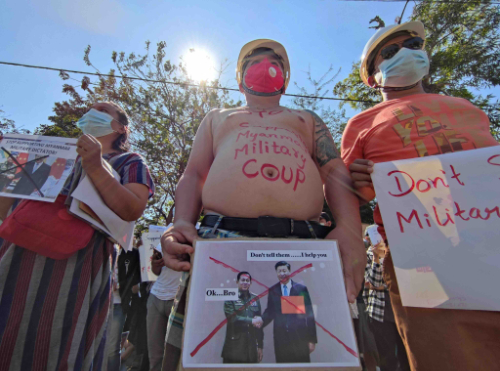
Beijing’s relationship with Myanmar’s military has become an even greater source of public resentment since the February 2021 coup. China has maintained diplomatic and economic relations with the military authorities and has actively involved itself in shaping the course of the conflict.
Kei Nemoto, professor emeritus at Sophia University in Tokyo and a historian of modern Myanmar, said this current political context further weakened Beijing’s attempt to mobilise wartime memory.
“For the present Burmese people, Min Aung Hlaing’s regime is recognised as far more brutal than the period of Japanese military occupation,” he said. “In such a situation, the fact that China has been supporting MAH’s government strongly, its attempts to revive memories of Japanese wartime atrocities will simply become counterproductive.”
In particular, Beijing has used its considerable leverage over some ethnic armed organisations along the China-Myanmar border to broker ceasefires and coerce them to halt offensives against the military. In 2025, Chinese pressure heavily contributed to the Myanmar National Democratic Alliance Army’s withdrawal from the strategic city of Lashio, which it had captured from the military the year before.
China’s support for the military also extends into the information sphere. Chinese state media regularly amplify narratives favourable to the junta, while Beijing continues efforts to strengthen relations with the junta’s propaganda media. On August 14, right before the burst of anti-Japan messaging, the Chinese embassy publicised a visit by a delegation of Myanmar media representatives to several Chinese media institutions in Yunnan.
Beijing’s bid to control the narrative
Such engagement follows a longstanding Chinese strategy of cultivating Myanmar’s media sector. A 2019 Myanmar Now investigation documented how Chinese state-linked organisations offered content to local Myanmar outlets, sponsored trips for journalists, and developed media partnerships as Beijing sought greater influence over coverage of China and its interests in national media.
CRI Myanmar, which Facebook identifies as “China state-controlled media,” is one of Beijing’s most direct channels for reaching Burmese-speaking audiences. It is also not the first time Beijing has used the channel to promote its increasingly bitter disputes with Japan.
In November 2025, the Chinese embassy published a lengthy Burmese-language post attacking remarks by Japanese Prime Minister Sanae Takaichi concerning Taiwan. The post attracted about 2,000 reactions and 785 comments, according to a screenshot reviewed by Myanmar Now. One response read, in English: “We stand with Japanese and Taiwan.”
Myanmar’s military authorities subsequently echoed Beijing’s position and responded to questions about Takaichi’s remarks by declaring that Myanmar “firmly” supported Beijing’s One China policy, their territorial integrity, and sovereignty.
Myanmar Now sought comment from the Chinese embassy in Yangon on the criticism of Beijing’s anti-Japan messaging and its support for Myanmar’s military authorities, but the embassy did not respond by the time of publication.