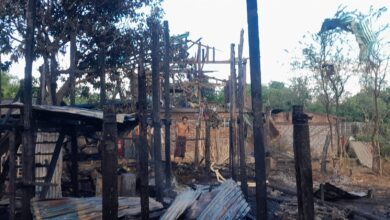
In her early forties, Khar Nan laid flattened cardboard across the dirt floor of her collapsing hut, its bamboo walls barely held together beneath a sagging tarpaulin roof. With little more than the boxes and the single jacket she owned, she tried to blunt the bite of Kachin State’s winter winds.
For nearly a year, Khar Nan and her three sons—five, 13, and 16—have been hiding in a forest in Momauk Township. At night, as the cold crept into the cramped 10-by-10-foot shelter, she would break down each time her youngest whispered the same question: “Mother, can we go home to Bhamo?”
“I try to explain it in words they can understand,” Khar Nan told Myanmar Now. “I tell them that the sound of gunfire is still there,” wiping away tears.
The Kachin Independence Army (KIA), one of the largest ethnic armed groups in Kachin State, have been carrying out attacks on junta positions in Bhamo Town since December 4, 2024, with fighting continuing at high intensity.
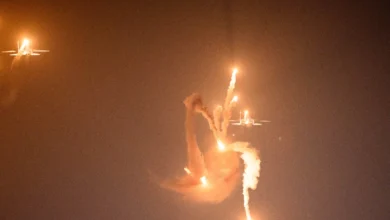
Relying on air and naval support as well as reinforcements of troops and ammunition, the junta has used airstrikes to secure an advantage, leaving Bhamo the town most affected by aerial bombardment.
Since the fighting has escalated, residents have sought refuge in villages and towns throughout Kachin State, including Myitkyina, and have also fled to Mandalay in central Myanmar.
“Our house had already burned down when the artillery shell hit, and the nearby homes are likely gone too,” Khar Nan said. “Fighting keeps breaking out, and I can see smoke all around.”
Khar Nan once traded rice in Thone Mile Ward of Bhamo Town, Kachin State. Today, she supports her family in Momauk by doing day labor and selling betel nuts.
“We can’t rely on others for food, so I have to do whatever I can to survive,” she said. “During the rainy season, our house leaks so badly that we can’t light a fire to cook or sleep properly. Patching the holes doesn’t help, and we suffer greatly whenever the sky darkens with rain.”
About 50 other displaced people are sheltering in the same forest in Momauk Township. According to Baptist minister Inn Khun La Sai, families survive by working in agriculture and taking daily wage jobs in nearby villages. Living in makeshift huts of bamboo and tarpaulin, they endure the winter cold and remain exposed to harsh weather year-round, another displaced resident.
“During the rainy season, we sleep in huts that leak through the holes in the tarpaulin roofs,” said Jar Sai San, another displaced resident.
“In winter, having escaped with only a thin blanket and three sets of clothes, we lack sufficient bedding, and three family members must share a single blanket,” she said.
She added that displaced people struggle with food shortages and livelihood challenges while also living in constant fear due to the ongoing military situation in Bhamo Town.
“We’ve heard that if the KIA captures Bhamo, the junta army might bomb the town everywhere, so we must be extremely cautious,” she said. “Yesterday, they even bombed near our area, but thankfully the bomb didn’t explode, by God’s grace.”
The town of Bhamo sits on the eastern bank of the Ayeyarwaddy River, about 115 miles south of the state capital Myitkyina and just under 40 miles from the Chinese border. Additionally, the town is a strategic hub connecting Kachin State with central Myanmar through both land and river routes, while also linking China in the east, Shan State in the southeast, and Sagaing Region in the west.
According to public data from 2023, Bhamo Township has a population of about 124,500 made up largely of Bamar, Shan and Kachin residents. The township includes 16 wards, 42 village tracts and 71 villages across roughly 759 square miles. The KIA Information Department says the KIA and its allies now control more than 90 percent of the area.
Since the 2021 military coup, fighting has intensified across Myanmar’s ethnic states, including Shan, Karenni (Kayah), Karen, Chin and Kachin, as resistance groups have moved to seize towns and territory from junta forces.
In March 2024, the KIA and allied resistance groups launched coordinated attacks on junta positions across Kachin State, capturing most areas east of the Ayeyarwaddy River. By May, fighting had reached Mansi and Momauk near Bhamo, with clashes only reaching Bhamo town itself toward the end of the year.
During the battle for Bhamo, the KIA was backed by allied forces including the Arakan Army and the All Burma Students’ Democratic Front, alongside Kachin and central Myanmar People’s Defense Force (PDF) units operating under coordination with the National Unity Government (NUG).
The Arakan Army—now one of Myanmar’s most powerful resistance forces and originally formed in KIA territory—also played a key role in Operation 1027 alongside the Myanmar National Democratic Alliance Army (MNDAA) and the Ta’ang National Liberation Army (TNLA), while advancing its separate campaign to seize control of Rakhine State.
Reports from the Kachin front say that AA commander Major General Twan Mrat Naing, the leader of the AA, told fighters they would remain until Bhamo Township was fully taken. Unlike other towns, Bhamo hosts multiple battalions and features strongly built buildings in its urban wards where junta troops are stationed and defending, which has slowed the town’s capture, according to KIA information officer Colonel Naw Bu.
“We face more than 20 enemy bases, and their firing range stretches over 20 miles, with numerous security and defense outposts within it,” Naw Bu said.
Bhamo Town has become a regrouping hub for junta forces pushed out by KIA offensives that began in March 2024. After capturing towns and hill camps along the Myitkyina–Bhamo Road, as well as nearby Mansi and Momauk, the KIA pushed remaining junta units to retreat into Bhamo, now the last remaining target of the campaign.
Zin Yaw, a former junta captain who defected to the resistance after the 2021 coup, told Myanmar Now that the junta has been defending Bhamo with 11 battalions and other units, estimating the junta has thousands of troops stationed across the town.
“Bhamo could even be seen as a small regional military command,” Zin Yaw said. “In the Northern Command area, there are major headquarters such as the Northern Command itself and Military Operation Commands 3 and 21. These bases exist as an administrative authority but lack military power. Compared to that, Bhamo is larger and houses a considerable number of tactical units.”
According to the Mingin Township PDF Battalion 3, which participated in the Bhamo battle, the junta army’s drones—more powerful and destructive—have outperformed those of the KIA and allied forces as the clashes dragged on.
“We’re not too concerned about their planes and don’t fear them, but the drones are a real threat, with their kamikaze drones being particularly terrifying,” said Naung Yoe, acting commander of Mingin PDF Battalion 3.
Additionally, the regime is said to use scouting drones to track the movements of resistance forces before carrying out drone and airstrikes.
Pro-junta Telegram channels have circulated videos purporting to show drone and kamikaze drone attacks—explosive “suicide” drones that detonate on impact—against resistance forces in Bhamo. While the military still holds its permanent battalions and divisional headquarters, heavy fighting continues in the town’s urban wards and nearby villages.
According to the KIA, intense fighting is taking place roughly three miles east of the town.
“Fighting is occurring in other areas too, but the most persistent clashes are in Thone Mile and the surroundings of 47, Tar Mong Long, and Nam Hpar,” Naw Bu said. “Our troops are active in the town. While we control roughly two-thirds of the area geographically, the presence of many enemy forces makes it hard to say definitively.”
Following the junta’s early August naval delivery of ammunition, rations, and troops, their drone operations intensified. With KIA reinforcements also arriving, fighting has escalated across all areas of the town, a Kachin resident close to the KIA told Myanmar Now.
“Since last month, over half of Infantry Battalion 47 has been captured,” the source said, who requested anonymity. “With their reduced numbers, they’ve had difficulty defending it. The airport and the entire route have been fully recaptured, and the junta is now holding only a small section of the airport.”
The source stated that each urban ward across Bhamo has been captured, adding that the KIA has also captured Tar Mong Long village in the northeast, along with Bhamo University.
“Tar Mong Long, the university, and the airport have all been captured, but with the ongoing back-and-forth fighting, the junta is desperately trying to keep Bhamo from falling,” he said.
China has played an increasingly direct role in shaping battlefield dynamics across Kachin and northern Shan, pressing ethnic armed groups to limit operations near its border. After Operation 1027 delivered major resistance gains in northern Shan, Beijing moved to curb further advances, including by pressuring the KIA as its offensives reached border trade hubs such as Pang War, Kan Paik Ti and Lwegel.
Beijing has responded by shuttering border gates at the end of 2024, reopening them only in October 2025 with continued restrictions on fuel, batteries and other dual-use supplies.
While China has repeatedly urged the KIA to preserve “border stability,” the leverage has been uneven. Resistance groups aligned under the Spring Revolution Alliance—operating across multiple fronts and less reliant on border trade—have proven largely insulated from Chinese pressure, allowing them to continue coordinated operations despite Beijing’s attempts to rein in the conflict.
Despite efforts by China to influence the battleground in the north, the KIA has not been subjected to the same intense pressures faced by the TNLA and MNDAA, and remains able to carry out military operations in Kachin State.
Yet the junta has tried to reinforce Bhamo by sending troops from Hopin and Mohnyin towns. Reports indicate that some KIA camps east of Hopin Town were forced to retreat as junta troops advanced, clearing a path through the hills from Hopin to Sinbo and then onward to Bhamo to deliver reinforcements.
Today, Bhamo is lined with shuttered shops, empty cinemas, schools without students, and broad roads with no people in sight. Heavily armed forces from both sides have positioned themselves across the town and nearby villages, clashing fiercely with powerful and destructive weaponry. Following over a year of artillery bombardment and airstrikes, the majority of homes in Bhamo Town’s urban wards have been reduced to ruins.
Most homes in wards such as Hpan Khar Kone, Han Te, Aung Thar, Khun Thar and Nawng Hko have been destroyed, while elsewhere schools, a Christian church and multiple residential buildings have been damaged or leveled.
Back in Momauk Town, Jar Sai San, who continues to shelter with her young sons, has no clear information about the situation in Bhamo since she fled, and fears she won’t be able to return home any time soon.
Inn Khun La Sai, the Baptist pastor, shares the same concern. Earlier this week, he discovered through Google Maps that his home had been destroyed by junta forces.
“Even in hardship, we carry on by giving thanks for God’s blessings and placing our faith in him,” he said. “We trust his promises and the future he has prepared.”