
Read more about the main characters in the story
From the investigation – The shadowy past—and present—of the Myanmar Times and Frontier

Thein Swe: The Intelligence Officer Behind the Headlines
Read more
Thein Swe, now around 80 years old, is one of the most enduring figures in Myanmar’s military intelligence ecosystem—his influence stretching from the dark years of junta rule, through the reform period, and into the post-coup era. A graduate of the 9th Intake of the elite Defence Services Academy, alongside future president Thein Sein, he came of age in the generation of officers forged after the 1962 military coup. He rose steadily through military intelligence and became a close deputy to Khin Nyunt, ultimately heading the Office of Strategic Studies (OSS), the unit tasked with monitoring Myanmar communities abroad and managing the regime’s international image.
Thein Swe first stepped prominently into public view in June 1997, when he fronted a Yangon press conference accusing Western governments of “aiding and abetting terrorism” under the guise of democracy and human rights. From there, he refined a more effective form of information warfare: persuasion rather than slogans. That strategy found its most powerful outlet in the Myanmar Times, where internal drafts and former editors’ testimony show he acted as the paper’s most powerful censor and de facto editor. He personally reviewed, rewrote and rejected stories, supplied narratives, and dictated tone, imagery and framing—allowing military intelligence propaganda to appear as credible, Western-style journalism aimed at diplomats and investors.
After the 2004 purge of military intelligence and his imprisonment, Thein Swe did not abandon this model. During the reform era, he quietly re-entered the media sphere through undisclosed ownership and directorship links to Frontier Myanmar, alongside long-time intelligence associate Pyone Maung Maung. These ties were unknown to most journalists, donors and readers, even as Frontier built a reputation as a flagship of post-censorship journalism.
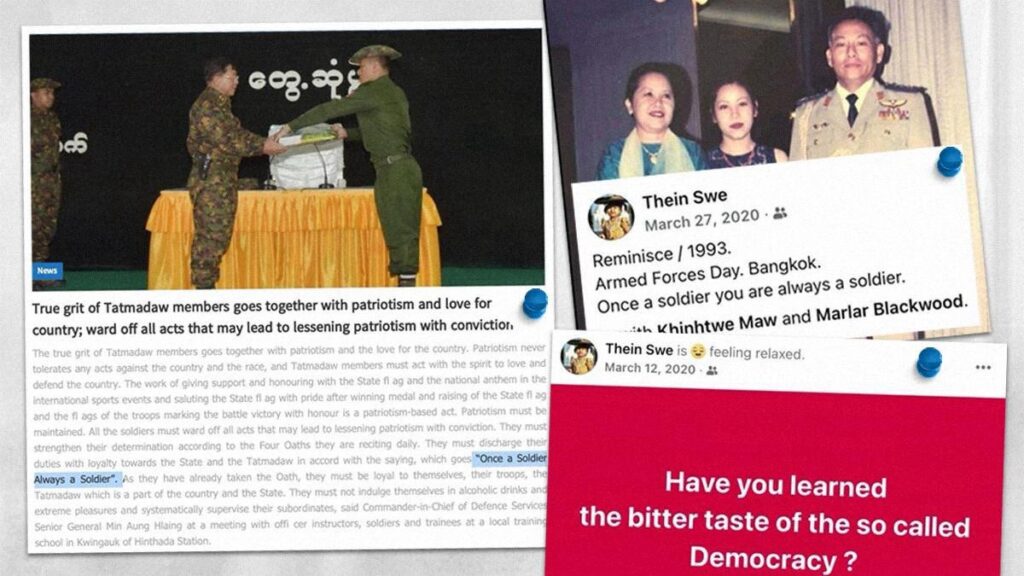
Crucially, prison did not weaken his loyalty to the military. As civil-military relations deteriorated, junta chief Min Aung Hlaing popularised the slogan “once a soldier, always a soldier.” Thein Swe echoed it by posting an old photograph of himself in uniform alongside the phrase. In 2020, a year before the coup, amid open contempt by former officers for civilian rule, he wrote on social media: “Have you learned the bitter taste of democracy?”
Alongside ideology came material links. Corporate records connect him to Delta-X Solutions, a company supplying equipment to Myanmar’s armed forces that expanded its registration after the 2021 coup—something that has been exposed by Myanmar Now for the first time.
In October 2024 and again in 2025, he travelled to China as a senior figure associated with the Paragon Institute—a little-known body aligned with the junta. During these trips, he met Chinese academics and policy figures linked to state-affiliated think tanks, discussing “national security,” regional stability, and cooperation, including issues related to border security and the deployment of private Chinese security companies in Myanmar. The visits took place just days before and after senior junta leader Min Aung Hlaing’s own trips to China, suggesting coordination rather than coincidence.
Taken together, Thein Swe’s trajectory shows continuity, not rupture: from Khin Nyunt’s chief propagandist, to hidden media powerbroker, to post-coup intermediary and loyalist—illustrating how Myanmar’s military intelligence has survived political change by controlling narrative, access and influence from behind the scenes.

What Sonny Swe Never Told His Readers
Read more
Sonny Swe has long occupied a distinctive place in Myanmar’s media narrative—publicly framed as a reform-minded publisher and former political prisoner, yet consistently operating at the intersection of journalism, business, and power. His career trajectory, when examined closely, reveals patterns that challenge the simplified story often told about him abroad.
Educated in the United States, Sonny Swe belonged to a small, privileged cohort able to study overseas during the height of military rule. In the late 1990s, when military intelligence (MI) tightly controlled exports and imports, he was also active as a car importer, a sector requiring licences and access overseen by the intelligence apparatus. At the same time, the family-owned printing business he ran was publishing propaganda books written by MI officers, including nationalist and fiercely anti-Thailand material—activities absent from his later public narrative as a media reformer.
Sonny Swe has repeatedly portrayed the Myanmar Times as a newspaper battling censorship. What he never disclosed was that the paper’s most powerful censor and de facto editor was his own father, Thein Swe, a senior MI official responsible for international propaganda. Nor did he reveal that he himself sometimes acted as a censor, approving stories on behalf of military intelligence, despite publicly claiming to be pushing back against censorship from within.
When Sonny Swe later launched Frontier Myanmar, presenting it as a clean break in the reform era, the same networks quietly resurfaced. Corporate records show that his father and a long-time MI-linked crony from the Myanmar Times again held shareholdings behind the scenes, ties undisclosed to staff, donors, or readers.
At the same time, Sonny Swe played the role of media associate for Myanmar Bureau, a consultancy where Thein Swe served as managing director. The firm’s core business was not journalism but introducing foreign businessmen to powerful figures in Myanmar, effectively monetising elite access cultivated during decades of military rule—further blurring the boundary between independent media, influence-peddling, and political connectivity.
Sonny Swe has also frequently expressed admiration for his father. In a Father’s Day Facebook post on June 21, 2020, he wrote, “Thanks so much for always being there for me no matter what it takes,” calling Thein Swe his idol—a declaration that sits uneasily alongside his silence about his father’s decisive role in shaping the media he ran.

Beyond publishing, Sonny Swe operates other ventures, including a co-working space in Chiang Mai, Thailand, and is widely regarded as a sociable, well-connected figure among foreign donors and Myanmar journalists.

Pyone Maung Maung: The Quiet Fixer Behind Myanmar’s Military Intelligence Media Network
Read more
Pyone Maung Maung has rarely appeared in public narratives about Myanmar’s media, yet a year-long Myanmar Now investigation shows he was a key connective figure linking military intelligence, technology infrastructure, and influential English-language media outlets.
He comes from a military family. His father, Lt.Col Tin Tun, was a navy officer, a background that embedded Pyone Maung Maung early in the armed forces’ social and institutional networks. Those ties helped propel him into the inner circle of military intelligence. Former associates and corporate records indicate he became one of the closest business cronies of MI chief Khin Nyunt, operating not on the margins but within trusted networks.
Pyone Maung Maung’s role went beyond commerce. He officially worked on military intelligence’s IT and communications infrastructure, alongside senior MI figures including Thein Swe and Tin Oo, placing him at the technical core of information control during the height of MI power. Parallel to this, he quietly embedded himself in the media sector. Records show he held ownership stakes in the Myanmar Times, providing technical and business support while the paper functioned as a polished, Western-style outlet aligned with MI interests. When Frontier Myanmar was later launched and presented as a reform-era break from the past, he again appeared behind the scenes as a shareholder through companies tied to its ownership—links never disclosed to journalists, donors or readers.
His activities extended regionally. Through communications ventures such as SEANET, Pyone Maung Maung supplied satellite and connectivity services used by Myanmar and Cambodian authorities, particularly in security-sensitive and border areas—positioning him within a regional security ecosystem rather than a purely commercial market.

Publicly, he also cultivated a cultural profile. Pyone Maung Maung is married to Khin Thidar Tun, one of Myanmar’s best-known actresses, and he himself appeared as a movie actor, acting alongside his wife—adding a layer of celebrity that contrasted sharply with his opaque business and intelligence ties.
Former Myanmar Times co-owner Ross Dunkley described him as a “family business associate” of Thein Swe, underscoring his function: quiet continuity—helping military intelligence survive transitions by migrating into companies, infrastructure and share registers.

Ross Dunkley and the Newspaper that Sold Myanmar’s Generals to the World
Read more
Ross Dunkley, now 68, stood in the soft morning light in Perth, relaxed but weathered, a navy-blue pullover zipped halfway at the neck. Behind him rose the sandstone walls of a church—far from Yangon, where two decades earlier he helped create the Myanmar Times, a newspaper that would become Myanmar’s most sophisticated military intelligence influence operation.
Dunkley does not deny that role. Living a largely solitary life in Perth, he speaks with the candour of someone no longer defending a project. “Of course, it benefited military intelligence and it benefited the military government,” he said. “Everyone got benefits out of it. There was very little downside.”
Dunkley entered Myanmar in the late 1990s with experience operating media in tightly controlled environments, including Vietnam. He believed engagement—not isolation—was the only way journalism could exist under authoritarian rule. That belief shaped the Myanmar Times, which he co-founded with Australian investor Bill Clough and Myanmar partners closely linked to military intelligence.
From the outset, the project was approved at the very top. Dunkley recalled being introduced by Brig-Gen Thein Swe to intelligence chief Khin Nyunt. “Khin Nyunt said, ‘Oh, here’s our man,’” Dunkley said, laughing. The proposal was later endorsed by junta leader Than Shwe, who ensured the paper reached every ministry and military office.
Censorship, Dunkley acknowledged, was never formalised. There was no official board or written rules. Instead, editorial control operated through personal relationships. Sensitive front pages were discussed with Thein Swe, who sometimes took proofs to consult Khin Nyunt directly. “Often the Myanmar Times would be used by the government as its mouthpiece to respond to international criticism or sanctions,” Dunkley said. “By de facto, the Myanmar Times became a forum in which the military could try and project the real opinion on what was happening.”
He described how the paper functioned as an English-language editing service for the junta. “I actually rewrote the ‘four causes,’” he said, referring to the military’s core propaganda slogans. “I rewrote them so they sounded a little bit more upbeat in English.”
Military intelligence also commissioned the paper directly. After the September 11 attacks, Dunkley said MI ordered the Myanmar Times to produce a glossy, 128-page magazine portraying Myanmar’s “tribute” to 9/11. “We produced this magazine for MI… It looked like Life magazine,” he said. “They told us to do it, and we did it within two weeks.”
The reporting was then recycled abroad. “They were using us,” Dunkley said plainly. “They were sending our stories to Congress and to lobbyists. That was the rules of the game. I didn’t mind it.”
Commercial interests were tightly interwoven with journalism. Dunkley acknowledged that he pitched the paper as a way to create opportunities for Australian investors. “I emphasised that having a media presence would open political doors for us to pursue bigger projects,” he said—projects that included oil and gas exploration by his partners. A junta minister later told him that concessions were granted largely because of the Myanmar Times.
Asked directly whether the paper functioned as propaganda, Dunkley did not equivocate. “Yes, exactly.” He paused, then added: “It benefited MI, it benefited the government, it benefited the partnership. Everyone got something out of it.”
Dunkley’s personal reckoning came later. He was jailed twice in Myanmar. During his final period of detention, he said his wife left him. He did not express resentment. “It was fair,” he said quietly—an acknowledgment that the costs of his choices had extended far beyond himself.
When he was released in 2021, as Myanmar slid back into full military rule, Dunkley left the country for good. He returned to Perth, where four generations of his family had lived, and took up work with a mining company, returning to an industry that had long intersected with his Myanmar ventures.
Before we parted ways, I asked him one final question: whether he would ever consider going back to Myanmar—now again under military rule, much as it was when he first arrived in the late 1990s. He did not hesitate. No, he said. Myanmar had given him a great deal—purpose, prominence, influence—but it had also almost destroyed his life. Two prison terms, a collapsed marriage, and permanent exile had closed that chapter for good.
That tension—between engagement and complicity, opportunity and consequence—lies at the heart of this investigation. Ross Dunkley did not merely witness Myanmar’s experiment in media capture. He helped build it, lived with its rewards, and ultimately bore its costs.

Pichai Chuensuksawadi, Frontier Myanmar’s controversial new owner
Read more
Pichai Chuensuksawadi, a Thai citizen, is the new owner of the publication Frontier Myanmar, after former owner and CEO Sonny Swe quietly transferred his shares last April. The ownership change was only disclosed to Frontier readers almost six months later, as part of Myanmar Now’s investigation into the legacy of military intelligence in Myanmar media.
Pichai first met Sonny Swe around 2013 and describes him as a colleague and friend. Sonny has described Pichai as one of his idols, alongside his father, former military intelligence brigadier general Thein Swe. When asked about his relationship with Thein Swe, Pichai explained, “As I got to meet and know Sonny Swe more, I met his family more often socially over the years in Myanmar and Thailand”.
While Sonny Swe’s exit means a military intelligence-linked family no longer owns a slice of Frontier’s publisher, Pichai brings new controversies after disclosing publicly and to Myanmar Now that he has been engaging with Myanmar military junta officials, who he referred to as the “government”. He would not disclose who he had engaged with or the nature of such engagement, citing source protection while also acknowledging that he is no longer working as a journalist, a necessary condition for source protection claims to apply.
Pichai Chuensuksawadi is the former Editor-in-Chief of Post Publishing and its English flagship newspaper, the Bangkok Post. Pichai worked in media for decades before retiring in 2016. At the Bangkok Post, he worked with Sylvia Saw McKaige, then a reporter who went on to become the Frontier Myanmar co-CEO alongside Sonny Swe, and spokesperson for the Myanmar crony Serge Pun.
Since his retirement, Pichai joined Frontier Myanmar as an editorial advisor and the two co-own Boomerang Network (Thailand), a company that runs the Greenhouse co-working space and Gatone’s Teashop, businesses linked to Frontier Myanmar.
Pichai has deep links to ASEAN, having worked as a Special Assistant to the Secretary General of ASEAN from 1993-1994 and has been a consultant to the ASEAN Secretariat for its media forum as recently as 2025.